 |
|
|
 |
|
 |
|
|||
|
||||
|
||||
|
Maryland State Archives Maryland Colonization Journal Collection MSA SC 4303 msa_sc4303_scm11070-0135 Enlarge and print image (4M) |
|
|
|
|
|
|
|
|||
|
||||
|
||||
|
Maryland State Archives Maryland Colonization Journal Collection MSA SC 4303 msa_sc4303_scm11070-0135 Enlarge and print image (4M) |
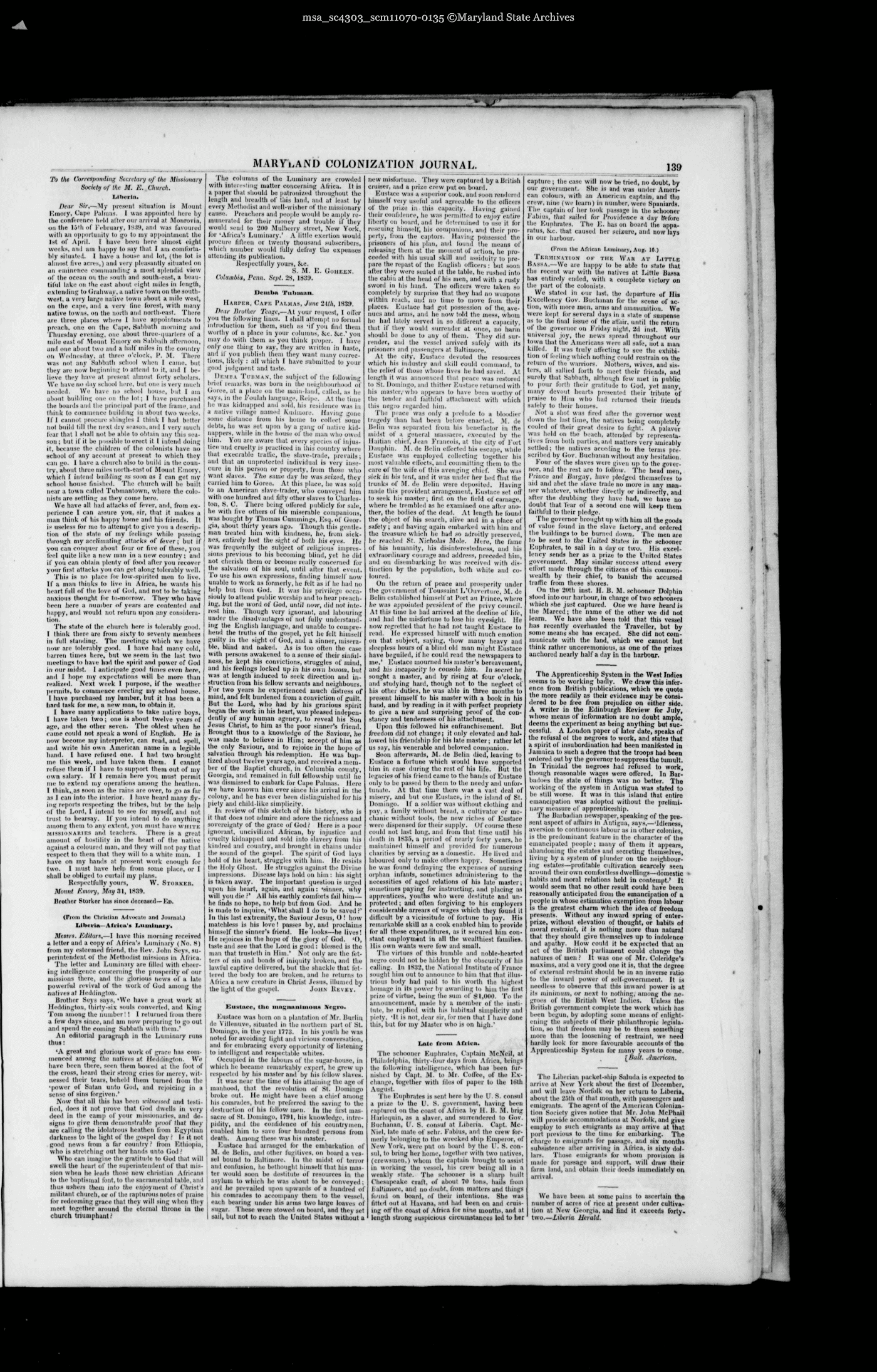
| MARYLAND COLONIZATION JOURNAL. 'To the Corresponding Secretary of the Missionary Society of the M. E. Church. Liberia. Dear Sir,—My present situation is Mount Emmy, Cape Palmas. I was appointed here by the conference held after our arrival at Monrovia, on the 15th of February, 1839, and was favoured with an opportunity lo JO to my appoiutineut the 1st Of April. [ have been here almost eight weeks, and am happy to say that I am comforta- bly situated. I have a house and lot, (the lot is almost live acres,) and very pleasantly situated on an eminece commanding a most splendid view of the ocean on the south and south-east, a beau- tiful lake on the east about eight miles in length, extending to Grahway.a native town on the south- west, a very large native town about a mile west, on the cape, and a verv line forest, with many native towns, on the north and north-east. There are three places where 1 have appointments to preach, one on the Cape, Sabbath morning and Thursday evening, one about three-quarters of a mile east of Mount Emory on Sabbath afternoon, and one about two and a ball mil.'- in the country on Wednesday, at three o'clock, 1'. M. There Wat not any Sabbath school when I came, hut they are now beginning to attend lo it, and I be- lieve tiny have .it pretest almost forty scholars. We have no day school here, but one If very much needed, W'e have no school home, but I am about building one on the lot; I have purchased the hoards and Hie principal part of the frame, and think to commence building in about two week*, If 1 cannot procure ihinglei 1 think I hail better I not build till the next dry season.and I very much feu that I shall not he able to obtain any tins sea- son ; but if it be possible to erect it I intend doing I it, because the children of the colonists have no | school of any account at present to which they can go. 1 liave a church also to build in the coun- try, about three miles north-east of Mount Emory, which I intend building as soon as I can get my school house finished. The church will be built near a town called Tiihinantown, where the colo- nists are settling as they come here. We have all had attacks of fever, and, from ex- perience I can assure you, sir, that it makes a man think of his happy home and his friends. It is useless for rue to attempt to give you a descrip- tion of the state of my feelings while nailing through my acclimating attacks of (ever; but if you can conquer about four or live of those. v>ii tool quite like a new man in a Hew country; anil ! if you can obtain plenty of bod after you recover your fust attacks you can gal along tolerably well. This is no place for low-spirited mm to live. If a man thinks to live in Africa, he wants his bent full of the love of Osdi and not to be taking nnviom thought lor to-morrow. They who have been here a number of years are contented and happy, and would not return upon any considera- tion. The state ol the church here is tolerably good. I think there are from sixty to seventy members in full standing. The meetings which we have now are tolerably good. I have had many cold, barren times here, but we seem in the last two meetings to ha\e had the spirit and power of God in our midst. 1 anticipate good limes even here, and I hope my expectations will be more than realized. Next week 1 purpose, if the weather permits, to commence erecting my school bouse. I have purchased my lumber, but it has been a hard task for me, a new man, to obtain it. I have many applications to take native boys. I have taken two ; one is about twelve years of age, and the other seven. The oldest when lie came could not speak a word of English. He 19 now become my interpreter, can read, and spell, and write his own American name in a legible band. I have refused one. 1 had two brought me this week, and have taken them. I cannot refuse them if 1 have to support them out of my own salary. If I remain here you must permit me to extend my operations aiming the heathen. I think,.as soon as the rains are over, to go as far as I can into the interior. I have heard many Hy- ing reports respecting the tribes, hut by the help of the Lord, I intend to see I'm myself, ami not trust to hearsay. If you intend to do anything among them to any extent, you must have wiiitf. missionaries and teachers. There is a great amount of hostility in the heart of the native against a coloured man, and they will not pay that respect to them that they will to a white man. I have on my hands at present work enough for two. I must have help from some place, or I shall be obliged to curtail my plans. Respectfully yours, W. Storkee. Mount Emory, May 31, 1839. Brother Storker has since deceased— Ed. The columns of the Luminary are crowded with intending matter concerning Africa. It is a paper that should be patronized throughout the length and breadth of this land, and at least by every Methodist and well-wisher of Hie missionary cause. Preachers and people would be amply re- munerated for their money and trouble it they would send to 200 Mulberry street. New York, for "Africa's Luminary.' A little exertion would procure fdleen or twenty thousand subscribers, which number would fully defray the expenses attending its publication. "Respectfully yours, fc.c. S. M. L'. Goiieen. Columbia, Penn. Sept. 28, 1839. (From ttle Christian Advocate and Journal.) Liberia--Africa's Luminary. Messrs. Editors,—I have this morning received j letter and a copy of Africa's Luminary ( No. 8) from my esteemed friend, the Itev. John Soys, su- perintendent of the Methodist mi-'-ions in Africa. The letter and Luminary are filled with cheer- ing intelligence concerning the prosperity of our missions there, and the trlorious news of a late powerful revival of the work of God among the natives at Haddington. Brother Seys says, 'We have a great work at Haddington, thirty-six souls converted, and King Tom among the number I ! 1 returned from there a lew days since, and am now preparing to go out and spend the coining Sabbath with them.' An editorial paragraph in the Luminary runs thus: 'A great and glorious work of grace has com- menced among the natives at Heddington. We have been there, seen them bowed at the foot of the cross, heard their strong cries tin- mercy, wit- nessed their tears, beheld them turned from the 'power of Satan unto God, and rejoicing in a sense of sins forgiven.' Now that all this has been witntnri ami testi- fied, does it not prove that Qod dwells in very deed in the camp of your missionaries, and de- signs to give them demonstrable proof that they are calling the idolatrous heathen from Egyptian darkness to the light of the gOtpel day ! Is it not good news from a far country ? from Ethiopia, who is stretching out her hands unto Qod ? Who can imagine the gratitude to God that will swell the heart of tbe superintendent of that mis- sion when he leads those new christian Africans to the baptismal Unit, to the sacramental table, and thus ushers them into the enjoyment of Christ's militant church, or of the rapturous notes ol praita lor redeeming grace that they will sing when they meet together around the eternal throne in the church triumphant.' Demba Tubman. Harper, Cape Palmas, June 24th, 1839. Dear Brother Teage,—At your request, I oiler you the following lines. I shall attempt no formal introduction lor them, such at 'if you find them worthy of a place in your columns, See., fce.* you may no with them as you think proper. I have only one tiling to say, they are written in haste, and if you publish them they want many correc- tions, likely : all which I have submitted to your good judgment and taste. Demba Tubman, the subject of the following brief remarks, was born in the neighbourhood ol Goree, at a place on the main-land, called, as he says, in the Foulah language, Beipe, At the time he was kidnapped and •old, Ins retidence was in a native village named kudiiiore. Having gone some distance Irom bis home to collect some debts, he was set upon by a gang of native kid- nappers, while in the house of the man who owed him. You are aware that every specie.-, of injus- tice and cruelly is practiced in this country where that execrable traffic, the slave-trade, prevails; and that an unprotected individual is very inse- cure in his person or property, from those who want slaves. The same day he was seized, they canied him to Goree. At this place, he was sold to all American slave-trader, who conveyed him with one hundred and fifty other slaves lo Charles- ton, S. C. There being olfered publicly for sale, hi? with live others of his miserable companions, was bought by Thomas Cuiuinings, Eeq, of Geor- gia, about thirty years ago. Though toil gentle- man treated him with kindness, lie, Irom sick- lies, entire)}' lost the sight of both his cyvs. lie was frequently the subject of religious impres- sions previous to his becoming blind, yet he did not cherish them or become really concerned for the salvation of his soul, until alter that event. To use his own expressions, finding himself now unable to work as formerly, he felt as if he had no help hut from God. It was his privilege ocea- siouly to attend public worship am! to hear preach- ing, but the word of God, until now, did not inte- rest him. Though very ignorant, and labouring under the disadvantages of not fully understand- ing the English language, and unable to compre- hend the truths of the gospel, yet he felt himsell guilty in the sight of God, and a sinner, mi-era- ble. blind and naked. As is too often the case with peisons awakened to a sense of their sinful- ness, he kept his convictions, struggles of mind, and his feelings locked up in his own bosom, but was at length induced to seek direction and in- struction from his fellow servants and neighbours. for two years he experienced much distiess of mind, and fell burdened from a conviction of guilt. Hut the Lord, who had by his gracious spirit began the work in his heart, was pleated indepen- dently of any human agency, to reveal his Sou Jesus Christ, to him as the poor sinner's friend. Brought thus to a knowledge of the Saviour, lie was made to believe in Him; accept of him as the only Saviour, and to rejoice in the hope of salvation through his redemption. He was bap- tized about twelve years ago, and received a mem- ber of the Baptist church, in Columbia county, Georgia, and remained in full fellowship until he was dismissed to embark for Cape Palmas. Here we have known him ever since his arrival in the colony, and he has ever been distinguished for his piety and child-like simplicity. in review ol' this sketch oi' his history, who is it that does not admire and adore the ricBBCtl and sovereignty of the grace of God ? Here is a poor ignorant, uncivilized African, by inpislice ami cruelty kidnapped and sold into slavery from bis kindred and country, and brought in chains under the sound of the gospel. The spirit of God lays hold of his heart, struggles with him. He resists the Holy Ghost. He struggles against the Divine impressions. Disease lavs hold on him: his sight is taken away. The important question is urged upon his heart, again, and again: 'sinner, why will you die >' All his earthly comforts fail him— he liuds no hope, no help but from (Jod. And he is made to inquire, 'What shall 1 do to be saved r' In this last extremity, the Saviour Jesus, O ! how matchless is his love! passes by, and proclaims himself the sinner's friend. He looks—he lives! He rejoices in the hope of the glory of God. 'O, taste ami see that the Lord is good : blessed is the man that trusteth in Hun.' Not only are the fet- ter- ol sin and bonds of iniquity broken, and the lawful captive delivered, but the shackle that let- tered the bod) too are broken, and he returns to Africa a new creature in Christ Jesus, illumed by the light of the gospel. John Revey. Eustace, the magnanimous Negro. Eustace was born on a plantation of Mr. liurlin de Villenuve, situated in the northern part of St. Domingo, in the year 1773. In his youth he was noted for avoiding light and vicious conversation, and for embracing every opportunity of listening to intelligent and respectable whites. Occupied in the labours ol the sugar-house, in which he became remarkably expert, he grew up respected by his mister and by his fellow slaves. It was near the time of his attaining the age ol manhood, that the revolution of St. Domingo broke out. He might have been g chief among his comrades, but he preferred the saving to the destruction of his lellow men. In the first mas- sacre of St. Domingo, 1701, Ins knowledge, intre- pidity, and the confidence of his country men, enabled him to save four hundred persons from death. Among these was Ins master. En-dace had arranged lor the embarkation of M. de lielin, and other fugitives, on hoard a ves- sel bound to Baltimore, In the midst of terror and confusion, he bethought himself that his mas- ter would soon be destitute of resources in the asylum to which he was about to be conveyed; and he prevailed upon upwards of a hundred of his comrades lo accompany them to the pajanri, each bearing under his arms two large loaves ol sugar. These were stowed on board, and they set sail, but not to reach the United States without a new misfortune. They were captured by a Biilish cruiser, and a prize crew put on board. Eustace was a superior cook, and soon rendered himself very useful and agreeable to the ollicers of the prize in this capacity. Having gained their confidence, he was permitted lo enjoy 'entire liberty on hoard, and he determined to use it for rescuing himself, his companions, and their pro- perty, from the captors. Having possessed the prisoner! of his plan, and found the means of releasing them at the moment of action, he pro- ceeded with his usual skill and atfiduity to pre- pare the repast of the English officer! : but soon after they were seated at the table. In- racked into the cabin at the head of his men, and with a rusty sword in his hand. Tin- ollicers were taken so completely by surprise that they had no weapons within reach, and no time to move from their places. Eustace had got possession of the ave- nues and arms, and he now told the mess, whom he had lately served in so different a capacity, that if they would surrender at once, no harm should he done to any of them. They did sur- render, and the vessel arrived safely with its prisoners and passengers at Baltimore. At the city, Eustace devoted the resources which his industry and skill could command, to the relief of those whose lives he had saved. At length it was announced that peace was restored to St. Domingo, ami thither Euttace returned with his master, who appears to have been worthy of the tender ami faithful attachment with which this negro regarded him. The peace was only a prelude to a bloodier tragedy than hail been before enacted. M. de lielin was separated from his benefactor in tbe midst of a general massacre, executed by the Haitian chief, Jean I'lancois, at the city of Fort Dauphin. M. de Belin affected his escape, while Eustace was employed collecting together his moat valuable effects, and committing them to the care of the wife of this avenging chief. She was sick in his tent, and it was under her bed flint the trunks of M. de lielin were depo-ited. Having made this provident arrangement, Eustace set oil to seek his master; first on the held of carnage, where he trembled as he examined one alter ano- ther, the bodies of the dead. At length he Broad the object of his search, alive and in a place ol safety; anil having again embarked with him and the treasure which he had to adroitly preserved, he reached St. Nicholas Mole. Hire, the fame of Ins humanity, his disinterestedness, and his extraordinary courage and address, preceded him, and on disembarking he was received with dis- tinction by the population, both white and co- loured. On the return of peace and prosperity under the govirninent of Toussaint L'Ouverture, M. de Helm established himsell at Port an Prince, where he was appointed president of the privy council. At this lime he had arrived at the decline of lite, and had the inisliirtuiie to lose his eyesight. He now regretted that he had not taught Eustace to read. He expressed himself with much emotion on that subject, saying, 'how many heavy and -leepless hours of a blind old man might Kiistace have beguiled, if he could read the newspapers to me.' Eustace mourned his master's bereavement, and his incapacity to console him. In secret he sought a master, and by rising at lour o'clock, and studying hard, though not to the neglect of his other duties, he was able in three months to present himself to his master with a book in his band, and by reading in it with perfect propriety to give a new and surprising proof of the con- stancy and tenderness of his attachment. Upon this followed his enfranchisement. But freedom did not change; it only elevated and hal- lowed his friendship for his late master; rather let us say, his venerable and beloved companion. Soon afterwards, M. de Belin died, leaving to Eustace a fortune which would have supported him in case during the rest of his life. Hut the legacies of his friend came to the bauds of Eustace only to be passed by them to the needy and unfor- tunate. At that time there was a vast deal of misery, and but one Euttace, i". the island of St. Domingo. If a soldier was without clothing and pay, a family without brand, a cultivator or me- chanic without tools, the new riches of Eustace were dispensed for their supply. Of course these could not last long, and from that time until his death in IS35, a period of nearly forty years, he maintained himself and provided for numerous charities by serving as a domestic. He lived and laboured only to make others happy. Sometimes he was found defraying the expenses of nursing orphan infants, sometimes administering to the nentltlHaa of aged relations of his late master; sometimes paying for instructing, and placing as apprentices, youths who were destitute and un- protected ; and often forgiving to his employers considerable arrears of wages which they found it difficult by a vicissitude of fortune to pay. His remarkable skill as a cook enabled him to provide for all these expenditures, as it secured him con- stant employment in all the wealthiest families. His own wants were few and small. The virtues of this humble ami noble-hearted negro could not be hidden by the obscurity of his calling. In 1832, the National Institute of France sought him out to announce to him that that illus- trious body had paid to his worth the highest homage in its power by awarding to him the first prize of virtue, being the sum of $1,000. To the announcement, made by a member of the insti- tute, he replied with his habitual simplicity ami piety, 'It is not, dear sir, for men that I have done this, but for my Master who is on high.' Late from Africa. The schooner Euphrates, Captain McNeil, at Philadelphia, thirty-four days from Africa, brings the following intelligence, which lias been fur- nished by Capt. M. to Mr. Coffee, of the Ex- change, together with tiles of paper to the ltith August. The Euphrates is sent here by the U. S. consul a piize to the U. S. government, having I.....n captured on that coast of Africa by 11. B. M. brig Harlequin, as a slaver, and surrendered lo Gov. Buchanan, 17. S. consul at Liberia. Capt. Mc- Nnd, I,de mate of srhr. I'abius, and the crew for- merly belonging to the wreaked ship Emperor, of New York, were put on board by the lr. S. con- sul, to bring her home, together with two natives, (crewsmen.) whom the captain brought to assist ill working the vessel, hi- crew being all in a weakly state. The schooner is a sharp built Chesapeake craft, of about 70 tons, haiis from Baltimore, and no doubt, Irom matters and things found on board, of their intentions. She was fitted out at Havana, old had been on and cruis- ing nil'the coast of Africa for nine months, and at length strong suspicious circumstances led to her ____ 139 captuie ; the case will now be tried, no doubt, by our government. She is and was under Ameri- can colours, with an American captain, and the crew, nine (we learn) ill number, were Spaniards. The captain of her took passage in the schooner Fabioa, that sailed for Providence a day before the Euphrates, The E. has on board the appa- ratus, &c. that caused her seizure, and now lays in our harbour. (From the African Luminary, Aug. 16 ) Termination of the War at Little Bassa.—We are happy to be able to state that the recent war with the natives at Little Bassa has entirely ended, with a complete victory on the part of the colonists. We stated in our last, the departure of His Excellency Gov. Buchanan for the scene of ac- tion, with more men, arms and ammunition, VVc were kept lor several days in a state of suspense as to the final issue of the affair, until the return of the governor on Friday night, 2d inst. With universal joy, the news spread throughout our town that the Americans were all sale, not a man killed. It was tiuly affecting to see the exhibi- tion of feeling which nothing could restrain or, the return of the warriors. Mothers, wives, and sis- ters, all sallied forth to meet their friends, and surely that Sabbath, although few met in public to pour forth their gratitude to God, yet many, many devout hearts presented their tribute of praise to Him who had returned their friends salely to their homes. Not a shot was fired alter the governor went down the la-t time, Ihe nalives being completely cooled of their great desire to light. A palaver was held on the beach, attended by lepresenta- tives from both parties, and matters very amicably settled; the natives acceding to the terms pre- scribed by Gov. Buchanan without any hesitation. Four of the slaves were given up to the gover- nor, and the rest are to follow. The head men. Prince and Bargay, have pledged themselves to aid and abet the slave trade no more in any man- ner whatever, whether directly or indirectly, and after the drubbing they have had, we have no doubt that tear of a second one will keep them faithful to their pledge. The governor brought up with him all the goods of value found in the slave factory, and ordered the buildings to be burned down. Tbe men are to be sent to the United States in the schooner Euphrates, to sail in a day or two. His excel- lency sends her as a prize to the United States government, May similar success attend every effort made through the citizens of this common- wealth by their chief, to banish the accursed traffic from these shores. On the 2i)th inst. II. B. M. schooner Dolphin stood into our harbour, in charge of two schooners which she just captured. One we have heard is the Marred; the name of the other we did not learn. We have also been told that this vessel bus recently overhauled the Traveller, bat by some means she has escaped. She did not com- municate with the land, which we cannot but think rather unceremonious, as one of the prizes anchored nearly half a day in the harbour. The Apprenticeship System in the West Indies seems to be working badly. We draw this infer- ence from British publications, which we quote the more readily as their evidence may be consi- dered to be free from prejudice on either side. A writer in the Edinburgh Review for July, whose means of information are no doubt ample, deems the experiment as being anything but suc- cessful. A Loudon paper of later datej speaks of the refusal ol the negroes to work, and states that a spirit of insubordination had been manifested in Jamaica to such a degree that the troops had been ordered out by the governor to suppress the tumult. In Trinidad the negroes had refused to work, though reasonable wages were otTered. In Bar- badoes the state of things was no better. The working of the system in Antigua was stated to be still worse. It was in this island that entire emancipation was adopted without the prelimi- nary measure of apprenticeship. The Barbadian newspaper, speaking of the pre- sent aspect of alfairs in Antigua, says,—'Idleness, aversion to continuous labour as in other colonies, is the predominant feature in the character of the emancipated people; many of them it appears, abandoning the estates and secreting themselves, living by a system of plunder on the neighbour- ing estates—profitable cultivation scarcely seen around their own comfortless dwellings—domestic habits and moral relations held in contempt.' It would seem that no other result could have been reasoually anticipated from the emancipation of a people in whose estimation exemption Irom labour is the greatest charm which the idea of freedom presents. Without any inward spring of enter- prize, without elevation of thought, or habits of moral restraint, it is nothing more than natural that they should give themselves up to indolence and apathy. How could it he expected that an act of the British parliament could change the natures of men.' It was one of Mr. Coleridge's maxims, and a very good one it is, that the degree of external restraint should be in an inverse ratio to the inward power of self-government. It is neediest to observe that this inward power is at its minimum, or next to nothing, ansae the ne- groes of the British West Indies. Unless the British government complete the work which has been begun, by adopting some means of enlight- ening the subjects of their philanthropic legisla- tion, so that freedom may be to them something more than the loosening of restraint, we need hardly look lor more favourable accounts of the Apprenticeship System for many years to come. [Balt. American. The Liherian packet-ship Saluda is expected to arrive at New York about the first of December, and will have Norfolk on her return to Liberia, about the 25th of that month, with passengers and emigrants. The agent of the American Coloniza- tion Society gives notice that Mr. John McPhail will provide accommodations at Norlidk, and give employ to such emigrants as may arrive at that port previous to the time lor embarking. The charge to emigrants for passage, and six months luhaiatenec alter arriving in Africa, is sixty dol- lars. Those emigrants lor whom provision is made for passage and support, will draw their farm land, and obtain then deeds immediately on arrival. We have been at some pains to ascertain the number of acres of rice at present under cultiva- tion at New Georgia, and find it exceeds forty- two.—Liberia Herald. |