 |
|
|
 |
|
 |
|
|||
|
||||
|
||||
|
Maryland State Archives Maryland Colonization Journal Collection MSA SC 4303 msa_sc4303_scm11070-0134 Enlarge and print image (4M) |
|
|
|
|
|
|
|
|||
|
||||
|
||||
|
Maryland State Archives Maryland Colonization Journal Collection MSA SC 4303 msa_sc4303_scm11070-0134 Enlarge and print image (4M) |
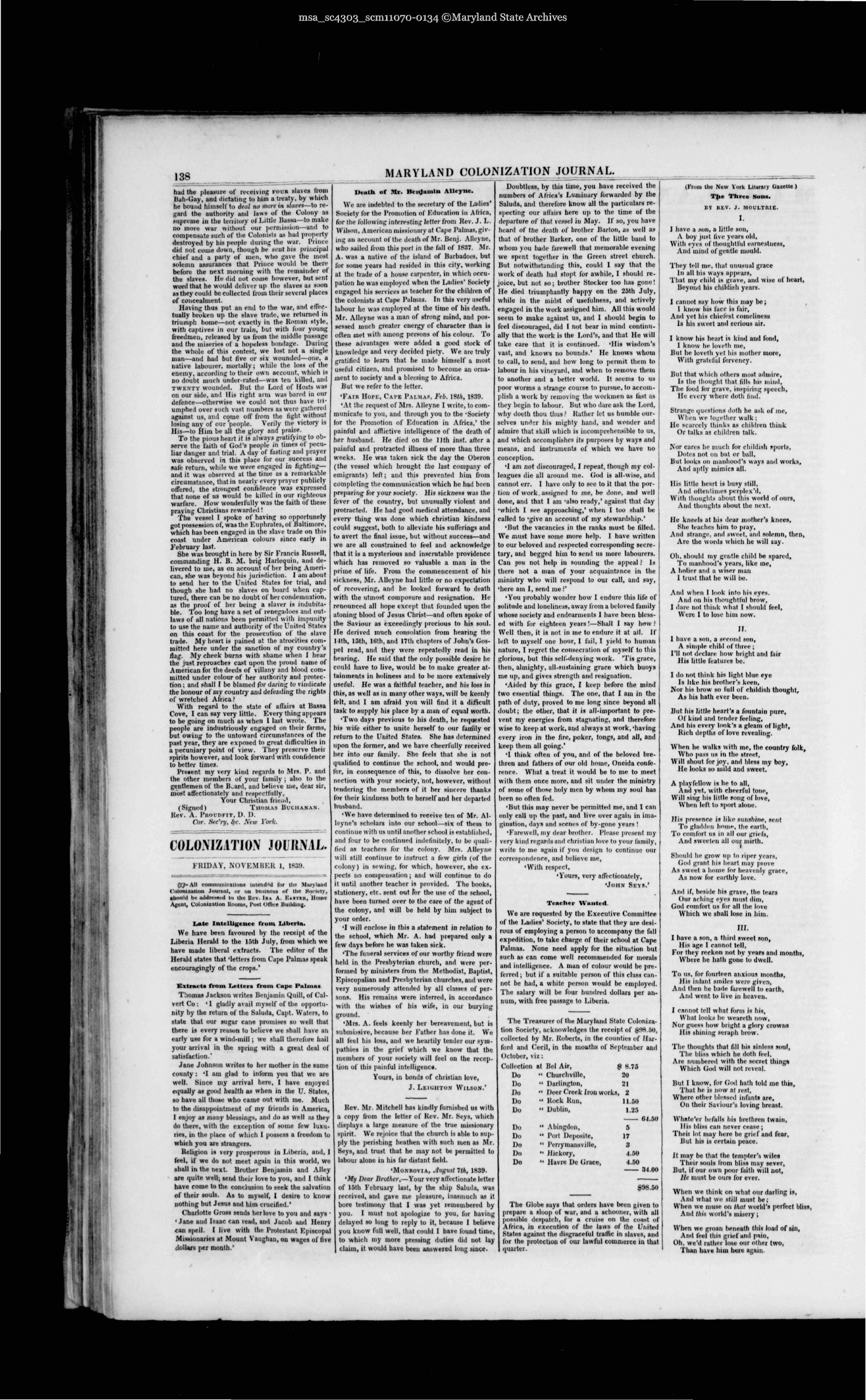
| 138 MARYLAND COLONIZATION JOURNAL. had the pleasure of receiving i'our slaves from Bah-Gay, and dictating to him a treaty, by which he bound himself to deal no more in slaves—to re- gard the authority ami laws of the Colony as supreme ill the territory ol Little Bassa—to make no more war without our permission—and to compensate such of the Colonics as had property destroyed by his people daring the war. Prince did not come down, though lie IMl Ins principal chief and a party of men, who gave the most solemn assurances that I'rince would be there before the next morning with the remainder of the slaves. He did not come however, but sent word that he would deliver up the slaves as soon as they could be collected from their several places of concealment. Having thus put an end to the war, and effec- tually broken up the slave trade, we returned in triumph home—not exactly in the Roman style, with captives in our train, but with four young freedmen, released by us from the middle passage and the miseries of a hopeless bondage. Dining the whole of this contest, we lost not a single man—and had but five or six wounded—one, a native labourer, mortally; while the loss of the enemy, according to their own account, which is no doubt much under-rated—was ten killed, and twenty wounded. But the Lord of Hosts was on our side, and His right arm was bared in our defence—otherwise we could not thus ha\e tri- umphed over such vast numbers as were gathered against us, and come otF from the fight without losing any of our 'people. Verily the victory is His—to Him be all the glorv and praise. To the pious heart it is always giatifying to ob- serve the faith of God's people in times of pecu- liar danger and trial. A day of fasting and prayer was observed in this place for our success and sale return, while we were engaged in fighting— and it was observed at the time as a remarkable circumstance, that in nearly every prayer publicly offered, the strongest confidence was expressed that none of us would be killed in our righteous warfare. How wonderfully was the faith of these praying Christians rewarded! 'the vessel I spoke of having so opportunely got possession of, was the Euphrates, of Baltimore, which has been engaged in the slave trade on this coast under American colours since early in February last. She was brought in here by Sir Francis Russell, commanding H. B, M. brig Harlequin, and de- livered to me, as on account of her being Ameri- can, she was beyond his jurisdiction. I am about to send her to'thc United States lor trial, and though she had no slaves on board when cap- tured, there can be no doubt of hci condemnation, as the proof of her being a slaver is indubita- ble. Too long have a set of renegadues and out- laws of all nations been permitted with impunity to use the name and authority of the United States on this coast for the prosecution of the slave trade. My heart is pained at the atrocities com- mitted here under the sanction of my country's flag. My cheek burns with shame when I hear the just reproaches cast upon the proud name of American for the deeds of villany and blood com- mitted under colour of her authority and protec- tion; and shall I be blamed for daring to vindicate the honour of my country and defending the rights of wretched Africa? With regard to the state of affairs at Bassa Cove, 1 can say very little. Every thing appears to be going on much as when 1 last wrote. The people are industriously engaged on their farms, but owing to the untoward circumstances of the past year, they are exposed to great difficulties in a pecuniary point of view. They preserve their spirits however, and look forward with confidence to better times. Present my very kind regards to Mrs. P. and the other members of your family j also to the gentlemen of the Board, and believe me, dear sir, most affectionately and respectfully, Your Christian friend, (Signed) Thomas Buchanan. Rev. A. Proudfit, D. D. Cor. Sec'ry, &c. New York. COLONIZATION JOURNAL. FRIDAY, NOVEMBER 1, 1839. All communications intended for the Maryland Colonization Journal, or on business of the Society, should beaddressed to the Rev. Ira A. Easter, Home Agent, Colonization Rooms, Post Office Building. Late Intelligence from Liberia. We have been favoured by the receipt of the Liberia Herald to the 15th July, from which we have made liberal extracts. The editor of the Herald states that 'letters from Cape Palmas speak encouragingly of the crops.' Extracts from Letters from Cape Palmas. Thomas Jackson writes Benjamin Quill, of Cal- vert Co ; 'I gladly avail myself of the opportu- nity by the return of the Saluda, Capt. Waters, to state that our sugar cane promises so well that there is every reason to believe we shall have an early use for a wind-null; we shall therefore hail your arrival in the spring with a great deal of satisfaction.' Jane Johnson writes to her mother in the same county ; '1 am glad to inform you that we are well. Since my arrival here, I have enjoyed equally as good health as when in the U. States, so have all those who came out with me. Much to the disappointment of my friends in America, 1 enjoy as many blessings, and do as well as they do there, with the exception of some few luxu- ries, in the place of which 1 possess a freedom to which you are strangers. Religion is very prosperous in Liberia, and, I feel, if we do not meet again in this world, we shall in the next. Brother Benjamin and Alley are quite well; send their love to you, and I think have come to the conclusion to seek the salvation of their souls. As to myself, I desire to know nothing but Jesus and him crucified.' Charlotte Gross sends her love to you and says - 'Jane and Isaac can read, and Jacob and Henry can spell. I live with the Protestant Episcopal Missionaries at Mount Vaughan, on wages of live dollars per month.' Death of Mr. Benjamin Alleyne. We are indebted to the secretary of the Ladies' Society for the Promotion of Education in Africa, for the following interesting lettei from Rev. J. L. Wilson, American missionary at Cape Palmas, giv- ing an account ol the death of Mr. Benj. Alleyne, who sailed from this port in the fall of 1837. Mr. A. was a native of the island of Barbadoes, but for some years had resided in this city, working at the trade of a house carpenter, in which occu- pation he was employed when the Ladies' Society engaged his services M teacher for the children of the colonists at Cape Palmas. In this very useful labour he was employed at the time of his death. Mr. Alleyne was a man of strong mind, and pos- sessed much greater energy of character than is often met with among persons of his colour. To these advantages were added a good stock of knowledge and very decided piety. We are truly gratified to learn that he made himself a most useful citizen, and promised to become an orna- ment to society and a blosing to Africa. But we refer to the letter. 'Fair Hope, Cave Palmas, Feb.18th, 1839. 'At the request of Mrs. Alleyne I write, to com- municate to you, and through you to the -Society for the Promotion of Education in Africa,' the painful and afflictive intelligence of the death of her husband. He died on the 11th inst. after a painful and protracted illness of more than three weeks. He was taken sick the day the Oberon (the vessel which brought the last company of emigrants) left; and this prevented him from completing the communication which he had been preparing for your society. His sickness was the fever of the country, but unusually violent and protracted. He had good medical attendance, and every thing was done which christian kindness could suggest, both to alleviate his sufferings and to avert the final issue, but without success—and we are all constrained to feel and acknowledge that it is a mysterious and inscrutable providence which has removed so valuable a man in the prime of life. From the commencement of his sickness, Mr. Alleyne had little or no expectation of recovering, and he looked forward to death with the utmost composure and resignation. He renounced all hope except that founded upon the atoning blood of Jesus Christ—and often spoke of the Saviour as exceedingly precious to his soul. He derived much consolation from hearing the 14th, 15th, 16th, and 17th chapters of John's Gos- pel read, and they were repeatedly read in his hearing. He said that the only possible desire he could have to live, would be to make greater at- tainments in holiness and to be more extensively useful. He was a faithful teacher, and his loss in this, as well as in many other ways, will be keenly felt, and 1 am afraid you will find it a difficult task to supply his place by a man of equal worth. 'Two days previous to his death, he requested his wile either to unite herself to our family or return to the United States. She has determined upon the former, and we have cheerfully received her into our family. She feels that she is not qualified to continue the school, and would pre- fer, in consequence of this, to dissolve her con- nection with your society, not, however, without tendering the members of it her sincere thanks for their kindness both to herself and her departed husband. 'We have determined to receive ten of Mr. Al- leyne's scholars into our school—six of them to continue with us until another school is established, and four to be continued indefinitely, to be quali- fied as teachers lor the colony. Mrs. Alleyne will still continue to instruct a few girls (of the colony) in sewing, for which, however, she ex- pects no compensation; and will continue to do it until another teacher is provided. The books, stationery, etc. sent out for the use of the school, have been turned over to the care of the agent of the colony, and will be held by him subject to your order. 'I will enclose in this a statement in relation to the school, which Mr. A. had prepared only a few days before he was taken sick. 'The funeral services of our worthy friend were held in the Presbyterian church, and were per- formed by ministers from the Methodist, Baptist, Episcopalian and Presbyterian churches,and were very numerously attended by all classes of per- sons. His remains were interred, in accordance with the wishes of his wife, in our burying ground. 'Mrs. A. feels keenly her bereavement, but is submissive, because her Father has done it. We all feel his loss, and we heartily tender our sym- pathies in the grief which we know that the members of your society will feel on the recep- tion of this painful intelligence. Yours, in bonds of christian love, J. Leighton Wilson.' Rev. Mr. Mitchell has kindly furnished us with a copy from the letter of Rev. Mr. Seys, which displays a large measure of the true missionary spirit. We rejoice that the church is able to sup- ply the perishing heathen with such men as Mr. Seys, and trust that he may not be permitted to labour alone in his far distant field. 'Monrovia, August 7th, 1839. 'My Dear Brother,—Your very affectionate letter of 15th February last, by the ship Saluda, was received, and gave me pleasure, inasmuch as it bore testimony that I was yet remembered by you. I must not apologize to you, for having delayed so long to reply to it, because I believe you know full well, that could I have found time, to which my more pressing duties did not lay claim, it would have been answered long siuce. Doubtless, by this time, you have received the numbers of Africa's Luminary forwarded by the Saluda, and therefore know all the particulars re- specting our atlairs here up to the time of the departure of that vessel in May. If so, you have heard of the death of brother Barton, as well as that of brother Barker, one of the little band to whom you bade farewell that memorable evening we spent together in the Green street church. But notwithstanding this, could I say that the work of death had stopt for awhile, I should re- joice, but not so; brother Stocker loo has gone! He died triumphantly happy on the 25th July, while in the midst of usefulness, and actively engaged in the work assigned him. All this would seem to make against us, and 1 should hegin to feel discouraged, did I not bear in mind continu- ally that the work is the Lord's, and that He will take care that it is continued. 'His wisdom's vast, and knows no bounds.' He knows whom to call, to send, and how long to permit them to labour in his vineyard, and when to remove them to another and a better world. It seems to us poor worms a strange course to pursue, to accom- plish a work by removing the workmen as last as they begin to labour. But who dare ask the Lord, why doeth thou thus I Rather let us humble our- selves under his mighty hand, and wonder and admire that skill which is incomprehensible to us, and which accomplishes its purposes by ways and means, and instruments of which we have no conception. 'I am not discouraged, I repeat, though my col- leagues die all around me. God is all-wise, and cannot err. I have only to see to it that the por- tion of work assigned to me, be done, and well done, and that I am 'also ready,' against that day 'which I see approaching,' when I too shall be called to 'give an account of my stewardship.' 'But the vacancies in the ranks must be filled. We must have some more help. 1 have written to our beloved and respected corresjionding secre- tary, and begged hiin to send us more labourers. Can you not help in sounding the appeal ? Is there not a man of your acquaintance in the ministry who will respond to our call, and say, •here am I, send mer' 'You probably wonder how I endure this life of solitude and loneliness, away from a beloved family whose society and endearments 1 have been bless- ed with for eighteen years I—Shall I say how I Well then, it is not in me to endure it at all. If left to myself one hour, I fail, I yield to human nature, I regret the consecration of myself to this glorious, but this self-denying work, 'lis grace, then, almighty, all-sustaining grace which buoys me up, and gives strength and resignation. 'Aided by this grace, I keep before the mind two essential things. The one, that I am in the path of duty, proved to me long since beyond all doubt; the other, that it is all-important to pre- vent my energies from stagnating, and therefore wise to keep at work, and always at work, 'having every iron in the fire, poker, tongs, and all, and keep them all going.' T think olten of you, and of the beloved bre- thren and fathers of our old home, Oneida conle- rence. What a treat it would be to me to meet with them once more, and sit under the ministry of some of those holy men by whom my soul has been so olten fed. 'But this may never be permitted me, and I can only call up the past, and live over again in ima- gination, days and scenes of by-gone years ! 'Farewell, my dear brother. Please present my very kind regards ami christian love to your family, write to me again if you design to continue our correspondence, and believe me, 'With respect, 'Yours, very affectionately, 'John Seys.' Teacher Wanted. We are requested by the Executive Committee of the Ladies' Society, to state that they are desi- rous of employing a person to accompany the fall expedition, to take charge of their school at Cape Palmas. None need apply for the situation but such as can come well recommended for morals and intelligence. A man of colour would be pre- ferred ; but if a suitable person of this class can- not be had, a white person would be employed. The salary will be four hundred dollars per an- num, with free passage to Liberia. The Treasurer of the Maryland State Coloniza- tion Society, acknowledges the receipt of £98.50, collected by Mr. Roberts, in the counties of Har- ford and Cecil, in the mouths of September and October, viz: Collection at Bel Air, $ 8.75 Do " Churchville, 20 Do " Darlington, 21 Do " Deer Creek Iron works, 2 Do " Rock Run, 11.50 Do " Dublin, 1.25 ------ 64.50 Do " Abingdon, 5 Do " Port Deposite, 17 Do " Perrymansville, 3 Do " Hickory, 4.50 Do " Havre De Grace, 4.50 ------ 34.00 $98.50 The Globe says that orders have been given to prepare a sloop of war, and a schooner, with all possible despatch, lor a cruise on the coast of Africa, in execution of the laws of the United States against the disgraceful traffic in slaves, and for the protection of our lawful commerce in that quarter. (From the New York Literary Gazette ) The Three Sons. BY REV. J. MOULTRIE I. I have a son, a little son, A boy just live years old. With eyes of thoughtful earnestness, And mmd of gentle mould. They tell me, that unusual grace In all his ways appears. That my child is giave, and wise of heart, Beyond his childish years. I cannot say how this may be; I know his face is fair, And vet his chielest comeliness Is his sweet and serious air. I know his heart is kind and fond, 1 know he loveth me, But he loveth yet his mother more, With grateliil fervency. But that which others most admire. Is the thought that fills his mind. The Ibod lor grave, inspiring speech, He every where doth find. Strange questions doth he ask of ine, When we together walk ; He scarcely thinks as children think Or talks as children talk. Nor cares he much for childish sports, Dotes not on bat or ball, But looks on manhood's ways and works, And aptly mimics all. His little heart is busy still. And oltenlimes perplex'tl. With thoughts about this world of ours. And thoughts about the next. He kneels at his dear mother's knees. She teaches him to pray. And strange, and sweet, and solemn, then, Are the wonts which he will say. Oh, should my gentle child be spared, To manhood's years, like me, A holier and a wiser man 1 trust that he will be. And when I look into his eyps. And on his thoughtful brow, I dare not think what I should feel, Were I to lose him now. II. I have a son, a second son, A simple child of three ; I'll not declare how bright and fair His little features be. I do not think his light blue eye Is like Ins brother's keen. Nor his brow so full of childish thought, As his hath ever been. But his little heart's a fountain pure. Of kind and tender feeling, And his every look's a gleam of light. Rich depths of love revealing. When he walks with me, the country folk. Who pass us in the street, Will shout for joy. and bless my boy, He looks so mild and sweet. A playfellow is he to all, And yet, with cheerful tone. Will sing his little song of love. When left to sport alone. His presence is like sunshine, sent To gladden home, the earth, To comfort us in all our griefs. And sweeten all our mirth. I Should he grow up to riper vcais. God grant his heart may piove As sweet a home lor heavenly grace, As now for earthly love. And if, beside his grave, the tears Our aching eyes must dim, God comfort us for all the love Which we shall lose in him. III. I have a son, a third sweet son, His age 1 cannot tell. For they reckon not by years and months. Where he hath gone to dwell. To ns, for fourteen anxious months, His infant smiles were given, And then he bade lurewell to earth, And went to live in heaven. I cannot tell what form is his, What looks he weareth now, Nor guess how bright a glory crowns His shining seraph brow. The thoughts that fill his sinless soul, The bliss which he doth feel, Are numbered with the secret things. Which God will not reveal. But I know, for God hath told ine this, That he is now al rest. Where other blessed infants are, On their Saviour's loving breast. Whate'er befalls his brethren twain, His bliss can never cease; Then lot may here be grief and fear. But his is certain peace. It may be that the tempter's wiles Their souls from bliss may sever, But, if our own jxior faith will not, He must be ours for ever. When we think on what our darling is, And what we still must be; When we muse on that world's perfect bliss, And this world's misery; When we groan beneath this load of sin, And feel this grief and pain, Oh, we'd rather lose our other two, Than have him here again. |