 |
|
|
 |
|
 |
|
|||
|
||||
|
||||
|
Maryland State Archives Maryland Colonization Journal Collection MSA SC 4303 msa_sc4303_scm11070-0137 Enlarge and print image (5M) |
|
|
|
|
|
|
|
|||
|
||||
|
||||
|
Maryland State Archives Maryland Colonization Journal Collection MSA SC 4303 msa_sc4303_scm11070-0137 Enlarge and print image (5M) |
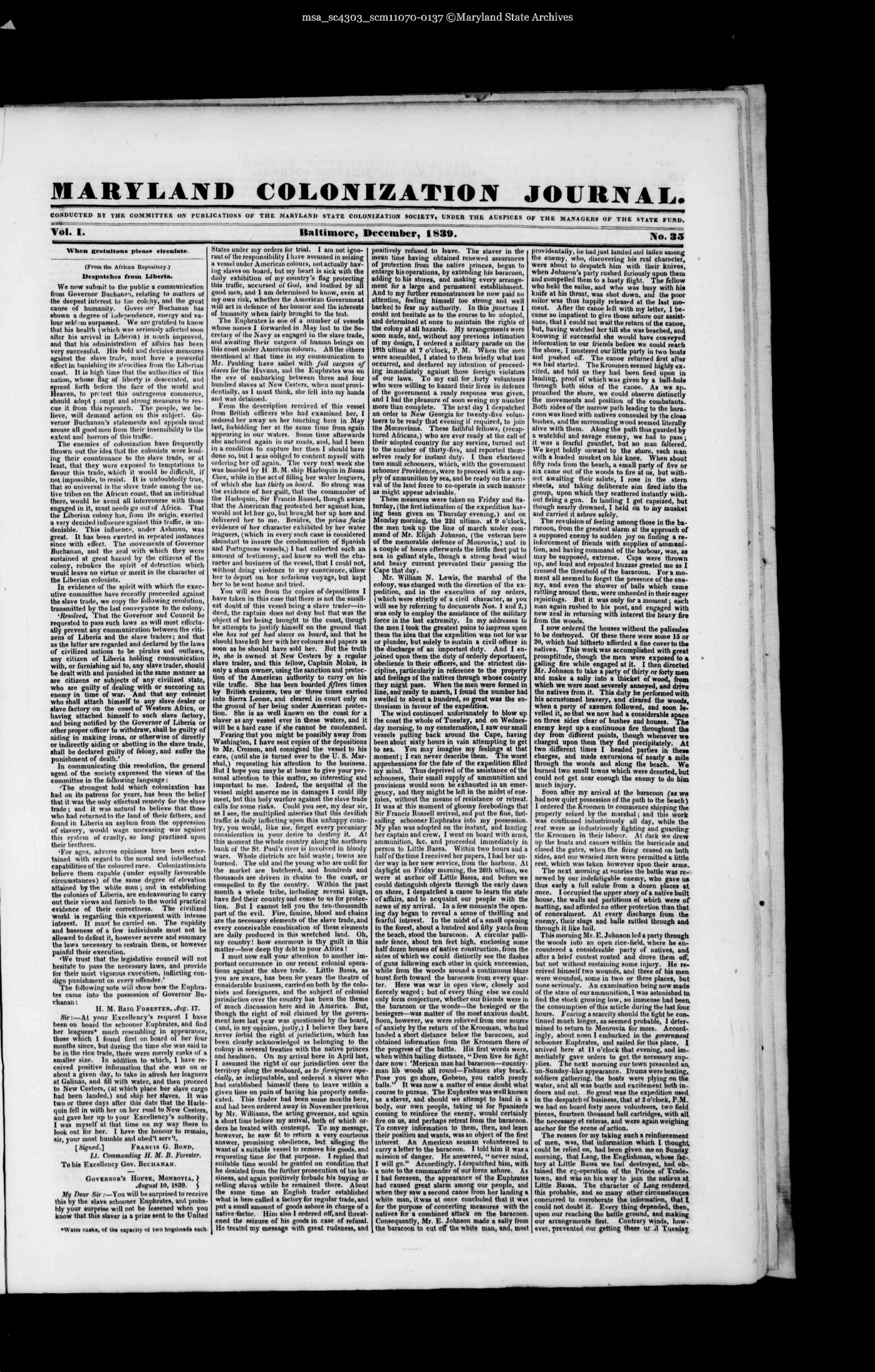
| MARYLAND COLONIZATION JOURNAL.. CONDUCTED BY THE COMMITTEE ON PUBLICATIONS OF THE MARYLAND STATE COLONIZATION SOCIETY, UNDER THE AUSPICES OF THE MANAGERS OF THE STATE FUND Vol. I. Baltimore, December, 1839. No. 35 When gratuitous please circulate. (From the African Repository.) Despatches from Liberia. We now submit to the public a communication from Governor Buchanan, relating to matters of the deepest interest to toe coh ny, and the great cause of humanity. Governor Buchanan has shown a degree of independence, energy anil va- lour sell1 in surpassed. We are gratified to know that his heallli (which was seriously allccted soon alter his arrival in Liberia) is mud) improved, and that his administration of a/fairs has been very successful. His hold and decisive measures against the slave trade, must have a powerful effect in banishing its atrocities from the Lib.rian coast. It is high time that the autlioiities of this nation, whose Hag of liberty is desecrated, and spread tbrth before the face of the world and Heaven, to pre lect this outrageous commerce, should adopt i ompt ami strong measures to res- cue it from this reproach. The people, we be- lieve, will demand action on this subject. Go- vernor Buchanan's statements and appeals must arouse all good men from their insensibility to the extent anil horrors of this tralfic. The enemies of colonization have frequently thrown out the idea that the colonists were lend- ing their countenance to the slave trade, or at least, that they were exposed to temptations to lavour this trade, which it would be difficult, if not impossible, to resist. It is undoubtedly true, that so universal is the slave trade among the na- tive tribes on the African coast, that an individual there, would lie avoid all intercourse with those engaged in it, must needs go out of Africa. That the Liberiau colony has, fioin its origin, exerted a very decided influence against this traffic, is un- deniable. This influence, under Ashmun, was great. It has been exerted in repeated instances since with effect. The movements of Governor Buchanan, and the zeal with which they were sustained at great hazard by the citizens of the colony, rebukes the spirit of detraction which would leave no virtue or merit in the character ol the Liberian colonists. In evidence of the spirit with which the exec- utive committee have recently proceeded against the slave trade, we copy the following resolution, transmitted by the last conveyance to the colony. 'Resolved, That the Governor and Council be requested to pass such laws as will most elloctu- ally prevent any communication between the citi- zens of Liberia and the slave traders; and that as the latter are regarded and declared by the laws of civilized nations to be pirates and outlaws, any citizen of Liberia holding communication with, or furnishing aid to, any slave trader, should be dealt with and punished in the same manner as are citizens or subjects of any civilized state, who are guilty of dealing with or succoring an enemy in time of war. And that any colonist who shall attach himself to any slave dealer or slave factory on the coast of Western Africa, or having attached himself to such slave factory, and being notified by the Governor of Liberia or other proper officer to withdraw, shall be guilty of aiding in making irons, or otherwise of directly or indirectly aiding or abetting in the slave trade, shall be declared guilty of felony, and sutler the punishment of death.' In communicating this resolution, the general agent of the society expressed the views of the committee in the following language: 'The strongest hold which colonization has had on its patrons for years, has been the belief that it was the only effectual remedy for the slave trade; and it was natural to believe that those who had returned to the land of their fathers, and found in Liberia an asylum from the oppression of slavery, would wage unceasing war against this system of cruelty, so long practised upon their brethren. 'For ages, adverse opinions have been enter- tained with regard to the moral and intellectual capabilities of the coloured race. Colonizationists believe them capable (under equally favourable circumstances) of the same degree of elevation attained by the white man | and in establishing the colonies of Liberia, are endeavouring to carry out their views and furnish to the world practical evidence of their correctness. The civilized world is regarding this experiment with intense interest. It must be carried on. The cupidity and baseness of a few individuals must not be allowed to defeat it, however severe and summary the laws necessary to restrain them, or however painful their execution. 'We trust that the legislative council will not hesitate to pass the necessary laws, and provide for their most vigorous execution, inflicting con- dign punishment on every offender.' The following note will show how the Euphra- tes came into the possession of Governor Bu- chanan : H. M. Brig Forester, Aug. 17. Sir:?At your Excellency's request I have been on board the schooner Euphrates, and find her leaguers* much resembling in appearance, those which I found first on board of her lour months since, but during the time she was said to be in the rice trade, there were merely casks of a smaller size. In addition to which, 1 have re- ceived positive information that she was on or about a given day, to take in afresh her leaguers at Galinas, and fill with water, and then proceed to New Cestcrs, (at which place her slave cargo had been landed,) and ship her slaves. It was two or three days alter this date that the Harle- quin fell in with her on her road to New Cesters, and gave her up to your Excellency's authority. I was myself at that lime on my way there to look out for her. I hi>ve the honour to remain, sir, your most humble and obed't serv't, [Signed.] Francis G. Bond, Lt. Commanding H. M. B. Forester. To his Excellency Gov. Buchanan. Governor's House, Monrovia, August 10, 1839. My Dear Sir:?You will be surprised to receive this by the slave schooner Euphrates, and proba- bly your surprise will not be lessened when you know that this slaver is a prize sent to the United *Water casks, of the capacity of two hogsheads each. States under my orders for trial. I am not igno- rant of the responsibility 1 have assumed in seizing a vessel under American colours, not actually hav- ing slaves on board, but my heart is sick with the daily exhibition of my country's tiag protecting this trallic, accursed of God, and loathed by afi good men, and 1 am determined to know, even at my own risk, whether the American Government will act in defence of her honour and the interests of Iniuianily when fairly brought to the test. The Euphrates is one of a number of vessels whose names I forwarded ill May last to the Se- cretaiy of the Navy as engaged in the slave trade, and awaiting their cargoes of human beings on this coast under American colours. All the others mentioned at that time in my communication to Mr. I'auldiug have sailed with full cargoes of stare* for the Havana, and the Euphrates was on the eve of embarking between three and lour hundred slaves at New Cesters, when most provi- dentially, as 1 must think, she fell into my hands and was detained. From the description received of this vessel from British officers who had examined her, I ordered her away on her touching here in May last, forbidding her at the same time from again appearing in our waters. Some time afterwards she anchored again in our roads, and, had I been in a condition to capture her then I should have done so, but I was obliged to content myself with ordering her oil' again. The very next week she was boarded by H B. M. ship Harlequin in Uassa Cove, while in the act of tilling her water leaguers, of which she has thirty on board. So strong was Hie evidence of her guilt, that the commander of the Harlequin, Sir Francis Mussel, though aware that the American Hag protected her against hiin, would not let her go, but brought her up here and delivered her to me. Besides, the prima facia evidence of her character exhibited by her water leaguers, (which in every such case is considered abundant to insure the condemnation of Spanish and Portuguese vessels,) 1 had collected such an amount of testimony, and knew so well the cha- racter and business of the vessel, that I could not, without doing violence to my conscience, allow her to depart on her nefaiious voyage, but kept her to be sent home and tried. You will see from the copies of depositions I have taken in this case that there is not the small- est doubt of this vessel being a slave trader?in- deed, the captain does not deny but that was the object of her being brought to the coast, though he attempts to justify liimsell on the ground that she Ans not yet had stares on board, and that he should have left her with her colours and papers as soon as he should have sold her. But the truth is, she is owned at New Cesters by a regular slave trader, and this fellow, Captain Molau, is only a sham owner, using the sanction and protec- tion of the American authority to carry on his vile traffic. She has been hoarded fifteen times by British cruizers, two or three times carried into Sierra Leone, and cleared in court only on the ground of her being under American protec- tion. She is as well known on the coast for a slaver as any vessel ever in these waters, and it will be a hard case if she cannot be condemned. Fearing that you might be possibly away from Washington, I have sent copies of the depositions to Mr. Crcsson, and consigned the vessel to his care, (until she is turned over to the U. S. Mar- shal,) requesting his attention to the business. But I hope you may be at home to give your per- sonal attention to this matter, so interesting and important to me. Indeed, the acquittal of the vessel might amerce me in damages I could illy meet, but this holy warfare against the slave trade calls for some risks. Could you see, my dear sir, as I see, the multiplied miseries that this devilish traffic is daily inflicting upon this unhappy coun- try, you would, like me, forget every pecuniary consideration in your desire to destroy it. At this moment the whole country along the northern bank of the St Paul's river is involved in bloody wars. Whole districts are laid waste; towns are burned. The old and the young who are unfit for the market are butchered, and hundreds and thousands are driven in chains to the coast, or compelled to fly the country. Within the past month a whole tribe, including several kings, have fled their country and come to us for protec- tion. But I cannot tell you the ten-thousandth part of the evil. Fire, famine, blood and chains are the necessary elements of the slave trade, and every conceivable combination of these elements are daily produced in this wretched land. Oh, my country! how enormous is thy guilt in this matter?how deep thy debt to poor Africa ! I must now call your attention to another im- portant occurrence in our recent colonial opera- tions against the slave trade. Little Bassa, as you are aware, has been lor years the theatre of considerable business, carried on both by the colo- nists and foreigners, and the subject of colonial jurisdiction over the country has been the theme of much discussion here and in America. But, though the right of soil claimed by the govern- ment here last year was questioned by the board, (and, in my opinion, justly,) I believe they have never Ibrbid the right ol jurisdiction, which has been clearly acknowledged as belonging to the colony in several treaties with the native princes and headmen. On my ariival here in April last, I assumed the right of our jurisdiction over the territory along the seaboard, as to foreigners espe- cially, as indisputable, and ordered a slaver who had established himself there to leave within a given time on pain of having his property confis- cated. This trader had been some months here, and had been ordered away in November previous by Mr. Williams, the acting gnvernoi, and again a short time before my arrival, both of which or- ders he treated with contempt. To my message, however, he saw fit to return a very courteous answer, promising obedience, but alleging the want of a suitable vessel to remove his goods, and requesting time for that purpose. I replied that suitable time would be granted on condition that he desisted from the further prosecution of his bu- siness, and again positively forbade his buying or selling slaves while he remained there. About the same time an F^nglish trader established what is here called a factory for regular trade, and put a small amount of goods ashore in charge of a native factor. Him also I ordered off, and threat- ened the seizure of his goods in case of refusal. He treated my message with great rudeness, and positively refused to leave. The slaver in the mean time having obtained renewed assurances of protection from the native princes, began to enlarge his operations, by extending his baracoon, adding to his stores, and making every arrange- ment for a large and permanent establishment. And to my further remonstrances he now paid no attention, feeling himself too strong and well backed to fear my authority. In this juncture 1 could not hesitate as to the course to be adopted, and determined at once to maintain the rights of the colony at all hazards. My arrangements were soon made, and, without any previous intimation of my design, I ordered a military parade on the ISth ultimo at 7 o'clock, P. M. When the men were assembled, I stated to them briefly what had occurred, and declared iny intention of proceed- ing immediately against those foreign violators of our laws. To my call for.forty volunteers who were willing to hazard their lives in defence of the government a ready response was given, and I had the pleasure of soon seeing my number more than complete. The next day I despatched an order to New Georgia lor twenty-five volun- teers to be ready that evening if required, to join the Monrovians. These faithful fellows, (recap- tured Africans,) who are ever ready at the call of their adopted country for any service, turned out to the number of thirty-five, and reported them- selves ready for instant duty. I then chattered two small schooners, which, with the government schooner Providence, were to proceed with a sup- ply of ammunition by sea, and be ready on the arri- val of the land force to co-operate in such manner as might appear advisable. These measures were taken on Friday and Sa- turday, (the first intimation of the expedition hav- ing been given on Thursday evening,) and on Monday morning, the 22d ultimo, at !) o'clock, the men took up the line of march under com- mand of Mr. Elijah Johnson, (the veteran hero of the memorable defence of Monrovia,) and in a couple of hours efterw arils the little fleet put to sea in gallant style, though a strong head wind and heavy current prevented their passing the Cape that day. Mr. William N. Lewis, the marshal of the colony, was charged with the direction of the ex- pedition, and in the execution of my orders, (which were strictly of a civil character, as you will see by referring to documents Nos. 1 and 2,) was only to employ the assistance of the military force in the last extremity. In my addresses to the men I took the greatest pains to impress upon them the idea that the expedition was not for war or plunder, but solely to sustain a civil officer in the discharge of an important duty. And I en- joined upon them the duty of orderly deportment, obedience to their officers, and the strictest dis- cipline, particularly in reference to the property and feelings of the natives through whose country they might pass. When the men were formed in line, and ready to march, I found the number had swelled to about a hundred, so great was the en- thusiasm in lavour of the expedition. The wind continued unfortunately to blow up the coast the whole of Tuesday, and on Wednes- day morning, to my consternation, I saw our small vessels putting back around the Cape, having been about sixty hours in vain attempting to get to sea. You may imagine my feelings at that moment; I can never describe them. The worst apprehensions for the fate of the expedition filled my mind. Thus deprived of the assistance of the schooners, their small supply of ammunition and provisions would soon be exhausted in an emer- gency, and they might be left in the midst of ene- mies, without the means of resistance or retreat. It was at this moment of gloomy forebodings that Sir Francis Russell arrived, and put the fine, last- sailing schooner Euphrates into my possession. My plan was adopted on the instant, and landing her captain and crew, I went on board with arms, ammunition, &c. and proceeded immediately in person to Little Bassa. Within two hours and a naif of the time I received her papers, I had her un- der way in her new service, from the harbour. At daylight on Friday morning, the 2fith ultimo, we were at anchor oil' Little Bassa, and before we could distinguish objects through the early dawn on shore, I despatched a canoe to learn the state of affairs, and to acquaint our people with the news of my arrival. In a few moments the open- ing day began to reveal a scene of thiilling and fearful interest. In the midst of a small opening in the forest, about a hundred and filly yards from the beach, stood the baracoon. A circular palli- sade fence, about ten feet high, enclosing some half dozen houses of native construction, from the sides of which we could distinctly see the flashes of guns following each other in quick succession, while from the woods around a continuous blaze burst forth toward the baracoon Irom every quar- ter. Here was war in open view, closely and fiercely waged ; but of every thing else we could only form conjecture, whether our friends were in the baracoon or the woods?the besieged or the besiegers?was matter of the most anxious doubt. Soon, however, we were relieved from one source of anxiety by the return of the Krooman, who had landed a short distance below the baracoon, and obtained information from the Kroomen there of the progress of the battle. His first words were, when within hailing distance, " Dem live (or light dare now: 'Merican man had baracoon?country- man lib woods all round?Fishmen stay brack. Pose you go shore, Gobeno, you catch prenty balls." It was now a matter of some doubt what course to pursue. The Euphrates was well known as a slaver, and should we attempt to land in a body, our own people, taking us for Spaniards coining to reinforce the enemy, would certainly fire on us, and perhaps retreat from the baracoon. To convey information to them, then, and learn their position and wants, was an object of the first interest An American seaman volunteered to carry a letter to the baracoon. I told him it was a mission of danger. He answered, " never mind, I will go." Accordingly, I despatched him, with a note to the commander of our force ashore. As I had foreseen, the appearance of the Euphrates had caused great alarm among our people, and when they saw a second canoe from her landing a white man, it was at once concluded that it was for the purpose of concerting measures with the natives for a combined attack on the baracoon. Consequently, Mr. E. Johnson made a sally from the baracoon to cut off the white man, and, most provideutally, he had just landed and lallen among the enemy, who, discovering his real character, were about to despatch hiin with their knives, when Johnson's party rushed furiously upon them and compelled them to a hasty flight. The fellow who held the sailor, and who was busy with hi* knife at his throat, was shot down, and the poor sailor was thus happily released at the last mo- ment. After the canoe left with my letter, 1 be- came so impatient to give those ashore our assist- ance, that 1 could not wait the return of the canoe, but, having watched her till she was beached, and knowing if successful she would have conveyed information to our friends before we could reach the shore, I mustered our little party in two boats and pushed oil'. The canoe returned first after we had started. The Kroomen seemed highly ex- cited, and told us they had been fired upon in landing, proof of which was given by a ball-hole through both sides of the canoe. As we ap- proached the shore, we could observe distinctly the movements and position of the combatants. Both sides of the narrow path leading to the bara- coon was lined with natives concealed by the close bushes, and the surrounding wood seemed literally alive with them. Along the path thus guarded by a watchful and savage enemy, we had to pass ; it was a fearful gauntlet, but no man faltered. We kept boldly onward to the shore, each man with a loaded musket on his knee. When about fifty rods from the beach, a small party of five or six came out of the woods to fire at us, but with- out awaiting their salute, I rose in the stern sheets, and taking deliberate aim fired into the group, upon which they scattered instantly with- out firing a gun. In landing I got capsized, but though nearly drowned, I held on to my musket and carried it ashore safely. The revulsion of feeling among those in the ba- racoon, from the greatest alarm at the approach of a supposed enemy to sudden joy on finding a re- inforcement of friends with supplies of ammuni- tion, and having command of the harbour, was, as may be supposed, extreme. Caps were thrown up, and loud and repeated huzzas greeted me as I crossed the threshold of the baracoon. For a mo- ment all seemed to forget the presence of the ene- my, and even the shower ol balls which came rattling around them, were unheeded in their eager rejoicings. But it was only for a moment; each man again rushed to his post, and engaged with new zeal in returning with interest the heavy fire from the woods. I now ordered the houses without the palisades lo be destroyed. Of these there were 9ome 15 or 20, which had hitherto afforded a fine cover to the natives. This work was accomplished with great promptitude, though the men were exposed to a galling fire while engaged at it. I then directed Mr. Johnson to take a party of thirty or forty men and make a sally into a thicket of wood, from which we were most severely annoyed, and drive the natives from it. This duty he performed with his accustomed bravery, and cleared the woods, when a party of axemen followed, and soon le- velled it, so that we now had a considerable space on three sides clear of bushes and houses. The enemy kept up a continuous fire throughout the day from different points, though whenever we charged upon them they fled precipitately. At two different times I headed parties in then charges, and made excursions of nearly a mile through the woods and along the beach. We burned two small towns which were deserted, but could not get near enough the enemy to do him much injury. Soon after my arrival at the baracoon (as we had now quiet possession of the path to the beach) I ordered the Kroomen to commence shipping the property seized by the marshal; and this work was continued industriously all day, while the rest were as industriously fighting and guarding the Kroomen in their labour. At dark we drevi uji the boats and canoes within the barricade and closed the gates, when the filing ceased on both sides, and ourweaiied men were permitted a little rest, which was taken however upon their arms. The next morning at sunrise the battle was re- newed by our indefatigable eiiemv, who gave us thus early a full salute from a dozen places at once. I occupied the upper story of a native built house, the walls and partitions of which were of matting, and afforded no other protection than that of concealment. At every discharge from the enemy, their slugs and balls rattled through and through it like hail. This morning Mr. E. Johnson led a party through the woods into an open rice-field, where he en- countered a considerable party of natives, and alter a brief contest routed and drove them off, but not without sustaining some injury. He re- ceived himself two wounds, and three of his men were wounded, some in two or three places, but none seriously. An examination being now made of the state of our ammunition, I was astonished to find the stock growing low, so immense had been, the consumption of this aiticle during the last four hours. Fearing a scarcity should the fight be con. tinned much longer, as seemed probable, I deter- mined to return to Monrovia for more. Accord- ingly, about noon I embarked in the government schooner Euphrates, and sailed for this place, I arrived here at 11 o'clock that evening, and im- mediately gave orders to get the necessary sup- plies. The next morning our town presented an, un-Sunday-like appeaiance. Drums were beating, soldiers gathering, the boats were plying on the water, and all was bustle and excitement both in- doors and out. So great was the expedition used in the despatch of business, that at 2 o'clock, P.M. we had on board forty more volunteers, two field pieces, fourteen thousand ball cartridges, with all the necessary et ceteias, and were again weighing anchor lor the scene of action. The reason for my taking such a reinforcement of men, w?s, that information which I thought, could be relied on, had been given me on Sunday morning, that Lang, the Englishman, whose fac- tory at Little Bassa we hail destroyed, had ob- tained the co-operation of the Prince of Trade- town, and was on his way to join the natives at Little Bassa. The character of Lang rendered this probable, and so many other circumstances concurred to corroborate the information, that I could not doubt it. Every thing depended, then, upon our reaching the battle ground, and making our arrangements first. Contrary winds, how- ever, prevented our getting there until Tuesday |