 |
|
|
 |
|
 |
|
|||
|
||||
|
||||
|
Maryland State Archives Maryland Colonization Journal Collection MSA SC 4303 msa_sc4303_scm11070-0138 Enlarge and print image (4M) |
|
|
|
|
|
|
|
|||
|
||||
|
||||
|
Maryland State Archives Maryland Colonization Journal Collection MSA SC 4303 msa_sc4303_scm11070-0138 Enlarge and print image (4M) |
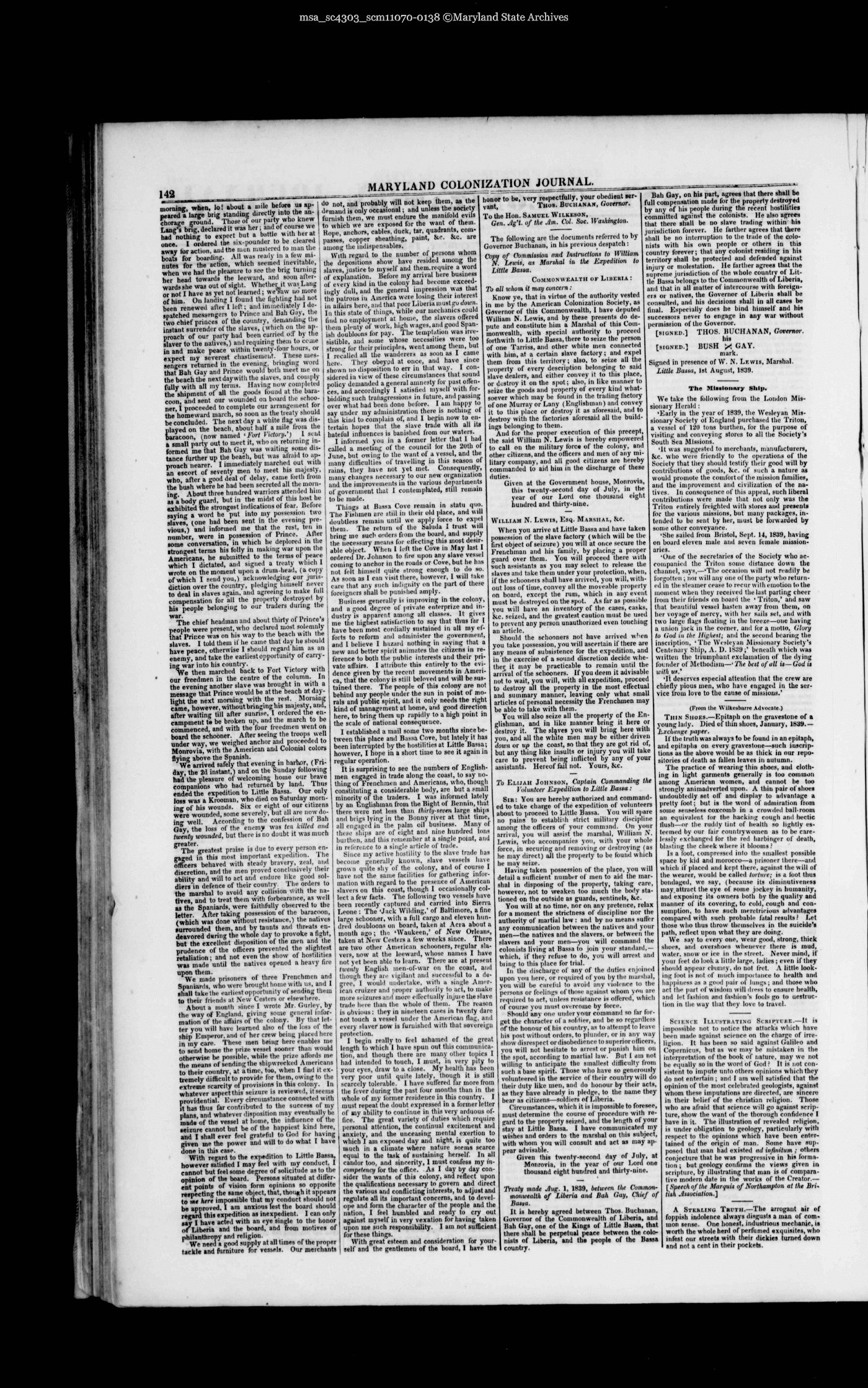
| MARYLAND COLONIZATION JOURNAL. morning, when, lo! about a mile before us ap- peared a large brig standing directly into the an- chorage ground. Those of our paity who knew Lang's brig, declared it was her; and of course we had nothing to expect but a battle w ith her at once. I ordered the six-pounder to be cleared away tor action, anJthe luen mustered to in.m the boats for boarding. All was ready in a few mi- nutes for the action, which seemed inevitable, when we had the pleasure to see the brig turning her head towards the leeward, and soon after- wards she was out of sight. Whether it was Lang or not I have as yet not learned; weraw no* more of him. On landing I found the fighting had not been renewed after I left; and immediately Ido- spatched messengers to l'rince and Bah G.iy, the two chief princes of the country, demanding the instant surrender of the slaves, (which on the ap- proach of our party had been carried off by the slaver to the natives,) and requiring them to ccaie in and make peace within twenty-lour hours, or expect my severest chastisement. These mes- sengers returned in the evening, bringing word that Bah Gay and Prince would both meet me on the beach the next day with the slaves, and comply fully with all my terms. Having now completed the shipment of all the goods found at the bara- coon, and sent our wounded on board the schoo- ner, I proceeded to complete our arrangement for the homeward march, so soon as the treaty should be concluded. The next day a white Hag was dis- played on the beach, about half a mile from the Daracoon, (now named 'Fort Victory.') I sent a small party out to meet it, who on returning in- formed me that Bah Gay was waiting some dis- tance further up the beach, but was afraid to ap- proach nearer. I immediately inarched out with an escort of seventy men to meet his majesty, who, after a good deal of delay, came Ibrth from the bush where he had been secreted all the morn- ing. About three hundred waniors attended him as a body guard, but in the midst of this host lie exhibited the strongest indications of fear. Before saying a word he put into my possession two slaves, (one had been sent in the evening pre- vious,) and informed me that the rest, ten in number, were in possession of Prince. After some conversation, in which he deplored in the •trongest terms his folly in making war upon the Americans, he submitted to the terms of peace which I dictated, and signed a treaty which 1 wrote on the moment upon a drum-head, (a copy of which I send you,) acknowledging our juris- diction over the country, pledging himself never to deal in slaves again, and agreeing to make full compensation for all the property destroyed by his people belonging to our traders during the war. The chief headman and about thirty of Prince's people were present, who declared most solemnly that Prince was on his way to the beach with the slaves. I told them if he came that clay he should have peace, otherwise I should regard him as an enemy, and take the earliest opportunity of carry- ing war into his country. We then marched back to Fort Victory with our freedmen in the centre of the column. In the evening another slave was brought in with a message that Prince would be at the beach at day- light the next morning with the rest. Morning came, however, without bringing bis majesty, and, after waiting till after sunrise, I ordered the en- campment to be broken up, and the march to be commenced, and with the four freedmen went on board the schooner. After seeing the troops well under way, we weighed anchor and proceeded to Monrovia, with the American and Colonial colors flying above the Spanish. We arrived safely that evening in harhor, (Fri- day, the 2d instant,) and on the Sunday following had the pleasure of welcoming home our brave companions who had returned by land. Thus ended the expedition to Little Bassa. Our only loss was a Krooman, who died on Saturday morn- ing of his wounds. Six or eight of our citizens were wounded, some severely, but all are now do- ing well. According to the confession of Bah Gay, the loss of the enemy was ten killed and twenty wounded, but there is no doubt it was much greater. The greatest praise is due to every person en- gaged in this most important expedition. The officers behaved with steady bravery, zeal, and discretion, and the men proved conclusively their ability and will to act and endure like good sol- diers in defence of their country The orders to the marshal to avoid any collision with the na- tives, and to treat them with forbearance, as well as the Spaniards, were faithfully observed to the letter. After taking possession of the baracoon, (which was done without resistance,) the natives surrounded them, and by taunts and threats en- deavored during the whole day to provoke a fight, but the excellent disposition of the men and the prudence of the ollicers prevented the slightest retaliation; and not even the show of hostilities was made until the natives opened a heavy fire upon them. We made prisoners of three Frenchmen and Spaniards, who were brought home with us, and I shall take the earliest opportunity of sending them to their friends at New C esters, or elsewhere. About a month since I wrote Mr. Gurley, by the way of F.ngland. Riving some general infor- mation of the affairs of tin- colony. By that let- ter you will have learned also of the loss of the ship Kmperor, and of her crew being placed here in my care. These men being here enables me to send home the prize vessel sooner than would otherwise be possible, while the prize atlbrds me the means of sending the shipwrecked Americans to their country, at a time, too, when I find it ex- tremely difficult to provide for them, owing to the extreme scarcity of provisions in this colony. In whatever aspect this seizure is reviewed, it seems providential. Kvery circumstance connected with it has thus far contributed to the success of my plans, and whatever disposition may eventually be mad* of the vessel at home, the influence of the seizure cannot but be of the happiest kind here, and I shall ever feel grateful to God for having given me the power and will to do what I have done in this ease. With regard to the expedition to Little Bassa, however satisfied I may feel with my conduct. I cannot but feel some degree of solicitude as to the opinion of the board. Persons situated at differ- ent points of vision form opinions so opposite respecting the same object, that, thouah it appears to n>* here impossible that my conduct should not be approved. I am anxious lest the board should regard this expedition as inexpedient. I can only say I have acted with an eye single to the honor of Liberia and the board, and from motives of philanthropy and religion. We need a good supply at all times of the proper tackle and furniture for vessels. Our merchants do not, and probably will not keen them, as the | demand is only occasional; and unless the society furnish them, we must endure the manifold evils to which we are exposed for the want of them. Rope, anchors, cables, duck, tar, quadrants, com- passes, copper sheathing, paint, &c. &c. are among the indispensables. Willi regaid to the number of persons whom the depositions show have resided among the slaves, justice to myself and them.require a word of explanation. Before my arrival here business of every kind in the colony had become exceed- ingly dull, and the general impression was that the patrons in America weie losing their interest in aliiiirs here, and that poor Liberia musttrui/ou'ii. In this state of things, while our mechanics could find no employment at home, the slavers offered them plenty o'f work, high wages, and good Span- ish doubloons for pay. The temptation was irre- sistible, and some whose necessities were too strong for their principles, went among them, but I recalled all the wanderers as soon as I came here. They obeyed at once, and have since shown no disposition to err in that way. I con- sidered in view of these circumstances that sound policy demanded a general amnesty for past offen- ces, and accordingly I satisfied myself with for- bidding such transgressions in future, and passing over what had been done before. I am happy to say under my administration there is nothing of this kind to complain of, and 1 begin now to en- tertain hopes that the slave trade with all its hateful influences is banished from our waters. I informed you in a former letter that 1 had called a meeting of the council lor the 20th of June, but owing to the want of a vessel, and the many difficulties of travelling in this season of rains, they have not yet met. Consequently, many changes necessary to our new organization and the improvements in the various departments of government that 1 contemplated, still remain to be made. Things at Bassa Cove remain in statu quo. The l'ishiuen are still in their old place, and will doubtless remain until we apply force to expel them. The return of the Saluda I trust will bring me such orders from the board, and supply the necessary means for effecting this most desir- able object. When 1 left the Cove in May last I ordered Ur. Johnson to tire upon any slave vessel coming to anchor in the roads or Cove, but he tins not felt himsell quite strong enough to do so. As soon as I can visit there, however, I will take care that any such indignity on the part of these foreigners shall he punished amply. Business generally is improving in the colony, and a good degree of private enterprise and in- dustry is apparent among all classes. It gives me tiie highest satisfaction to say that thus far 1 have been most cordially sustained in all my ef- forts to reform and administer the government, and 1 believe I hazard nothing in saying that a new and better spirit animates the citizens in re- ference to both the public interests and their pri- vate affairs. I attribute this entirely to the evi- dence given bv the recent movements in Ameri- ca, that the colony is still beloved and will be sus- tained there. The people of this colony are not behind any people under the sun in point of mo- rals and public spirit, and it only needs the right kind of management at home, and good direction here, to bring them up rapidly to a high point in the scale of national consequence. I established a mail some two months since be- tween this place and Bassa Cove, but lately it has been interrupted by the hostilities at Little Bassa; however, I hope in a short time to see it again in regular operation. It is surprising to see the numbers of English- men engaged in trade along the coast, to say no- thing of Frenchmen and Americans, who, though constituting a considerable body, are but a small minority of the traders. I was informed lately by an Englishman from the Bight of Bennin, that there were not less than thirty-seven large ships anil brigs lying in the Bonny river at that time, ' all engaged in the palm oil business. Many of these ships are of eight and nine hundred ions Inn then, and this remember at a single point, and in reference to a single article of trade. Since my active hostility to the slave trade has become generally known, slave vessels have grown quite shy of the colony, and of course I have not the same facilities for gathering infor- mation with regard to the presence of American slavers on this coast, though I occasionally col- lect a few facts. The following two vessels have been recently captured and carried into Sierra Leone : The 'Jack Wilding,' of Baltimore, a fine- large schooner, with a lull cargo and eleven hun- dred doubloons on board, taken at Acra about a month ago; tin.' 'Waukeen,' of New Orleans, taken at New Cesters a few weeks since. There are two other American schooners, regular sla- vers, now at the leeward, whose names I have not yet been able to learn. There are at present twenty English men-of-war on the coast, and though they are vigilant and successful to a de- gree, 1 would undertake, with a single Amer- ican cruizer and proper authoiity to act, to make more seizures and more effectually injuie the slave trade here than the whole of them. The reason is obvious: they in nineteen cases in twenty dare not touch a vessel under the American (lag, and every slaver now is furnished with that sovereign protection. I begin really to feel ashamed of the great length to which 1 have spun out this communica- tion, and though there are many other topics I had intended to touch, I must, in very pity to your eyes, draw to a close. My health has been very poor until quite lately, though it is still scarcely tolerable. I have suifered far more from the fever during the past four months than in the whole of my Ibriuer residence in (his country. I must repeat the doubt expressed in a former letter of my ability to continue in this very arduous of- fice. The great variety of duties which require personal attention, the continual excitement and anxiety, and the unceasing mental exertion to which I am exposed day and night, is quite too much in a climate where nature seems scarce equal to the task of sustaining herself. In all candor too, and sincerity, 1 must confess my tn- competency for the office. As I day by day con- sider the wants of this colony, and reflect upon the qualifications necessary to govern and direct the various and conflicting interests, to adjust and regulate all its important concerns, and to devel- ope and form the character of the people and the nation, I feel humbled and ready to cry out against myself in very vexation for having taken upon me such responsibility. I am not sufficient for these things. With great esteem and consideration for your- self and the gentlemen of the board, 1 have the honor to be, very rctpectfully, your obedient ser- vant, Thos. Buchanan, Governor, To the Hon. Samuel Wilkeson, Gen. Ag't. of the Am. Col. Soc. Washington. The following arc the documents referred to by Governor Buchanan, in bis previous despatch: Copy of Commission and Instructions to William N. Lewis, as Marshal in the Expedition to Little Bassa. Commonwealth or Liberia: To all whom it may concern: Know ye, that in virtue of the authority vested in me by the American Colonization Society, as Governor of this Commonwealth, I have deputed William N. Lewis, and by these presents do de- pute and constitute him a Marshal of this Com- monwealth, with special authority to proceed forthwith to Little Bassa, there to seize the person of one Tarriss, and other white men connected with him, at a certain slave factory; and expel them from this territory• also, to seize all the property of every description belonging to said slave dealers, and either convey it to this place, or destroy it on the spot; also, in like manner to seize the goods and property of every kind what- soever which may be found in the trading factory* of one Murray or Lany (Englishman) and convey it to this place or destroy it as aforesaid, and to destroy with the factories aforesaid all the build- ings belonging to them. And for lh« proper execution of this precept, the said William N. Lewis is hereby empowered to call on the military lore* of the colony, and other citizens, and the officers and men of any mi- litary company, and all good citizens are hereby commanded to aid hiui in the discharge of these duties. Given at the Government house, Monrovia, this twenty-second day of July, in the year of our Lord one thousand eight hundred and thirty-nine. Bah Gay, on his part, agrees that there shall be full compensation made for the property destroyed by any of his people during the recent hostilities committed against the colonists. He also agrees that there shall be no slave trading within his jurisdiction forever. He farther agrees that there shall be no interruption to the trade of the colo- nists with his own people or others in this country forever; that any colonist residing in his territory shall be protected and defended against injury or molestation. He farther agrees that the supreme jurisdiction of the whole country of Lit- tle Bassa belongs to the Commonwealth of Liberia, and that in all matter of intercourse with foreign- ers or natives, the Governor of Liberia shall be consulted, and his decisions shall in all cases be final. Especially does he hind himself and his successois never to engage in any war without permission of the Governor. [signed.] THOS. BUCHANAN, Governor. his [signed] BUSH X GAY. mark. Signed in presence of W. N. Lewis, Marshal. Little Bassa, 1st August, 1839. William N. Lewis, Esq.. Marshal, Sec. When you arrive at Little Bassa and have taken possession of the slave factory (which will be the first object of seizure) you will at once secure the Frenchman and his family, by placing a proper guard over them. You will proceed there with such assistants as you may select to release the slaves and take them under your protection, w hen, if the schooneis shall have arrived, you will, with- out loss of time, convey all the moveable property on board, except the rum, which in any event must be destroyed on the spot. As far as possible you will have an inventory of the cases, casks, Stc. seized, and the greatest caution must be used to prevent any person unauthorized even touching an article. Should the schooners not have arrived w'en you take possession, you w ill ascertain if there are any means of subsistence for the expedition, and in the exercise of a sound discretion decide whe- ther it may he practicable to remain until the arrival of the schooners. If you deem it advisable not to wait, you w ill, with all expedition, proceed to destroy all the property in the most effectual and summary manner, leaving only what small articles of personal necessity the Frenchmen may be able to take with them. You will also seize all the property of the En- glishman, and in like manner bring it here or destroy it. The slaves you will bring heie with you, and all the white men may be either driven down or up the coast, so that they arc got rid of, but any thing like insults or injury you will take care to prevent being inflicted by any of your assistants. Hereof fail not. Yours, Sic'. The Missionary Ship. We take the following from the London Mis- sionary Herald : 'Early in the year of 1839, the Wesleyan Mis- sionary Society of England purchased the Triton, a vessel of 120 tons burthen, for the purpose of visiting and conveying stores to all the Society's South Sea Missions. 'It was suggested to merchants, manufacturers. Sic. who were friendly to the operations of the Society that they should testify their good will by contributions of goods, &c. of such a nature as would promote the coinfoitof the mission families, and the improvement and civilization of the na- tives. In consequence of this appeal, such liberal contributions were made that not only was the Triton entirely freighted with stores and presents for the various missions, but many packages, in- tended to be sent by her, must be forwarded by some other conveyance. 'She sailed from Bristol, Sept. U, 1839, having on board eleven male and seven female mission- aries. 'One of the secretaries of the Society who ac- companied the Triton some distance down the channel, says,—'The occasion will not readily be forgotten; nor will any one of the party who return- ed in the steamer cease to recur with emotion to the moment when they received the last parting cheer Iroin their friends on board the ' Triton,' and saw that beautiful vessel hasten away from thein, on her voyage of mercy, with her sails set, and with two large flags floating in the breeze—one having a union jack in the corner, and lor a motto, Glory to God in the Highest; and the second bearing the inscription, 'The Wesleyan Missionary Society's Centenary Ship, A. D. 1839;' beneath which was written the triumphant exclamation of the dying founder of Methodism—' The best of all is—God is with us.' 'Ii deserves especial attention that the crew are chiefly pious men, who have engaged in the ser- vice from love to the cause of missions.' To Elijah Johnson, Captain Commanding the Volunteer Expedition to Little Bassa: Sir: You are hereby authorized and command- ed to take charge of the expedition of volunteers about to proceed to Little Bassa. You will spare no pains to establish strict military discipline among the officers of your command. On your arrival, you will assist the marshal, William N. Lewis, who accompanies you, with your whole force, in securing and removing or destroying (as be may direct) all the property to be found which he may seize. Having taken possession of the place, you will detail a sufficient number of men to aid the mar- shal in disposing of the property, taking care, however, not to weaken too much the body sta- tioned on the outside as guaids, sentinels, Sic. You will at no time, nor on any pretence, relax for a moment the strictness of discipline nor the authority of martial law : and by no means sutler any communication between the natives and your men—the natives and the slavers, or between the slavers and your men—you will command the colonists living at Bassa lo join your standard,— which, if they refuse to do, you will arrest and bring to this place for trial. In the discharge of any of the duties enjoined upon you here, or required of you by the marshal, you will be careful to avoid any violence to the persons or feelings of those against whom you are required to act, unless resistance is olfered, which of course you must overcome by force. Should any one under your command so lar for- get the character of a soldier, and be so regardless of the honour of his country, as to attempt to leave his post without orders, to plunder, or in any way show disrespect ordisobedience tosuperioroflicers, you will not hesitate to arrest or punish him on the spot, according to martial law. But I am not willing to anticipate the smallest difficulty from such a base spirit. Those who have so generously volunteered in the service of their country will do their duty like men, and do honour by their acts, as they have already in pledge, to the name they bear as citizens—soldiers of Liberia. Circumstances, which it is impossible to foresee, must determine the course of procedure with re- gard to the property seized, and the length of your stay at Little Bassa. I have communicated my wishes and orders to the marshal on this subject, with whom you will consult and act as may ap- pear advisable. Given this twenty-second day of July, at Monrovia, in the year of our Lord one thousand eight hundred and thirty-nine. (From the Wilkesbarre Advocate.) Thin Shoes.—Epitaph on the gravestone of a young lady. Died of thill shoes, January, 1839.— Exchange paper. If the truth was always to be found in an epitaph, and epitaphs on every gravestone—such inscrip- tions as the above would be as thick in our repo- sitories ol death as fallen leaves in autumn. The practice of wearing thin shoes, and cloth- ing in light garments generally is too common among American women, and cannot be too strongly animadverted upon. A thin pair of shoes undoubtedly set off anil display to advantage a pretty foot; hut is the word of admiration from some senseless coxcomb in a crowded ball-room an equivalent for the hacking cough and hectic flush—or the ruddy tint of health so lightly es- teemed by our fair countrywomen as to be care- lessly exchanged for the red harbinger of death, blasting the cheek where it blooms ? Is a foot, compressed into the smallest possible space by kid and morocco—a prisoner there—and which if placed and kept there, against the will of the wearer, would be called torture; is a loot thus boudaged, we say, (because its dimimitiveness may attract the eye of some jockey in humanity, ami exposing its owners both by the quality and manner of its covering, to cold, cough and con- sumption, to have such inerelririous advantages compared with such probable fatal results ? Let those who thus throw themselves in the suicide's path, reflect upon what they are doing. We say to every one, wear good, strong, thick shoes, and overshoes whenever there is mud, water, snow or ice in the street. Never mind, if yum feet do look a little large, ladies; even if they should appear clumsy, do not fret. A little look- ing loot is not id' much iinpoi lance to health and happiness as a gonil pair of lungs; and those who act the part of wisdom will dress to ensure health, and let fashion and fashion's fools go to uestruc- lion in the way lhat they love to travel. Treaty made Aug. 1, 1839, between the Common- monwealth of Liberia and Bah Gay, Chief of Bassa. It is hereby agreed between Thos. Buchanan, Governor of the Commonwealth of Liberia, and Bah Gay, one of the Kings of Little Bassa, that there shall be perpetual peace between the colo- nists of Liberia, and the people of the Bassa country. Science Illustrating Scripture.—It is impossible not to notice the attacks which have been made against science on the charge of irre- ligion. It has been so said against Galileo and Copernicus, but as we may be mistaken in the interpretation of the book of nature, may we not be equally so in the word of God I It is not con- sistent to impute unto others opinions which they do not entertain; and I am well satisfied that the opinion of the most celebrated geologists, against whom these imputations are directed, are sincere in their belief of the christian religion. Those who are afraid that science will go against scrip- ture, show the want of the thorough confidence I have in it. The illustration of revealed religion, is under obligation to geology, particularly with respect to the opinions which have been enter- tained of the origin of man. Some have sup- posed that man had existed ad infinitum ; others conjecture that he was progressive in his forma- tion ; but geology confirms the views given in scripture, by illustrating that man is of compara- tive modern date in the works of the Creator.— [Speech of the Marquis of Northampton at the Bri- tish Association.} A Sterling Truth.—The arrogant air of foppish indolence always disgusts a man of com- mon sense. One honest, industrious mechanic, is worth the whole herd of perfumed exquisites, who infest our streets with their dickies turned down and not a cent in their pockets. 142 |