|
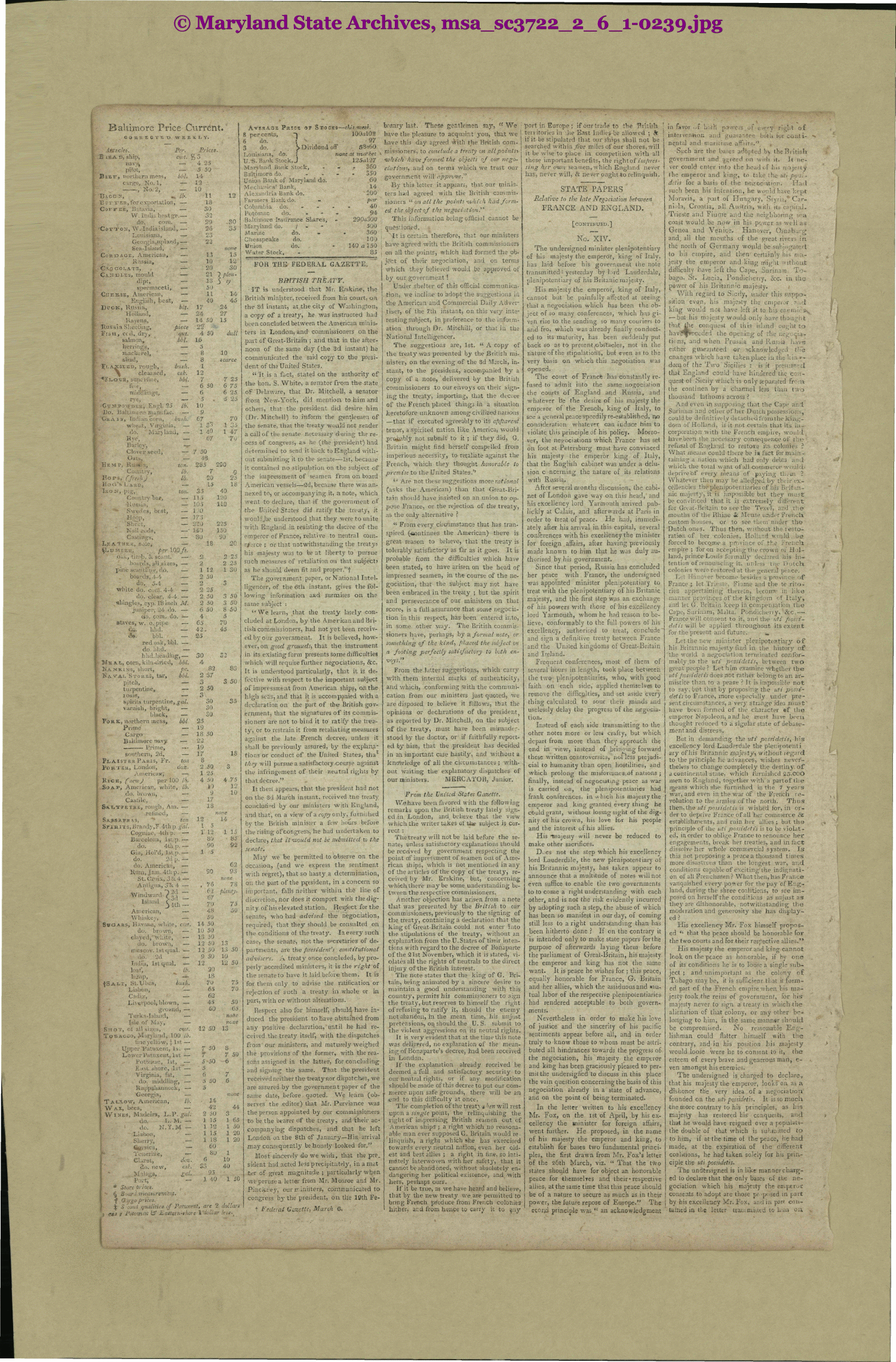
Baltimore Price Current.
t'UKKE.l'l^U W £. £. 0h It 1 *
Articles'. Per. Prices.
E iEA.T>. ship, ouif. S3
mil , — 4 25
pilot, — 5 50
Beet-, northern mess, bbl. 14
cargo, No. 1, — 13
--------, No. 2, — 10
'"Bacc*, » lb. 11 12
Butter, for"exportation, — 18
Coffee, Batavia, — 30
W. Indja best gr.— 32
do. com. — 29 .30
: 'Cor ton, W.India island, — 26 35
Louisiana, — 23
Georgki,upland, — 22
Sea-Island, — none
Cordage, American, — 1? 15
Russia, — 10 12
PCOJ-A.TB, ----' 20 30
Ca:;elcs, mould — 21 Iplen-
dipt, — 13 S ty
spermaceti, — 50
¦Ci:f.sse, American, — English, Lest, — 11 14
40 45
Duck, Russia, bit- 17 24
Holland, — 24 27
Havens, — 14 50 15
Russia Sheeting, J>icce 22
I'.'Sti, Ccd, dry, t/Ut. ~4 £0 dull
salmon, bbl. 16
herrir — 5
mackerel, — 8 10
shad, — 8 scarce
T'i.axseed, rough, ¦ bush. ^ cleansed, csk. 1
12
^Lota, supci bbl. 7 7 25
R ,e. - 6 50 6 73
midElhigg, — 6 6 25
rye, — 5 5 25
-Gumpow dkk, F.npfl. 95 lb. 10
Do. Balti n;fac. — 9
Ghajs, n, bush. 67 70
wheat, Virginia, — 1 S" 1 35
<'. i. Mar) land, — 1 40 1 47
Rye, — 67 TO
B a. —¦
Clover seed, — 7 50
Oats, ¦ — 48
Hemp, Ru s , ten. 2S5 2S0
C.;,'.,. '.">-, lb. 7 •9
Mors, fjretfij lb. 20 25
Hoe's Lard, — 15 18
Ikon, p ton. S3 40
Country "bajf, — I 1 i 120
— 105 110
Swedes, best, — 1 0
— 173
set, — 220 225 ¦
cods, —' , 1 150
Castings, — 80 90
Leather, sole, — 18 20
per 100 ft.
(>..;., tit! b, ".. scant. — ¦ 2 • 2 25
boards, (ill sizes, — 2 2 25
pine acanttTiig, do. — 1 12 1 30
boards, 4-4 — 2 50
do. 5-4' — 2 3
•white do. coin". 4-4 — 2 25
do. clear, 4-4 — shingles, cyp". 1'8 inch M. 2 50 3 50
2 50 3 50
juniper, 24 do. — 6 50 8 50
(Jo, com. do. — 4 5
staves, w. o. pipe — 65 70
flu. hhd. — 42. 45
tie. bbl. ~ 25
red oak, bbl. —
do. hhd. —
bhd. heading,— 30 £2
Mk At., corn, kiln-dried, bbl. 4
Mankins, short, pc. 82 83
IJavai. Stores, tar, bbl. 2 37
pitch, — 3 3 50
turpentine, -— 2 50
losin, — 3
S|)iri(s turpentine, gal. 30 35
varnish, bright, — 30
black, — 30
1 Pork, northern mess, bbl 25
Prime — 19
Cargo — 18 50
Baltimore navy — 22
_______Prime, 19
southern, 2d, — 17 18
Plaistck Paris, Fr. ton 8
Pokier, London, duz. 2 50 3
Amerie.'v, — 1 25
Rice, (new J per 100 lb. 4 50 4 75
Soap, American, white, lb. l 1 12
do. hio\vii, — 9 10
Castile, — 17
Sat,tpetke, rough, Am. — 13
refined, — none
Sassafras, ton 12 14
Spziuts,Brandy,F.4th p gal. 1 5
Cogniac, 4th p. — 1 12 1 15
Barcelona, 1st p.— 80 85
do. 4th p. — 90 92
Gin, Hol'd, 1st p.— 1 5
do. p. —
do. American, — 62
Rum, Jam. 4th p. — 90 93
St.Croix, 3&4 — norm
Antigua, 3 St 4 — . 76 78
Windward ? ~)j ~ Island C4^_ 62 67 70 plenty. 73
An ericfln, 48 50
Whiskey, — 50
Swgars, Havana, while, cwt. 14 50
do. In own, — 10 50
clayed, White, — 13 30
do. brown, — 12 50 13
moscov. tstqaal. — 12 50 13 50
do. 2d — 9 50 10
Tiuiia, Islcuuil. — 12 12 50
loaf, . ^ lb. 30
luSip, — 18
•j-Salt, St. Vi'f'S, bush. 70 75
Lisbon, ,— 65 70
Cadiz, — 62
Li\ cvpot'l, blown, — 45 50
ground,— 60 65
Turks-Island, — none
Isle of May, — none
Shot, of all s; civt. ¦12 50 13
obacco, Maryland, 100 lb.
tine yellow, \ 1st —
toper Patuxent, 1st -,— 7 50 8
Lower Ratuxent, 1st — 7 7 50
Potomac, 1st, — 5 50 6
-.1.shore, li 5
Virginia, fat, — (i 7
do. middling, — 5 50 6
Rappahannock, — 5
Georgia, — none
Tau-ow, American, lb. ¦ 14
Wax, bees, , — 42 44
Wines, Madeira, h.V. gal- 2 50 3
do. L. M. — I 15 1 65
do. N.Y.M -- 1 12 1 50
Lisbon, — 1 15 1 20
Sherry, 1 18 1 20
Corsica, — 60
Teiierine, — 80 1
Claret, daz 6 10
do. new,' est. £3 40
Malaga, gel. 95
Port, — 1 40 1 50
* Store prioet.
§ B lOOalOS
•97
3 do. [>Div Louisiana, do. i dend off 5816O
none at market
U.S. Bank Stock,J 125al27
Maryland Bank Stock, - - 360
Baltimore do. . - 350
Union Bank of Maryland do. 60
Mechanics' Bank, 14
Alexandria Bank do. 200
Farmers Bank do. . par
Columbia do. - . 40
Potomac do. - . 94
Baltimore Insurance SI ares, . 290«3O0
Maryland do. / - 500
Marine do. • 360
Chesapeake do. 100
Union do. - 140 a 150
Watar Stock, 85
I
FOR THE FEDERAL GAZETTE.
BRITISH TREATY.
• TT is understood that Mr. Erskine, the
British minister, received from his court, on
the 3d instant, at the city of Washington,
a copy of a treaty, he was instructed had
been concluded between the American minis-
ters in London, and commissioners on the
part of Great-Britain ; and that in the after-
noon of the same day (the 3d instant) he
communicated the said copy to the presi-
dent of the United States.
" It is a fact, stated on the authority of
the hon. S. White, a senator from the state
of Delaware, that Dr. Mitchell, a senator
from New-York, did mention to him and
others, that the president did desire him
(Dr. Mitchell) to inform the gentlemen of
the senate, that the treaty would not render
a call of the senate necessary during the re-
cess of congress, as he (the president) had
determined to send it back to England with-
out submitting it to the senate—1st, because
it contained no stipulation on the subject of
the impressment of seamen from on board
American vessels—2d, because there was an-
nexed to, or accompanying it, a note, which
went to declare, that if the government of
tin- U.iifcvd States did ratify the treaty, it
wouki.be understood that they were to unite
with England in resisting the decree of the
empercr of France, relative to neutral com-
merce ; or that notwithstanding the treaty)
his majesty was to be at liberty to pursue
such measures of retaliation on that subject;
as he should deem fit and proper."t
The government paper, or National Intel-
ligencer, of the 6th instant, gives the fol-
lowing information aad surmises on the
same subject :
''We learn, that the treaty lately con-
cluded at London, by the American and Bri-
tish commissioners, had not yet been receiv-
ed by our government. It is believed, how-
ever, on good grouuds, that the instrument
in its existing form presents some difficulties
which will require further negociations, &c.
It is understood particularly, that it is de-
fective with respect to the important subject
of impressment from American ships, on the
high seas, and that it is accompanied with a
declaration on the part of the British gov-
ernment, that the signatures of its commis-
sioners are not to bind it to ratify the trea-
ty, or to restrain it from retaliating measures
against the late French decree, unless it
shall be previously assured, by the explana-
tions or conduct of the United States, tha
they will pursue a satisfactory course against
the infringement of their neutral rights by
that decree."
It then appears, that the president had not
on the 3d March instant, received tne treaty
concluded by our ministers with England,
and that, on a view of a copy only, furnished
by the British minister a few hours befoie
the rising of congress, he had undertaken to
declare, that it'would not be submitted to the
senate.
May we be permitted to observe on the
occasion, (and we express the sentiment
with regret), that so hasty a determination,
on the part of the president, in a concern so
important, falls neither within the line of
discretion, nor does it comport with the dig-
nity of his elevated station. Resrfect for the
senate, who had advised the negociation,
required, thattheyshould.be consulted on
the conditions of the treaty. In every such
case, the senate, not the secretaries of de-
partments, are the president's constitutional
advisers. A treaty once concluded, by pro-
perly accredited ministers, it is the right of
the senate to'have it laid before them. It is
for them only to advise the ratification or
rejection of such a treaty in whole or in
part, with or without alterations.
Respect also for himself, should have in-
duced the president to have abstained from
any positive declaration, until he had re-
ceived the treaty itself, with the dispatches
from our ministers, and maturely weighed
the provisions of the former, with the rea-
sons assigned in the latter, for concluding
and signing the same. That the president
received neither the treaty nor dispatches, we
are assured by the government paper of the
same date, before quoted. We learn (ob-
serves the editor) that Mr. Purviance was
the person appointed by our commissioners
to be the beater (if the treaty, and 'their ac-
companying dispatches, and that he left
London on the 8th of January—His arrival
may consequently be hourly looked for,"
Most sincerely do we wish, that the pre.
sident had acted less precipitately, in a mat
&r of great magnitude ; particularly when
we peruse a letter from Mr. Monroe and Mr.
Pinckuey, our ministers, communicated to
congress by the president, on the 18th Fe-
* Federal Gazette, March 6.
braary last. These gentlemen say, <( We
have the pleasure to acquaint you, that we
have this day agreed vVith the British com-
missioners, to conclude a treaty cm all points,
which have formed the objects of our nego-
ciations, and on terms which we trust our
government will approve."
By this letter it appears, that our minis,
ters had agreed with the British cammis-
sioners " on all the points luhieh had form-
ed the object of the negociition."
This information being official cannot be
questioned.
It is certain therefore, that our ministers
have agreed with the British commissioners
on all the points, which had formed the ob-
ject of their negociation, and on terms
which they believed would be approved of
by our government !
Under shelter of this official communica-
tion, we incline to adopt the suggestions in
the American and Commercial Daily Adver-
tiser, of the 7th instant, on this very inte-
resting subject, in preference to the inform-
ation through Dr. Mitehill, or that in the
National Intelligencer.
The suggestions are, 1st. " A copy of
the treaty was presented by the British mi-
nister, on the evening of the 3d March, in-
stant, to the president, accompanied by a
copy of a note, ' delivered by the British
commissioners to our envoys on their sign-
ing the treaty, importing, that the decree
of the French placed things in a situation
heretofore unknown among civilized nations
— that if executed agreeably to"itfe afifiarenl
tenor, a spirited nation like America, would
pr<4iab!y not submit to it ; if they did, G.
Britain might find herself compelled from
imperious necessity, to retaliate against the
French, which they thought honorable to
premise to the United States.''
" Are not these suggestions more rational
(asks the American) than that Great-Bri-
tain should have insisted on an union to op-
pose France, or the rejection of the treaty,
as the only alternative ?
" From every circumstance that has tran-
spired (continues the American) there is
great reason to believe, that the treaty is
tolerably satisfactory as far as it goes. It is
probable from the difficulties which have
been stated, to have arisen on the head of
impressed seamen, in the course of the ne-
gociation, that the subject may not have
been embraced in the treaty ; but the spirit
and perseverance of our ministers on that
score, is a full assurance that some negocia-
tion in this respect, has been entered into,
in some other way. The British commis-
sioners have, perhaps, by a formal note, or
something of the kind, placed the subject on
a footing perfectly satisfactory to both en-
voys."
From the latter suggestions, which carry
with them internal marks of authenticity,
and which, conforming with the communi-
cation from our ministers just quoted, we
are disposed to believe it follows, that the
opinions or declarations of the president,
as reported by Dr. Mitchell, on the subject
of the treaty, must have been misunder-
stood by the doctor, or if faithfully report-
ed by him, that the president has decided
in an important case hastily, and without a
knowledge of all the circumstances ; with-
out waiting the explanatory dispatches of
our ministers. MERCATOH, Junior.
port in Europe ; if our trade to the British '
territories in lie East Indies be allowed ; Sr !
if it be stipulated that our ships shall not be |
searched \v\th\n five miles of our shores, will
it be wise to place in competition with all
these important benefits, the rightof impres-
sing her o-wn seamen, which England never
has, never will, & never ought to relinquish.
From the United States Gaactte.
Wehave been favored with the following
re-marts upon the British treaty lately sign-
ed in. London, and believe that the view
which the writer takes oi Uir subject is cor-
rect :
The treaty will not be laid before the se-
nate, unless satisfactory explanations should
be received by government respecting the
point of impressment of seamen out of Ame-
rican ships, which is not mentioned in any
of the articles of the copy of the treaty, re-
ceived by Mr. Erskine, but, concerning
which there may be some understanding be-
tween the respective commissioners.
Another objection has arisen from a note
that was presented by the British to our
commissioners, previously to the signing of
the treaty, containing a declaration that the
king of Great-Britain could not enter into
the stipulations of the treaty, without an
explanation from the U.States of their inten-
tions with regard to the decree of Bonaparte
of the 21st November, which it is stated, vi-
olates all the rights of neutrals to the direct
injury of the British interest.
The note states that the king of G. Bri-
tain, being animated by a sincere desire to
maintain a good understanding with this
country, permits his commissioners to sign
the treaty, but reserves to himself the right
of refusing to ratify it, should the enemy
not abandon, m the mean time, his unjust
pretensions, ou should the U. S. submit to
the violent aggressions on its neutral rights.
It is very evident that at the time this note
was delivered, no explanation of the mean-
ing of Bonaparte's decree, had been received
in London.
If the explanation already received be
deemed a full and satisfactory security to
our neutral rights, or if any modification
should be made of this decree to put our com-
merce upon safe grounds, there will be an
end to this difficulty at once.
The completion of the treaty then will rest
upon a single point, the relinquishing the
right of impressing British seamen out of
American siiips ; a right which no reason-
able man ever supposed G. Britain would re-
linquish, a right which she has exercised
towards every neutral nation, even her old-
est and best allies ; a right in fine, so inti-
mately interwoven with her safety, that it
cannot be abandoned, without absolutely en-
dangering her political existence, and with
hers, perhaps ours.
If it be true, as we have heard and believe,
that by the new treaty we are permitted to
bring French produce from French colonies
hither, ar.d from hence to carry it to any
STATE PAPERS
Relative to the late Negociation between
FRANCE AND ENGLAND.
[continued.]
No. XIV.
The undersigned minister plenipotentiary
of his majesty the emperor, king of Italy,
has laid before his government the note
transmitted¦'• yesterday by lard Lauderdale,
plenipotentiary o.f his Britanic majesty.
His majesty the emperor, king of Italy,
cannot but be painfully affected at seeing
that a negociation which has been the ob-
ject of so many conferences, which has gi-
vsn rise to the sending so many couriers to
and fro, which was already finally conduct-
ed to its maturity, has been suddenly put
back so as to present .obstacles, not in the
nature of the stipulations, but even as to the
very basis on which this negotiation Has
opened.
The court of France has constantly re-
fused to admit into the same nogociation
the courts of England and Russia, and
whatever be the desire of his majesty the
emperor of the French, king of Italy, to
see a general peace speedily re-established, no
consideration whatever can induce him to
violate this principle of his policy. Moreo-
ver, the neoociations which France has set
on foot at Petersburg must have convinced
his majesty the emperor king of Italy,
that the English cabinet was under a delu-
sion concerning the nature of its relations
with Russia.
After several months discussion, the cabi-
net of London gave way on this head, and
his excellency lord Yarmouth arrived pitb-
lickly at Calais, and afterwards at Paris in
order to treat of peace. He had, immedi-
ately after his arrival in this capital, several
conferences with his excellency the minister
for foreign . affairs, after having previously
made known to him that he was duly au-
thorised by his government.
Since that period, Russia has concluded
her peace with France, the undersigned
was appointed minister plenipotentiary to
treat with the plenipotentiary of his Britanic
majesty, and the first step Was an exchange
of his powers with those of his excellency
lord Yarmouth, whom be had reason to be-
lieve, conformably to the full powers of his
excellency, authorised to treat, conclude'
and sign a definitive treaty between Fiance
and the United kingdoms of Great-Britain
and Ireland.
Frequent conferences, most of them of
several hours in length, took place between
the two plenipotentiaries, who, with good
faith on each side, applied themselves to
remove the difficulties, and set aside every
thing calculated to sour their minds and
uselessly delay the progress of the negocia-
tion.
Instead of each side transmitting to the
other notes more or less crafty, but which
depart from more than they approach the
end in view, instead of .briivdng forward
these written controversies, nolless prejudi-
cial to humanity than open hostilities, and
which prolong the misfortunes of nations ;
finally, instead of negociatmg peace as war
is carried on, the plenipotentiaries had
frank conferences, in which his majesty the
emperor and king granted every thing he
could grant, without losing sight of the dig-
nity of his crown, his love tor his people
and the interest of his allies.
His -majesty will never be reduced to
make other sacrifices.
Does not the step which his excellency
lord Lauderdale, the new plenipotentiary of
his Britannic majesty, has taken appear to
announce that a multitude of notes will not
even suffice to enable the two governments
to to come a right understanding with each
other, and is not the risk evidently incurred
by adopting such a step, the abuse of which
has been so manifest in our day, of coming
still less to a right understanding than has
been hitherto done ? If on the contrary it
is intended only to make state papers for the
purpose of afterwards laying them before
the parliament of Great-Britain, his majesty
the emperor and king has not the same
want. It is peace he wishes for ; this peace,
equally honorable for France, G. Britain
and her allies, which the assiduous and "Mu-
tual labor of the respective plenipotentiaries
had rendered acceptable to both govern-
ments.
Nevertheless in order to make his love
of justice and the sincerity of his pacific
sentiments appear before all, and in order
truly to know those to whom must be attri-
buted all hindrances towards the progress of-
the negociation, his majesty the emperor
and king has been graciously pleased to per-
mit the undersigned to discuss in this place
the vain question concerning the basis of this
negociation already in a state of advance,
and on the point of being terminated.
In the letter written to his excellency
Mr. Fox, on the 1st of April, by his ex-
cellency the minister for foreign affairs,
went further. Pie proposed, in the name
of his majesty the emperor and king, to
establish for bases two fundamental princi-
ples, the first drawn from Mr. Fox's letter
of the 26th March, viz. " That the two
states should have for object an honorable
peace for themseltes and their-respective
allies, at the same time that this peace should
be of a nature to secure as much as in their
power, the future repose of Europe." The
ecor,d principle was " an acknowledgment
in favor of -. right of
intervention aiid guarantee both for ceati- *»
nental and maritime affairs."
Such arc the bases adopted by the British
government and agreed on with it. It ne-
ver could enter int.) the head of his majrfty
the emperor and king, to take the uti /n:.'.-
dctls for a basis of the neeoc'ation. Had
such been his intention, he would have kept
Moravia, a past of Hungary, Styrn, Car-
niola, Croatia, al! Austria, with its capital.
Trieste and Fiur.ie and the neighboring sea
coast would be now in his power as -veil as
Genoa and Venice, Planover, Osnaburg
and, all the mouths of the preat rivers in
the north of Germany would be subjugater!
to his empire, and then certainly iris n
jesty the emperor and king might without
difficulty have left the Cape, Surinam, T---
bago, St. Lucia, Pone'iclierry, &c. in the;
power of his Britannic majesty.
With regard to Sicily, under this suppo-
sition cvun, his majesty the emperor . niid
king wou.'J not have left it to his enemi
— but his majesty would only b-ave thou
that die conquest of this island ought to
havi^receded the opening- of ..'14-
tjbns, and when Prussia an«i Russia have
either guaranteed or acknowledge.i (he;
cnanges \vh;ch have taken place in the kia;»*
do:a of the Two Sicilies : is it presumed
that England could have hindered the con-
quest ol Siciiy winch is only separated firo'rt*
the. continen by a channel less than two
thousand fathoms across ?
And even in supposing that the Cape ah I
Surinam and other cifher Dutch posse :. ,
could be definitively detachedfronitbe-king-
dom of Holland, is it not certain that its i
corporation with the French empire, wotil I
have been 1 he necessary consequence or' tlii
refusal of England to restore its colonies i
What means could there be in fact for main-
taining a hatiqn which bad only debts and
which the total want of all commerce svotll I
depriveof every means of paying theoi ?
Whatever then may be alledged by their ex-
cellencies the plenipotentiaries of his Britan -
nic majesty, it is impossible but they must
be convinced that it is extremely different
for Great-Britain to see the Texel, and the
mouths of the lUiine & Meuse under French.
custom houses, or to see them under the
Dutch ones. Thus then, without the resto-
ration of her colonies, Holland would be
forced to become a prpyiijce-of.Jrhe French
empire ; for on accepting the crown of Hol-
land, princeLouis formally declared his in-
tention ofrenouneing it, unless ttu> i"".:tch
colonies were restored at the general
i - ' ¦ ¦-. :• er become besides a province of
France,; let Trieste, Fiume and the te rjto-
ries appertaining thereto, lecomv ii; like
manner provinces of the kingdom of Italy,
and let G. Britain keep in compensation the
Cape, Surinam, Malta, Pondicheny, &c,—•
France will consent to it, and the ttti fiossi-
deiis-will be applied throughout its extent
for the present and future. _
Let the new minister plenipotentiary of
his Britannic majesty fmd in the history of
the world a negociation terminated confor-
mably ,to the ttti pijssid/.tis, between two
great people ? Let him examine whgther the
uti jiossidttis does not rather belong to an ar-
mistice than to a peace ? It is impossible not
to say, but that by proposing the uti possi-
detis to Fiance, more especially under pre-
sent circumstances, a very strange idea must'
have been formed of the character ef the
einperor Napoleon, and lie must have been
thought reduced to a sigular state of debase-
ment and distress.
But in demanding the uti possidetis, his
excellency lord Lauderdale the plenipotenti
ary of his Britannic majesty, without regard
to the principle he advances, wishes never-
theless to change completely the destiny of
a continental state, which furnished 25.000
men to England, together with a partoftlie
ineans which she furnished in the 7 years
war, and even in the war of the French re-
volution to the aunies of the north. Thus
then, the idipossidetis is wished for, in or-
der to deprive France of all her commerce to
establishments, and ruin her allies ; but the
principle of (he uti possidetis is to be violat-
ed, in order to oblige France to renounce her
engagements, break her treaties, and intact
dissolve her whole commercial system. Is
this not proposing a peace a thousand times
more disastrous than the longest war, and
conditions capable of exciting the indignati-
on of all Frenchmen? What then, has Fiance
vanquished every power for the pay of Eng-
land, during the shree coalitions, to see im-
posed on herself the conditions as unjust as
they are dishonorable, notwithstanding the
moderation and generosity she has display-
ed?
rlis excellency Mr. Fox himself propos-
ed " that the peace should be honorable for
the two courts and for their respective allies."
His majesty the emperor and king cannot
look on the peace as honorable, if by one
of its conditions he is to loose a single sub-
ject ; and unimportant as the colony of
Tobago may be, it is sufScienr that it form-
ed part of the French empire when his ma-
jesty took,the reins of government, for his
majesty never to sign a treaty in which the
alienation of that colony, or any other be-
longing to him, in the same manner should
be compromised. No reasonable Eng-
lishman could flatter himself with the
contrary, and in his position his majesty
would loose were he to consent to it, the
esteem of every brave and generous man, e-
ven amongst his enemies.
The undersigned is charged to declare,
that his majesty the emperor, looks on as a
dishonor the very idea of a negociation
founded on the uh-possidetis. It is so much
tne more contrary to his principles, as his
majesty has restored his conquests, and
that he would have reigned over a pcpuiaii-
the double of that which is submitted to
to him, if at the time of the peace, he had
made, at the expiration of the different
coalitions, he had taken solely for his prin-
ciple the uti possidetis.
The undersigned is in like manner charg-
ed to declare that the only bases of the ne-
gociation which his majesty the emperor.
consents to adopt are those proposed in part
by his excellency Mr. Fox, and in part con-
tained in the letter train milled to-him on
|