 |
|
|
 |
|
 |
|
|||
|
||||
|
||||
|
Federal Gazette & Baltimore Daily Advertiser 1807/01-1807/06 msa_sc3722_2_6_1-0496 Enlarge and print image (4M) |
|
|
|
|
|
|
|
|||
|
||||
|
||||
|
Federal Gazette & Baltimore Daily Advertiser 1807/01-1807/06 msa_sc3722_2_6_1-0496 Enlarge and print image (4M) |
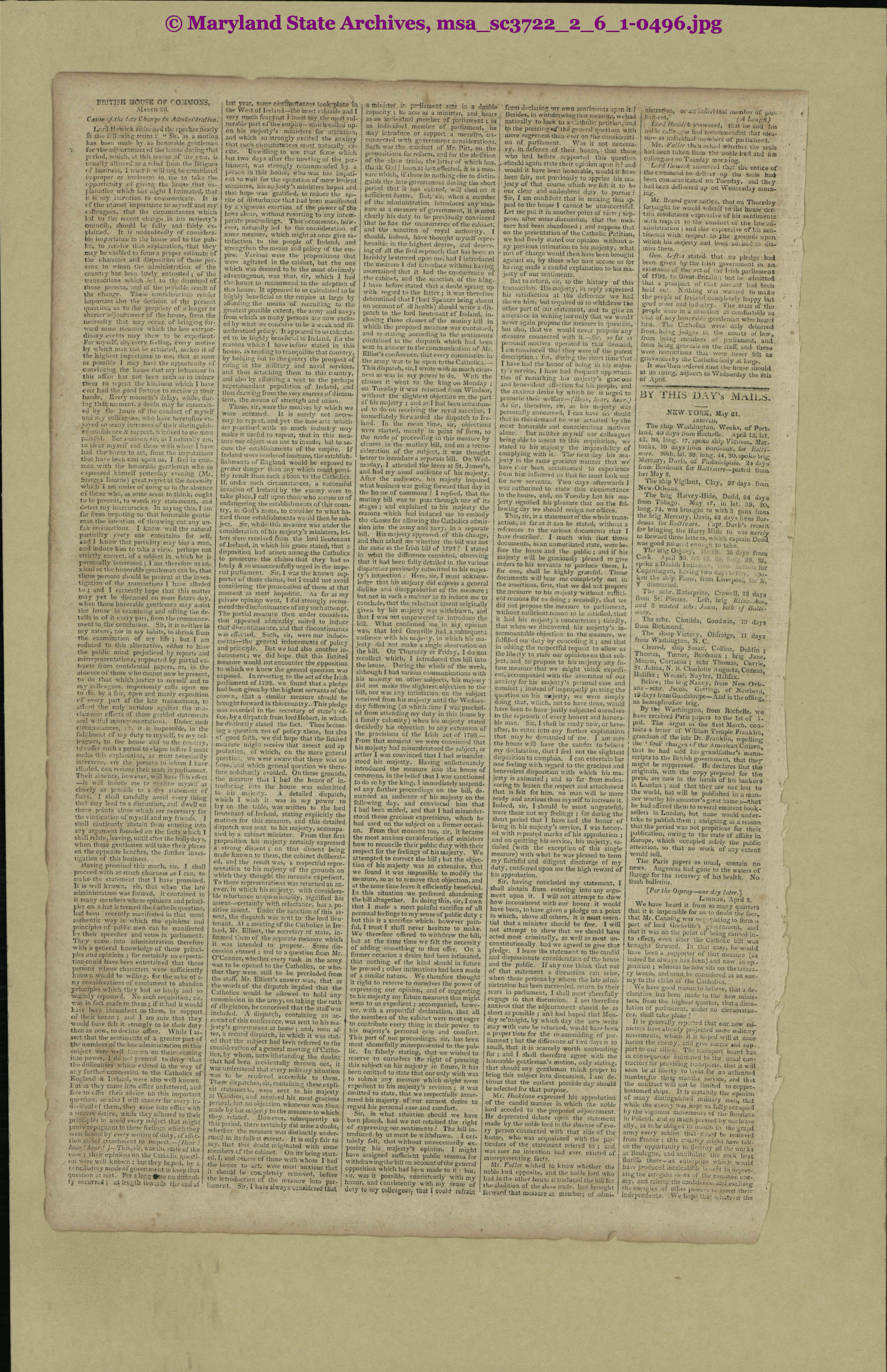
| ERITIfH HOUSE OF COMMONS, March ss. Cause of the tote Change in Attmlnistfyfton'. Lord Howiek addressed the speaker nearly ill Che C Mowing terms :' " Sir, as a motion has been made by. an honorable gentleman '; for tire adjournment of the house 'luring that period, which, at this Season of the yftar, is usually allowed as a relief from the fittignes of business, 1 trust i' will not, bo: considered improper or irrelevant in me to take the opportunity of giving the house that ex- planation which last night I Intimated, that it is my intention to communicate. It is of the utmost importance to myself and my colleagues, that the circumstances which I'd to the recent change.in iiis majesty's council;, should be fully and fairly ex- plained. It is undoubtedly of considpra- ble importance to the house and to the pub- lic, to .receive thai;, explanation, that they may be enabled to form a proper estimate of the character and disposition of those per- sons to whom the administration of the country has been lately entrusted ; of the transactions which lei to the dismissal of those persons, arid of the probable result of the change. These considerations render important also the decision of the present question, as to the propriety of a longer or shorter'adjournment of the house, from the necessity that may occur of bringing for- ward some measure which the late extraor- dinary events may shew to be expedient. For myself, sir, every feeling, every motive by which man can be actuated, makes it of the highest importance to me, that as soon :is possible I may have the opportunity of convincing the house that my behaviour in this affair has not been such as to induce them to repent the kindness which I have ever had the gocd fortune to receive at their hands. Every moment's delay, while, dar- ing.that moment, a doubt may be entertain- ed by the house of the conduct of myself and tr.j colleagues, who have heretofore en- joyed so many instances.of their distinguish- ed confidence & support, is indeed to me most I. But anxious, sir, as I naturally am, to clear myself and the se with whon I have had the honor to act, from the imputations that have been cast upon us, I feel in com- mon with the honorable gentleman who so expressed himself yesterday evening (Mr. Sterges Bourne) great regret at the necessity which" T am tinder of doing so in the absence cf these who, as some seem to think, ought to be present, to watch my statements, and detect my inaccuracies. In saying this, I am far from imputing to that honorable gentle man the intention of throwing cut any un- fair insinuations. I know well the natural parti~iity evsry one entertains for self, and I know that partiality may bias a man, and induce him to take a view, perhaps not strictly correct, of a subject in which he is personally interested ; I am therefore as an,- xious as the honorable gentleman can be, that those persons should be present at the inves- tigation of the .transactions I have alluded to ; and I earnestly hope that this matter may yet be discussed on some future day, when those honorable gentlemen may assist the house in examining and sifting the de- tails in of it every parr, from the commence- ment to the conclusion. Sir, it is neither in my nature, nor in my habits, to shrink fiom the examination, of my life ; but I am reduced to this alternative, either to have the public mind prejudiced by reports and misrepresentations,, supported by partial ex- tracts from confidential papers, or, in the absence of those who cannot now be present, to do that which justice to myself and to my o lien gues, imperiously calls upon me to do, by a fair, open and manly exposition of every part of the late transactions, to alTord the only antidote against the mis- chievous effects of those garbled statements and wilful misrepresentations. Under such cis&ilrnstances, sir, it is impossible, in the fulfilment cf my duty to myself, to my col- leagues, to the house and to the country, to suffer such a period to elapse before I must inaiie t.S;i - explanation, as must necessarily intervene, ere the persons to whom I have alluded, can resume their seats in parliament. Their ai sence, however, wiil have this effect —it will induce me to CbnSne myself as closely as possible to a dry statement of facts. I shall carefully avoid every thing tin . may lead to a discussion, and dwell on those points alone which are necessary for the vindication of myself andmy friends. I shall cautiously abstain frcm entering into any argument founded on the facts which I shall relate, leaving, until after the hollydays, when those gentlemen will take their places on the opposite benches, the further inves- tigation of this business. Having premised this much, sir, I shall proceed with as much clearness as I can, to make the statement that I have promised. It is well known, sir, that when the late administration was formed, it contained in it many members whose opinions and princi- ples on what is termed the (atholicquestion, had been recently manifested in that most authentic way in which the opinions and principles of public men can be manifested Jby their speeches and votes in parliament. They came into administration therefore with a general knowledge of those princi- ples and opinions ; for certainly no expecta- tion ccuid have been entertained that those persons whose characters were sufficiently known would be willing, for the sake of a- ny considerations of emolument to abandon principles which tiny had so lately and so wainily espoused. No such requisition, sir, •was in fact made to them ; if it had it would have been incumbent on them, in support of their honor ; and I am sure that they would have felt it strongly to be their duty then as now, to decline office. While I as- sert that the sentiments of a greater part of the members of the late administration on this subject were weil J p.own on their coming jr. to power, I d d end to deny that the difficulties which existed in the way of any further concession to the Catholics of England k Ireland, were also well known. Jut as they came into office unfettered, and fiee-to offer their advice on this important question, so also I will answer for every, in- dividual of them, they same into office with a sincere desire, while they adhered to their principles to avoid every subject that might prove repugnant to these feelings which they were bound b3' every motive of duty, of affec- tion andof attachment to respect.— (Hear ! hear! hear.' J—This, sir, was the state of the case ; their opinions on the Catholic questi- on were well known; but they heped, by a o; nciliatoiy mode of government to keep that question at rest.' For a long gfcie no diii'-.'ul- tg occurred.; at leagth. towards the end of last year, som? circfhnStanees foolcplace In the West of Ireland—the most valuable and I very much fear tuat I most say the most vul- nerable part of the empire—which called up- on his majesty's ministers for attention, and wdiich so strongly excited the anxiety that such circumstances must naturally ex- cite. Unwilling to use that force which but two days after the meeting-of the par- liament, was strongly recommended by a person in this house, who was too impati- ent to wait for the operation of more lenient measures, his majesty's ministers hopeci and that hope was gratified, to reduce the spi- rite of disturbance that had been manifested by a vigorous exertion of the power of the laws alone, without resorting to any intem- perate proceedings. This occurrence, how- ever, naturally led- to the consideration of some measure, which might at once give sa- tisfaction to the people of Ireland, and strengthen the means and policy of the em- pire. Various were the propositions that were agitated in the cabinet, but the one which was deemed to be the most obviously advantageous, was that, sir, which I had the honor to recommend to the adoption of this house. It appeared to us calculated to be highly beneficial to the empire at large by affording the means of recruiting to the greatest possible extent, the army and navy, from which so many persons are now exclu- ed by what we conceive to be a weak and ill- understood policy. It appeared to us calculat- ed to be highly beneficial to Ireland, for the reasons which I have before stated in this house, as tending to tranquility that country, by holding out to the gentry the prospect of ill the military and naval services, and thus attaching them to this country, and also by affording a vent to the perhaps superabundant population of Ireland, and thus drawing from the very sources of discon- tent, the means of strentgh and union. These, sir, were the motives by which we were actuated. It is surely not neces- sary to repeat, and yet the base arts which at? piactised with so much industry may make it useful to repeat, that in this mea- sure our object was not to invade, but to se- cure the establishments of the empire. If Ireland were rendered insecure, theestablish- lishments of England would be exposed to greater danger than any which could possi- bly result from such a boon to the Catholics. If, under such circumstances, a Successful invasion of Ireland by the enemy were to take place,I call upon those who accuse us of endangering the establishments of this coun- try, in God's name, to consider to wdiat ha- zard those establishments would then be sub- ject. Sir, while this measure was under the consideration of his majesty's ministers, let- ters were received from the lord lieutenant of Ireland, in which his grace stated, that a disposition, had arisen among the Catholics to prosecute the claims that they had so lately & so unsuccessfully urged in the impe- rial parliament. Sir, I was the known sup- porter of those claims, but I could not avoid considering the prosecution of them at that moment as most impolitic. As far as my private opinion went, I did strongly recom- mend the discontinuance of any such attempt. The partial measure then under considera- tion appeared admirably suited to induce that discontinuance, and that discontinuance was effected. Such, sir, were our induce- ments—the general inducements of policy and principle. But we had also another in- ducement; we did hope that this limited measure would not encounter the opposition to which we knew the general question was exposed. In reverting to the act of the Irish parliament of 1793, we found that a pledge had been given by the highest servants of the c.;v n, that a similar measure should be brought forward in thiscountry. This pledge was recorded in the secretary of state's of- fice, by a dispatch from lordHobart, in which he distinctly stated the fact. Thus becom- ing a question not of policy alone, but also of good faith, we did hope that the limited measure might receive that assent and ap probation, of which, on the more general question, we were aware that there was no 'ope, and which general question we there- fore sedulously avoided. On those grounds, the measure that I had the honor of in- troducing iitto the house was submitted to his majesty. A detailed dispatch, which I wish it was in my power to lay on the table, was written to the lord lieutenant of Ireland, stating-explicitly the motives for this measure, and this detailed dispatch was sent to his majesty, accompa- nied by a cabinet minister. From that first proposition his majesty certainly expressed a strong dissent ; on that dissent being made known to them, the cabinet deliberat- ed, and the result was, a respectful repre- sentation to his majesty of the grounds on which they thought the measure expedient. To these representations was returned an an- swer, in which his majesty, with considera- ble reluctance unquestionably, signified his assent—certainly with reluctance, but a po- sitive assent. Under the sanction of this as- sent, the dispatch was sent to the lord lieu- tenant. At a meeting of the Catholics in Ire- land, Mr. Elliott, the secretary of state, in- formed them of the separate measure which it was intended to propose. Some dis- cussion ensued ; and to a question from Mr. O'Connor, wdiether every rank in the army was to be opened to the Catholics, or whe- ther they were still to be precluded from the staff, Mr. Elliott's answer was, that as the words of the dispatch implied that the Catholics would be allowed to hold any commission in the army, on taking the oath of allegiance, he conceived that the staffwas included. A dispatch, containing an ac- cc>unt of this conference, was sent to his ma- jesty's government at home ; and, soon af- ter, a second dispatch, in which it was stat- ed that the subject had been referred to the consideration of a general meeting of Catho- lics, by whom, notwithstanding the doubts that had been incidentally thrown out, it was understood that every military situation was to be rendered accessible to them. These dispatches, sir, containing these expli- cit statements, were sent to. his majesty at Windsor, and received his most gracious perusal, but no objection whatever was then made by his majesty to the measure to which they related. However, subsequently to this period, there certainly did arise a doubt, wdiether the measure was distinctly under- stood in its fullest extent. It is only fair to say, that this doubt originated with some members of the cabinet. On its being start- ed, I, and others of those with whom I had the honor to act, were most anxious that it should be completely removed, before the introduction of the measure into par- liament. Sir. I have always considered that a minister in parliament acts in a double capacity ; he acts as a minister, and,hears as an individual member pf parliament ; as an individual member of parliament, he may introduce or support a measure, un- connected with government considerations. Such was the conduct of Mr. Pitt, on the propositions for reform, and for the abolition of the slave trade, the latter of w'hich has, thank God ! been at U-sfc e'fected, & is a mea- sure which, if there be nothing else to distin- guish the late government duiing the short period that it has existed, will shed oh it sufficient lustre. But; sir, when a member of the administration introduces any mea- sure as a measure of government, it is most clearly his duty to be previously convinced that he has the consurrence of the cabinet, and the sanction of royal authority. I should, indeed, have thought myself repre- hensible in the highest decree, and deserv- ing of all the foul reproach that has been so lavishly bestowed upon me, had I introduced the measure I did introduce without, having ascertained that it had the concurrence of the cabinet, and the sanction of the Line. I have before stated that a doubt sprang up with regard to the latter ; it was therefore determined that I (lord Spencer being absent on account of ill health) should write a dis- patch to the lord lieutenant of Ireland, in- closing those clauses of the mutiny bill in which the proposed measure was contained, and re stating according to the sentiments contained in the dispatch which had been sent in answer to the communication of Mr. Elliot's conference, that every commission hi the army was to be open tu the Catholics.— This dispateh, sir,I wrote with as much clear- ness as was in my power to do. With the clauses it went to the king on Monday ; on Tuesday it was returned from Windsor, without the slightest objection on the part of his majesty ; and as I had been accustom- ed to do on receiving the royal sanction, I immediately forwarded the dispatch to Ire- land. In the mean time, sir, objections were started, merely in point of form, to the mode of proceeding in this measure by clauses in the mutiny bill, and on a recon- sideration of the subject, it was thought betrer to introduce a separate bill. On Wed- nesday, I attended the levee at St. James's, and had my usual audience of his majesty. After the audience, his majesty inquired what business was going forward that day in the ho ise of commons ? I replied, that the mutiny bill was to pass through one of its stages ; and explained to his majesty the reasons which had induced me to embody the clauses for allowing the Catholics admis- sion into the army and navj', in a separate bill. His majesty approved of this change, and then asked me whether the bill was not the same as the Irish bill of 1793 ? I stated in what the difference consisted, observing that it had been fully detailed in the various dispatches previously submitted to his majes- ty's inspection : Here, sir, I must acknow- ledge that his majesty did express a general dislike and disapprobation of the measure ; but not in such a manner as to induce me to conclude, that the reluctant assent originally given by his majesty was withdrawn, and that I was not empowered to introduce the bill. What continued me in my opinion was, that lord Grenville had.a subsequent; audience with his majesty, in which his ma- jesty did not make a single observation on the bill. On Thursday or Friday, I do not recollect which, I introduced this bill into the house. Duiing the whole of the week, although I had various communications with his majesty on other subjects, his majesty did not make the slightest;objection to the bill, nor was any intimation on the subject received from his majesty until the Wednes- day following (at which time I was preclud- ed from attending my duty in this house by a family calamity) when his majesty stated decidedly his objection to any extension of the provisions of the Irish act of 1793.— From that moment we were convinced that his majesty had misunderstood the subject, or arther I was convinced that I had misunder- stood his majesty. Having unfortunately introduced the measure into the house of commons, in the belief that 1 was sanctioned to do so by the king, I immediately suspend- ed any further proceedings on the bill, de- manded an audience cf his majesty on the following day, and convinced him that I had been misled, and that I had misunder- stood those gracious expressions, which he had used on the subject on a former occasi- on. From that moment too, sir, it became the most anxious consideration of ministers how to reconcile their public duty with their respect for the feelings of his majesty. We attempted te correct the bill; but the objec- tion of his majesty was so extensive, that we found it was impossible to modify the measure, so as to remove that objection, and at the same time leave it efficiently beneficial. In this situation we preferred abandoning the bill altogether. In doing this, sir, I own that I made a most painful sacrifice of all personal feelings to my sense of public duty ; but this is a sacrifice which, however pain- ful, I trust I shall never hesitate to make. We therefore offered to withdraw the bill, but at the same time we felt the necessity of adding something to that offer. On a former occasion a desire had been intimated, that nothing of the kind should in future be pressed ; other intimations had been made of a similar nature. We therefore thought it right to reserve to ourselves the power of expressing our opinion, and of suggesting to his majesty any future measures that might seem to us expedient ; accompanied, howe- ver, with a respectful declaration, that all the members of the cabinet were most eager to contribute every thing in their power to his majesty's personal ease and comfort. This part of our proceedings, sir, has been most shamefully misrepresented to the pub- lic. In falsely stating, that we wished to reserve to ourselves tile right of pressing this subject on his majesty in future, it has been omitted to state that our only wish was to submit any measure which might seem expedient to his majesty's revision ; it was omitted to state, that we respectfully assur- snred his majest3' of our earnest desire to regard his personal ease and comfort. Sir, in what situation should we have been placed, had we not retained the right of expressing our sentiments ? The bill in- troduced by us must be withdrawn. I cer- tainly felt, that without unnecessarily ex- posing his majesty's opinion, I might have assigned sufficient public reasons for withdrawingthe bill on account of the general opposition which had been made to it : but, sir, was it possible, consistently with my honor, and consistently with my sense of duty to my colleagues, that I could: refrain from declaring my own sentiments upsn it ? Besides, in withdrawingthis measure, wehad naturally to look to a Catholic petition, and to the pressing «tf" the general question with more eagerness than ever on the considerati- on of parliament. Was it not necessa- ry, in defence of their honor, that those who had before supported this question -should again state their opinion upon it ? and would it have been honorable, would it have been fair, not previously to apprize his ma- jesty of that course which we felt it to be our clear and undoubted duty to pursue ? Sir, I am confident that in making this ap- peal to the house I cannot be unsuccessful. Let me put it in another point of view ; sup- pose, after some discussion, that the mea- sure had been abandoned ; and suppose that on the presentation of the Catholic Petition, we had freely stated our opinion without a- ny previous intimation to his majesty, what sort of charge would then have been brought against us, by those who now accuse us for having made a candid explanation to his ma- jesty of our sentiments. But to return, sir, to the history of this transaction1; His majesty, in reply expressed satisfaction at the deference we had no pledge had government in an his shewn him, but required us to withdraw the other part of our statement, and to give an assurance in writing not only that we would never again propose the measure in question, but also, that we would never propose any measure connected with it. -Sir, as far as personal motives operated in this' demand, I ..'ii convinced thai they were of the purest description: for, during the short time that I have had the honor of being in his majes- ty's service, I have had frequent opportuni- ties of remarking his majesty's grac'ous and benevolent affection for his people, and the anxious desire by which he is urged to promote their welfare—fi/tse/', 'nar, hear.) As far, therefore, sir, as his majesty was personally concerned, I can have no' doubt that m this demand he was actuated by the most honorable and conscientious motives alone. But neither myself nor colleagues being aide to assent to this requisition, we stated to his majesty the impossibility of complying with it. The next day his ma- jesty in the sanle gracious manner that we' have ever been accustomed to experience from him informed us that he -must lookout for new servants. Two days afterwards I was authorised to state this circumstance to the house, and, on Tuesday last his ma- jesty signified his pleasure that on the fol- lowing day we should resign our offices. This, sir, is a statement of the whole trans- action, as far as it can be stated, without a reference to the various documents that I have described. I much wish that those documents, in an unmtitilated state, were be- fore the house and the public ; and if his majesty will be graciously pleased to give orders to his servants to produce them, I, for one, shall be highly grateful. These documents will bear me completely out in the assertions, first, that we did not propose the measure to his majesty without suffici- ent reasons for so doing ; secondly, that we did not propose the measure to parliament, Without Sufficient-reason to be satisfied, that it had his majesty's concurrence ; thirdly, that when we discovered his majesty's in- surmountable objection to the measure, we fulfilled our duty by conceding it ; ami that in adding the respectful request to allow us the liberty to state our opinions on that sub- ject, and to1 propose to his majesty any fu- ture measure that we might think expedi- ent, accompanied with the assurance of our anxiety for his majesty's personal ease and comfort ; instead of improperly pressing the question on his imjesty, we were simply doing that, which, not to have done, would have been to have justly subjected ourselves to the reproach cf every honest and honora- ble man. Sir, I shall be ready now, or here- after, to enter into any further explanation that may be demanded of me. I am sure the house will have the candor to believe my declaration, that I feel not the slightest disposition to complain. I cat1, entertain bur one feeling with regard to the gracious and benevolent disposition with which his ma- jesty is animated ; and so far from endea- voring to lessen the respect and attachment that is felt for him, no man will be more ready and anxious than myself to increase it. Indeed, sir, I should be most ungrateful, were these not my feelings ; for during the short period that I have had the honor of being in his majesty's service, I was honor- ed with repeated marks of his approbation ; and on quitting his service, his majesty, sa- tisfied (with the exception of this single measure) with what he was pleased to term my faithful and diligent discharge of my duty, conferred upon me the high reward of his approbation. Sir, having concluded my statement, I shall abstain from entering into any argu- ment upon it. I will not attempt to shew how inconsistent with our honor it would have been, to have given a pledge on a point in which, above all others, it is most essen- tial that a minister should be free. I will not attempt to shew that we should have acted most criminal! hfstraffon, or a.i I member of par- liament, (A Laugh) i.erd iimoick answered, that he and his noble colleague had recommended that mea- sure as individual members of parliament, Mr, Fuller then asked whether the seals had eeen taken from the noble ford and his colleagues on Tuesday morning. Lord fluwirk aiiswsTed that the notice of the command to deli er up the seats had been communicated on Tuesday, and they had been delivered up oil Wednesday morn- ing. Mr. Brand gave notice, that on Thursday fortnight he would submit to the house cer- tain resolutions expressive cf his sentiments With respect to the conduct of the late ad- ministration ; and also expressive cf his sen- timents with respect to idle grounds upon which his majesty uad been advised:to uis- miss them. Gen. L"fiul stated-, that been given by the Irish _ . ___ .._____ extension of the act of the Irish parliament of 1793, to Great-Britain ; but he admitted that a prospect of th.it amount had bt'cis held out. Nothing was wanted to make; the people of Ireland completely happy but good order and industry. The mass of the? people were in a situation as comfortable as that of any honorable gentleman who-heartj hurl. The Catholics were only debarred from, being judges in the couits of law,, from being members of parliament} audi from being gem ..us on the staff, and thesu- were restrictions that were never felt as grievances by tile Catholic body at large. It was r.hen ordered tuat the house should at its rising, aujoura to Wednesday the 8tli of April. ¦- m&aM^*- in— wWii ¦p.ijgwiiiii imm ¦,?i«,-iiWHo«iiWMiiaa BY THIS DAY's' M^lLd. NEW-YORK, May 81. ARRlvtD, The ship Washington, Weeks, of Port- land, 4U days from Hochelle. April 15, Jat. 42, 30, long. 17, spoke ship Victress, Mat- tosks, 10 days horn riordeaux, for Baltic tn-rre. 30th, lat. 38. long. -14, 30, spoke bri Mercury, Davis, of Philadelphia, 2j dii from Bordeaux for Baltimore her May 3. The ship Vigilant, New-Orleans. g parted troiu Clay, 27 days from The brig Harvey-Hide, Dodd, 24 days; from Tobago. May i7, in lat. 39, SO, long. 74, was brought to with 3 guns from the brig Mercury, Davis, 42 days from Bor- deaux tor Baltimore, Capf. Davis's reason for bringing the Uarvy Hide to was merely to forward three letters, which captain Dodd was good na. j, to take. The bf/ig Osprey, Ii 36 days from Cork. April 30 Ii ¦:. 23, 32, spoke a,Danish Indiani ¦ ¦ ¦ . •: for Copenhagen, having two da\ ,:>o- ken the ship Fame, from Liverpool, Y dismasted', The sci.r. Enterprize, Crowell, 23 days from St. Pienes. Left, brig Eltza-AtiN* and 3 masted schi. Jason, bulk Theschr. Clotilda, Goodwin, 10 days '¦/ Haiti. e, U days y , as well as most un- constitutionally, had we agreed to give that pledge. I leave tilt statement to the candid and dispassionate consideration of the house and the public. If any one think that out of that statement a discussion can arise, when those persons by whom the late admi- nistration has been succeeded, return to their scats in parliament, I shall most cheerfully engage in that discussion. I am therefore anxious that the adjournment should be as short as possible ; and had hoped that Mon- day se'nnight, by which day the new writs may with ease be returned, would have been a proper time for the re-assembling of par- liament ; but the difference.of two days is so small, that it is scarcely worth contending for ; and I shall therefore agree with the honorable gentleman's motion, only stating, that should any gentleman think proper to bring this subject into, discussion, lam de- sirous that the earliest possible day should be selected for that purpose. Mr. Huskisson expressed his approbation of the candid manner in which the noble lord acceded to the proposed adjournment. He deprecated debate upon the statement made by the noble lord in the absense of eve- ry person connected with rhat side of the house, who was acquainted with the par- ticulars of the statement refered to ; and was sure no intention had ever existed of misrepresenting facts. Mr. Fuller wished to know whether the noble lord opposite, and the noble lord who had in the other house introduced the bill fer- tile abolition of the slave trade, had brought forward that measure as jnetiibers of admL from Richmond. ^^^^^^^^ The sloop Victory, Olci'ridge from Washington, N. C, ^^^^^^^^ Cleared, ship Susan, Collins, Dublin ; Thomas, Turner, Bordeaux ; brig Jane, Morris, Curracoa ; schr Thomas, Curiae, St. Johns, N. B. Charlotte A tigtista, Cozens, Halifax; Wetzel, Naylor, Halifax. Below, tile bug Nancy, from New-Orle- ans-schr. Jacob, Getting, of Newbern, i9 days from Guadeloupe—And in the offing, an hemophrodU'e brig. By the Washington, from Rochelle, we have received Paris papers to the 1st of -i- pril. The Argus oi the 3ist March, con- tains a letter of William Temple Franklin, grandson of the late Dr. Franklin, repelling the ' foul' charges of the American Citizen, that he had sold his grandfather's manu- scripts to the British government, that they might be suppressed. He declares that the originals, with the copy prepared for the press, are now in the hands of his bankers in London ; and that they are not lost to the world, but will be published in a man- ner worthy his ancestor's great name ;—-that he had offered them to several eminent book- sellers in London, but none would under- take to publish them ; assigning as a reason that the period was not propitious for their publication, owing to the state of affairs in Europe, which occupied solely the public attention, so that no work of any extent would sell. The Paris papers as usual, contain no news. Augereau had gone to the waters of Barege for tha recovery of his health. No fresh bulletins. \Perthe Ospray—one day later.] ^^^^^^^^^^^^^ London, April 3. We have heard it frot m so many quarters that it is impossible for us to doubt the facr, that Mr. Canning was negotiating to form ;t part of lord Greiiville's government, and that it was on the point of being carried in- to effect, even alter the Catholic bill brought forward. ^_^^^^^_. was gut iorwara. In that case, he would have been a supporter of that measure (as indeed he always iias been) and now in op,. position ; whereas he now sits on the treasu- ry bench, and must be considered as an tne- my to the claim of the Catholics. We have good reason to believe, that a de- claration has been made to the new miuis- titrs, from the highest quarter, thata disso- lution of parliament, under no circumstan- ces, shall take place ! It is generally reported that our.new mi- nisters have already projected some military movements, which it is hoped will at once harass the enemy, and give succor and sup- port to our allies. The transport board iia:> in consequence intimated to the usual con- tractors for providing transports, that it will »oon be at liberty to treat for an unlimited number.for thte£ months service, and that the contract will not be limited to copper- bottomed ships. It is certainly the opinion of many distinguished military men, that while the enemy was kept so fully occupied by the vigorous movements of the Russians in Poland, and so much pressed by ourbiave ally, as to be oblige! to march to the grand army every soldiei that could be removed from France ; this country might have tak- en the oppoituuity to destroy all the works at Boulogne, and annihilate the cock host flotilla there —an enterprise which have produced incalculable benefit sing the arregant views of the my, and raising the con!;dei the energies of other powers to assert: their independence. We hope that whatever the would in dejires- 1 common ene- »nd exciting |