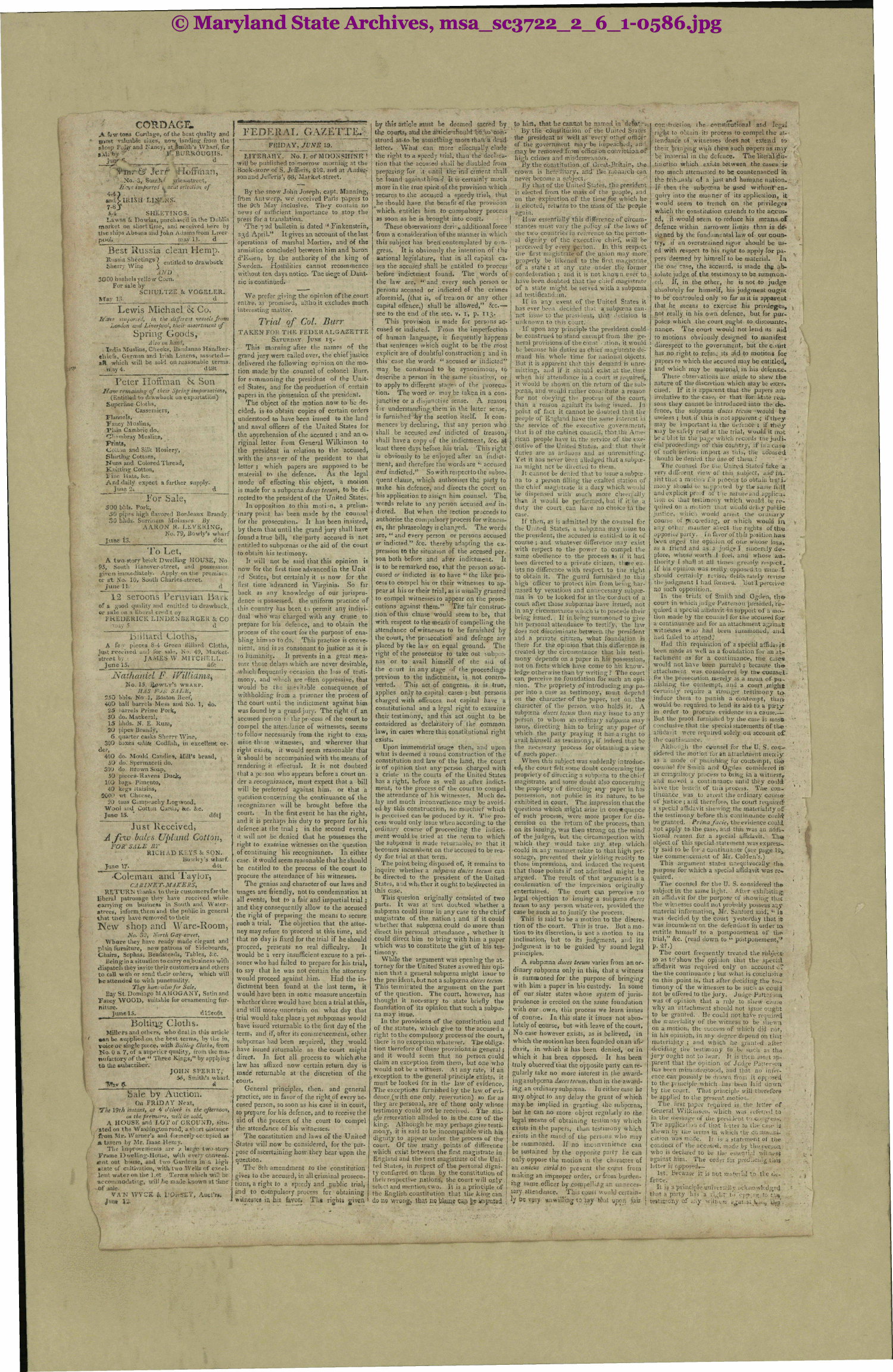
|
CORDAGE.
A few tons Cordage, of the 'ocst quality and
rimst raluaWe sines, now •landing'from the
sloop 1'ulivanil I.'ancv, at Smith's Wlisri', for
sAyby '" 1 .BURROUGHS.
_jujr % _______ ________ a___
'1*rn."6f Jerr Hoffman,.
No. 3, Stmih' tries-street,
£fo\'e imported k ftttit selection of
4,4.1 I
and^IRISHl.^.A'S.
A-i • SHEETINGS. .
Lawns St Dowlas, purchased in the Dublin
market on short time, and received here by
the ships Abeona and John Adams from Liver
pooh. may 11. d
Best Russia clean Hemp.
Russia Sheetings? ^^ d tack
sherry Wine 3
30 00 bushels yellow Corn.
For sale by
'SCHULTZE.& VOGELER.
UTav 13. d
Lewis Michael ik Co.
.hate imported, in the different vessels from
London and Liverpool, their assortment of
Spring Goods,
Also on halvl,
India Muslins, Checks, Ba.iclannO Handker-
chiefs, German and Irish Linens, assorted—
aS which will be sold on reasonable terms.
n.ny 4. d48t
Peter Hoffman &t Son
Have remaining of their Spring importations,
(Entitled to drawback on exportation)
Superfine Cloths,
Cassemiers,
Flannels,
Taney Muslins,
Plain Cambric do.
^Jhambray Muslins,
Prints,
Hill's brand, •
50 do. Spermaceti do.
30K do Brown Soap,
50 pieces-Havens Duck,
100 bags. Pimento,
40 kegs ttsusins,
200t> wt Cheese,
20 tons Cnitcachy Logwood,
Wool mid Colt.n Qar'cU, ice &c.
June 15. " eI6ti
just Recelvedi
A few bales Upland Cotton^
FOR SALE BV
RICH AD K YS Sc SON.
Bo.vlcy's wharf.
June 1£__________________________d4t
•Coleman and Taylor,
CA SINE T-MAKERS,
RETURN thanks to their customers for the
Ijberal patronage tliey have received while
Carrying on business in South and Water-
•trees, inform.them and the public in general
that tliey have removed to their
New shop and Ware-Room,
No. 33, North Gay street.
Where they have ready made elegant and
plain furniture, new patrons of Sideboards,
Chairs, Sophas; Beadsteads, Tables, &c.
Being- in a situation to carry oiVbusiness with
dispatch they invite their customers and others
to call with or send their orders, which will
fee attended to with punctuality.
They home oho for Sale.
Bay St Domingo MAHOGANY, Satin and
Fancy WOOD, suitable for ornamenting fur-
niture.
June 15.____________________dlSeo6t
Bolting Cloths.
Millers and others, who deal in this article
•sn be supplied on the best terms, by the in,
voice or single piece, with Bolting Cloths, from
No. 0 a 7, of a Snpericr quality, from the ma.
tiufactory of the " Three Kings," by appljiiig
to the subscriber.
JOHN SPERRY,
56, Smith's wharf.
ItTav ft.________________________A
Sale by Auction.
On FRIDAY Next,
I The 19th instant, at 4 o'clock in the afternoon,
Ur^jfe two-story
Frame Dwelling-House, with every conveni-
ent out bouse, and two Gardens in u high
¦tate of cultivation, with two Wells of excel-
lent water on the Lot Terms which wi.'! be
accommodating, will oe made known at time
Of sale-
VAN V.'YCK. & 1'OivS-XY, Aucl'rs.
this object, a motion
is made for a suhpeena duces tecum, to be di-
rected to the president of the United States.
In opposition to this motion, a prelim-
inary point has been made by the counsel
for the prosecution. It has been insisted,
by them that until the grand jury shall have
found a true bill, the party accused is not
entitled to subpoenas or the aid of the court
to obtain his testimony.
It will not be said that this opinion is
now for the first time advanced in the Unit
ed States, but certainly it is now for the
first time advanced in Virginia. So far
back as any knowledge of our jurispru-
dence is possessed, the uniform practice of
this country has been to permit any indivi-
dual who was charged with any crime to
prepare for his defence, and to obtain the
process of the court for the purpose of ena-
bling him so to do. This practice is conve-
niens, and is i's consonant to justice as it is
to humanity. It prevents in a great mea-
sure these delays wdiich are never desirable,
.which frequently occasion the loss of testi-
mony, and which are r-ften oppressive, that
would be the inevitable consequence of
withholding from a prisoner the process of
the court until the indictment against him
was found by a grand jury. The right of an
accused person t the process of the court to
compel the attendance of witnesses, seems
to follow necessarily from the right to exa?
mine those witnesses, and wherever that
right exists, it would seem reasonable that
it should be accompanied with the means of
rendering it effectual. It is not doubted
that a person who appears before a court un-
der a recognizance, must expect that a bill
will be preferred against him. or that a
question concerning the continuance of the
recognizance will be brought before the
court. In the first event he has the right,
and it is perhaps.his duty to prepare for his
defence at the trial ; in the second event,
it will not be denied that he possesses the
right to examine witnesses on the question
of continuing his recognizance. In either
case, it would seem reasonable that he should
be entitled to the process of the court to
procure the attendance of his witnesses.
The genius and character of our laws and
usages are friendly, not to condemnation at
all events, but to a fair and impartial trial;
and they consequently allow to the accused
the right of preparing the means to secure
such a trial. The objection that the attor-
ney may refuse to proceed at this time, and
that no day is fixed for the trial if he should
proceed, presents no real difficulty. It
would be a very insufficient excuse to a pri-
soner who had failed to prepare for his trial,
to say that he was not certain the attorney
would proceed against him. Had the in-
dictment been found at the last term, it
would have been in some measure uncertain
whether there would have been a trial at this,
and still more uncertain on what day that
trial would take place ; yet subpoenas would
have issued returnable to the first day of the
term., and if, after its commencement, other
subpoenas had been required, they would
have issued returnable as the court might
direct. In fact all process to which #the
law has affixed now certain return day is
made returnable at the discretion of the
court.
General principles, then, and general
practice, are in favor of the right of every ac-
cused person, so soon as his case is in court,
to prepare for his defence, and to receive the
aid of the process of the court to compel
the. attendance of his witnesses.
The constitution and laws of the United
States will now be considered, for the pur-
pose of ascertaining how they bear upon the
question.
The 8th amendment to the constitution
gives to the accused, in all criminal prosecu-
tions, a right to a speedy and public trial,
and to compulsory process fcr obtaining
wdriesses in his favor. Thg rights given
by this article must be deemed sacred by
the courts, aiid the article- should "be so 'con-
strued.as.to.be something more than a dead
letter.. What can more ehectually elude
the right to a speedy trial, than the declara-
tion that the accused sh.ilt be disabled from
preparing for it until the in! ctment shall
be found against him ¦: It is certainly much
more in the true spirit of the provision which
secures to.the accused a speedy trial, that
he should have the benefit of the provision
which, entitles him to compulsory process
as soon as he is brought into court.
These observations derive additional force
from a consideration of the manner in which
this subject has been contemplated by con-
gress. It is obviously the intention of the
national legislature, that in all capital es-
ses the accused shall be entitled to process
before indictment found. The words of
the law are, "and every such person or
persons accused or indicted of the crimes
aforesaid, (that is, of trea on or any other
capital offence,) shall be allowed," &c.—
see to the end of the sec. v. I, p. 113.
This provision is made for persons ac-
cused or indicted. From the imperfection
of human language, it frequently happens
I that sentences which ought to be the rriost
I explicit are of doubtful construction; and in
i this case the words " accused or indicted"
I may be construed to be synonimous, to
describe a person in the same situation', or
! to apply to different stages of the prosecu-
, tion. The word or- may be taken in a con-
junctive or a disjunctive sense. A reason
for understanding them in the latter sense,
is furnished by the section itself. It com-
mences by declaring, that any person who
shall.be accused and indicted of treason,
shall have a copy of the indictment, &c. a*
least three days before his trial. This right
is obviously to be enjoyed after an indict-
ment, and therefore the words are " accused
and indicted." So with respectto the subse-
quent clause, which authorises the party to
make his defence, and directs the court on
his application to assign him counsel. The.
words relate to any person accused and in-
dicted. But when the section proceeds to
authorise the compulsory process for witness-
es, the phraseology is changed. The words
are, " and every person or persons accused
or indicted " &c. thereby adapting the ex-
pression to the situation of the accused per.
son both before and after indictment. It
is to be remarked too, that the person so ac-
cused or indicted is to have " the like pro-
cess to compel his or their witnesses to ap-
pear at his or their trial, as is usually granted
to compel witnesses to appear on the prose-
cutions against them." The fair construc-
tion of this clause would seem to be, that
with respect to the means of compelling the
attendance of witnesses to be furnished by
the court, the prosecution and defence are
placed by the law on equal ground. The
right of the prosecutor to takeout sub
nas or to avail himself of the atu of
the court in any stage of the proceedings
previous to the indictment, is not contro-
verted. This act of congress, it is true,
applies only to capital. cases ; but persons
charged with ofFeuces not capital have a
constitutional and a legal right to examine
their testimony, and this act.ought to be
considered as declaratory of the common
law, in cases where this constitutional right
exists.
Upon immemorial usage then, and upon
what is deemed a sound construction of the
constitution and law of the land, the court
is of opinion that any person charged with
a Crime m.the courts of the United States
has a right, before as well as after indict-
ment, to the process of the court to compel
the attendance of his witnesses. Much de-
lay and much inconvenience may be avoid-
ed by this construction, no mischief which
is peiceived can be poduced by it. The pro-
cess would only issue when according to the
ordinary comse of proceeding the indict-
ment would be tried at the term to which
the subpoena is made returnable, so that it
becomes incumbent on the accused to be rea-
dy for trial at that term.
The point being disposed of, it remains to
inquire whether a subptena duces tecum can
be directed to the president of the United
States, aid whether it ought to he-directed in
this case.
This quesion originally consisted of two
parts. It was at first doubled whether a
subpoena could issue in any case to the chief
magistrate of the nation ; and if it could
whether that subpoena could do more than
direct his personal attendance , whether it
could direct him to bring with him a paper
which was to constitute the gist of his tes-
timony.
While the argument was opening the at-
torney for the United States avowed his opi-
nion that a general subpoena might issue to
the pre; ident, but not a subpoena duces tecum.
This terminated the argument on the part
of the question. The court, however, has
thought it necessary to state briefly the
foundation of its opinion that such a subpoe-
na may issue.
In the provisions of the constitution and
of the statute, which give to the accused a
right to the compulsory process of the court,
there is no exception whatever. The obliga-
tion therefore of these provisions is general;
and it would seem that no person could
claim an exception from them, but one who
would not be a witness. At any rate, if an
exception to the general principle exists, it
must be looked for in the law of evidence.
The exceptions furnished by the law of evi-
dence (with one only reservation) so far as
they are personal, are of those only whose
testimony could not be received. The sin-
gle reservation alluded to is the case of the
king. Although he may perhaps give testi-
mony, it is said to be incompatible with his
dignity to appear under the process of the
court. Of the many points of difference
which exist between the first magistrate in
England and the first magistrate of the Uni-
ted States, in respect of the personal digni-
ty conferred on them by the constitution of
their respective nations, the court will only
select and mention two. Ii is a principle of
the English constitution that the king can j
do no wrong, that no Um\< Caji be iflsBUttd •
to hirn, that he cannot be named in defet?.
'"• By the constitution of the United State's
the president as well as every oilier officer
of the government may be impeached, art '
may be removed from office on coiivicUou of
high crimes and misdemeanors.
By the constif iition.,pf. Grea.trRritain, the-
crown is hero'itary, and the 'monarch can
never become a subject.
By that of the United States, the president
is elected from the mass of the people, and
on the expiration of the time for which he
is elected, returns to the mass of the people
again.
How essentially this difference of circum-
stances must v.uy the policy of the laws of
the two countries in reference to the person-
i al dignity of the executive chief, will be
pi rceived by every person. In this respect
the first magistrate of the union may more
properly be likened to the first magistrate
of a state ; at any rate under the former
i confederation ; and it is not kno^n ever to
¦ have been doubted that t)»e chief magistrate
• of a state might be served with a subpoena
ad testificanci:'.m.
If in any event of the United States it
has ever been decided that a subpoena can-
not issue to the president^ tint decision is
unknown to this court.
If upon any principle the president could
be construed to stand exempt from the ge-
neral provisions of the const ition, it would
bs because his duties as chief magistrate de-
mand his whole time for national objects.
But it is apparent that this demand is unre-
mitting, and if it should e:Jst at tiie time
when his attendance in a court is required,,
it would be shown on the return of tin- sub-
poena, and would rather'constitute a reason
for not obeying Jhe process of the court,
than a reason against its being issued. In
point of fact it cannot be doubted that the
people of England have the same interest in
the service of the executive government}
that is of the cabinet council', thai the Ame-
rican people have in the service of the exe-
cutive of the United States, and that their
duties are as arduous and as unremitting.
Yet it lias never been alledged that a subpoe-
na might net be directed to them.
It cannot be der.ied that to issue a subpte-
na to a person filling the exalted station of
the chief magistrate is a duty which would
be dispensed with much more cheerfully
than it would be performed, but if it '>:• s
duty the court can have no choice in the
case.
If then, as is admitted by the counsel for
the United States, a subpoena may issue to
the president, the accused is entitled to it of
course ; and whatever difference may exist
with respect to the power to compel the
same obedience to the process is if it had
been directed to a private citizen, thare ex-
ists no difference with respect to tiie right
to obtain it. The guard furnished to this
high officer to protect him from being har-
rassed by vexatious and unnecessary subpoe-
nas is to be looked for in the coiduct of a
court after those subpoenas have issued, not
in any circumstance which is to precede their
being issued. If in.being summoned to give
his personal attendance to testify, the law
does not discriminate between the president
and a private citizen, what foundation is
there for the opinion that this difference is
created by the circumstance that his testi-
mony depends on a paper in his possession,
not on facts which have come to his know-
ledge otherwise than by writing ? The court
can perceive no foundation for such an opi-
nion. The propriety of introducing any pa-
per into a case as testimony', must depend
on tiie character of the paper, not oil the
character of the person who holds it. A
subpoena duces tecum then may issue to any
person to whom an ordinary subpoena may
issue, directing hi;n to bring any paper of
which the party praying it has a right to
avail hi;ii-it-li as testimony, if indeed that be
the necessary process lor obtaining a view
of such paper.
When this subject was suddenly introduc-
ed, the court felt some doubt concerning the
propriety of directing a subpoena to the chief
magistrate, and some doubt also concerning
the propriety of directing any paper in his
possession, not public in its nature, to be
exhibited in court. The impression that the
questions which might arise in con*quei:ce
of such process, were more proper for dis-
cussion on the return of the process, than
on its issuing, was then strong on the mind
of the judges, but tiie circumspection with
which they would take any step which
could in any manner relate to that high per-
sohage, prevented their yielding readily to
those impressions, and induced the request
that those points if not admitted might be
argued. The result of that argument is a
confirmation of the impression originally
entertained. The court can perceive no
legal objection to issuing a subpoena duces
tecum to any person whatever, provided the
case he such as .to justify the process.
This is said to be a motion to the discre-
tion of the court. This is true. But a mo-
tion to its discretion, is atot a motion to its
inclination, but to its judgment, and its
judgment is to be guided by sound legal
principles.
A subpoena duces tecum varies from an or-
dinary subpoena only in this, that a witness
is summoned for the purpose of bringing
with him a paper in his custody. In some
of our sister states whose system of juris-
prudence is erected on the same foundation
with our own, this process we learn issues
of course. In this state it issues not abso-
lutely of course, but with leave of the court.
No case however exists, as is believed, in
which themotionha5 been founded onan afi-
davit, in which it has been denied, or in
which it has been opposed. It has been
truly observed'that the opposite party can re-
gularly take no more interest in fhe award-
ing a suhpeena duces tecum-, than in the award-
ing an ordinary subpoena. In either case he
miy object to any delay the grant of which
may be implied in granting the subpoena,
but he can no more object regularly to the
legal means of obtaining testimony which
exists in the papers, than testimony which
exists in the mind of the persons who may
be summoned. If no inconvenience can
be sustained by the opposite party he can
only oppose the motion in the character of
an amicus curid to prevent the court from
making an improper order, or from burden-
ing same officer by t-.ompel'if-g an unneces-
sary, attendance. Tins cviui wonld'certatn-
ly be vsry unwilling (5 say btat- \jnor. fair {
con'buctioiv the- constitutional and legal
right to obtain, its process to compel the at-
tendance of witnesses does not extend to
their blinking with them such papers as may
be material in the defence. The literal dis-
tinction which exists between the cases is
too much attenuated to be countenanced in
the tribunals of a just and humane nation.
If then the subpoena be used without en-
quiry into the manner of its application, it
would seem to trench on the privilege*
which the: constitution extends to the accus-
ed, it would seem to reduce his means of
defence within narrower limits than is de-
signed by the fundamental law of our coun-
try, if an overstrained rigor should be us-
ed with respect to his right to apply for pa-
pers deemed by himself to be material. In
the one case, the accused, is made the ab-
solute judge of the testimony to be summon-
ed. If, in the other, he is not to judge
absolutely for himself, his judgment ought
to be confronted only so far as it is apparent
that he means to exercise his privileges,
not really in his own defence, bvit for pur-
poses which the court ought to discounte-
nance. The court would not lend its aid
to motions obviously designed to manifest
disrespect to the government, but thec.mrt
has no right to refuse its aid to motions for
papers to which the accused may be entitled,
and which may be material, in his defence. .
These observations are made to shew the
nature of the discretion which may be exer-
cised. If it is apparent that the papers are
irrelative to the case, or that for. bt.ite rea-
sons they cannot be introduced into the cfce-
fonce, the subptena duces tecum would ba
useless ; but if this is not apparent-; if tliey
may be important in the defence ; if rhey
may be safely reiid at the trial, would it irot
bea blot in the page which records tiie judi-
cial proceedings or this country, if in a case
of such seriou-i import as tiiij, the ae'eiiseci
should be denied the use of them ? ' •¦>¦
The counsel for the United Spates take a
very different view of this subject, aikflA.
sist that a motion fir process to obtain test i-
mony should to supported by the same t'i,U
and explicit pro t of t ie nature and applica-
tion o. that testimony which would be re-
quired on a mi.tion that would dehiy public
justice, which would aneat tiie ordinary
corns of proceeding, or which would iu
any other manner atiect the rights of the
opposite party. In favor of this position has
been urged the opinion of one whose losa,
as a friend and as a judge I sincerely de-
plore, whose1 worth 1 feel, anu whose au-
thority [ shall, at all times greally respect.
If his opinion was reaiiy opposed to mine I
should certainly re-vise, deliberately revise
the judgment I had formed. But 1 perceive
11O such opposition.
In the trials of Smith and Ogden, the
court in whichjiiige Patterson presided, re-
quired a special affidavit insuppott of a mo-
tion made by the counsel for the accused for
a continuance and for an attachment against
witnesses wao had heen summoned, and
had failed to attend.'
Had this requisition of a special affidavit
been made as well as a foundation for an at-
tachment as for a continuance, tiie c.isesi
would not have been parralel ; because th»
attachment was considered by thv counsel-
for the prosecution merely as a moan of pu-
nishing the contempt, and a court mighc
certainly require a stronger testimony to-
induce them to punish a contempt, that*
would be required to lent! its aid tu a parfv"
in order to procure evidence in a cause.-1.
But the proof furnished by the case is moso
conclusive that the speoi.d statements of the-
afSdaYJt We'te re-quired solely on account of
the coatimianee.
Although ¦ the ctnmsel for the U. S. coir—
sidered the motion for an attachment merely.
as a mode of punishing for contempt, tht>
connse' for Smith, and Ogtleu considered is
as compulsory process to bring in a witness,-
and moxe-d a continuance until they could
have the beiietit of tiiis process. Tiie con-
tinuance was to arre-st the ordinary course?
of justice; and therefore, the court rexjniiod
a special affidavit shewing the mate'riality of
the testimony before this continuance couM?
be granted. Prima facie, theevidence could,
not apply to the case, and this was an addi-
tional reason for a special affii'1-ivit. Th«»
object of this special statfiiient was express^
ly said to be for a continuance (see page IS,,
the commencement of Mr. Colden's.)
This argument states unequivocally tha
purpose for which a special affidavit was re*
quired.
Tiie counsel for the U. S>. considered tlio
subject in the same light. After exhibiting;
an affidavit for the purpose of showing tint
the witnesses could not probably possess ar.y
matoriai information, Mr. Sanford said, " lit
was decided by the court yesterday that ic
was incumbent on the defendant in order to
entitle himself to a postponement of the-
trial," &c. (read down to " postponement,;'
p. 27.)
The court frequently treated the subject-
so as tci'show the opinion that the special
affidavit was required only- on account ilT
the the continuance ; but what is conc'usi'.a
on this point is, that after deciding the to.-
timony of the witnesses to be such as could
not be offered to the jury. Judge patl: -, .1.11
was of opinion that a rule to shew cause,
why an attachment should not issue ought
to be granted. . He could not have required
the materiality of the witness to be shewn,
on a motion, the success of which did not,
in his opinion, in any degree depend on that
materiality ; and which he granted, after
deciding tiie testimony to be such as tlia
jury ought not to hear. It is then most tip-
parent that the opinion of Judge Patterson;
has been misunderstood, and that no infer-
ence can possibly be drawn from it opposed,
to the principle which has been laid down,
by the court. That principle will therefore
be applied to the present motion.
The first paper required is the letter of
General Wilkinson, which was referred to
in the message of the presi.lent to congregtj
The application of that letter to tbf/case ij
shown by the terms rtl which the CGtiwtuni-
cation was made. It is a statement of the
conduct of the accused, made by the person
who is declared to be the essentia! witness
against him. The order for pfocuiciijg this
letter is oppose!,—
1st. Because it is not matvriaj to the |