 |
|
|
 |
|
 |
|
|||
|
||||
|
||||
|
Maryland State Archives Maryland Colonization Journal Collection MSA SC 4303 msa_sc4303_scm11070-0045 Enlarge and print image (5M) |
|
|
|
|
|
|
|
|||
|
||||
|
||||
|
Maryland State Archives Maryland Colonization Journal Collection MSA SC 4303 msa_sc4303_scm11070-0045 Enlarge and print image (5M) |
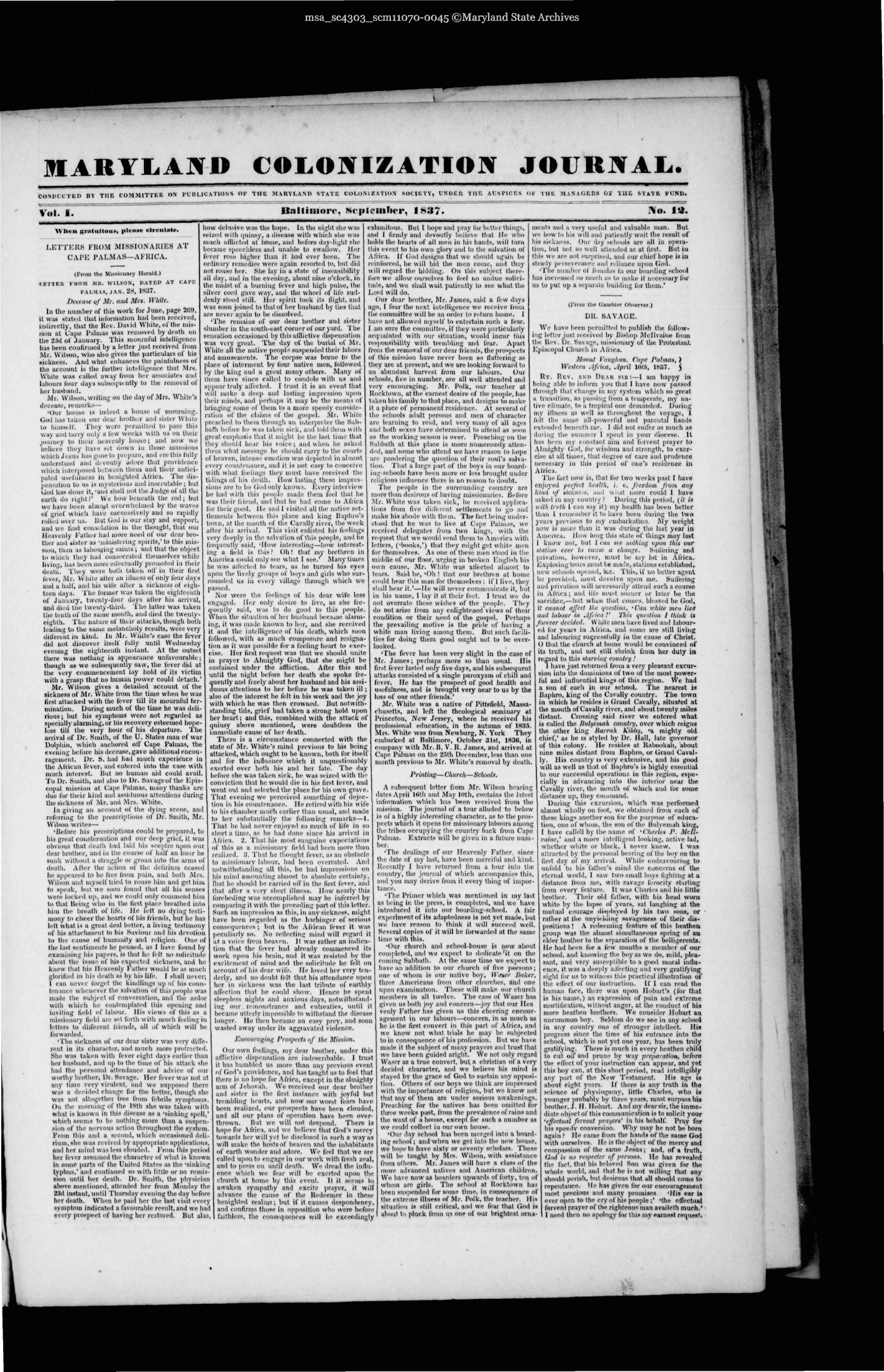
| MARYLAND COLONIZATION JOURNAL. CONDUCTED BY THE COMMITTEE ON PUBLICATION S OF THE MARYLAND STATE COLONIZATION SOCIETY, UNDER THE AUSPICES OF THE MANAGERS OF THE STATE FUND. Vol. I. Baltimore. September, 1837. No. 12. When gratuitous, please circulate. LETTERS FROM MISSIONARIES AT CAPE PALMAS—AFRICA. (From the Missionary Herald.) LETTER FROM MR. WILSON, DATED AT CAPE PALMAS, JAN. 28, 1837. Decease of Mr. and Mr: White. In the number of this work for June, page 269, it was stated that Information had been received, indirectly, that the Rev. David White, of the mis- sion at Cape I'almas was removed by death on the 2dd of January. This mournful intelligence has been confirmed by a letter just received from Mr. Wilson, who abe gives the particular* of his sickness. And what enhances the painlulness of the account is the furthei intelligence that Mrs. White wits called away from kef associates and labour! four days subs, qui ntly to the removal of her husband. Mr. Wilson, writing on the day of Mrs. White'! decease, remarks— •Our house is indeed a house of mourning. God has taken our dear brother and sister While to himsell. They were permitted to pass tliis way and tarry only a few weeks with us ou their journey to Weir Heavenly home; and now we believe they have set down in those mansion! which Jesus has gone to prepare, and ere this fully understand and devoutly adore that providence which interposed between them and their antici- pated usefulness in benighted Africa, pensatiou to us is mysterious The dis- aud inscrutable; but God has done it,-anil shall not the Judge of all the earth do right:' We bow beneath the rod; but we have been almost overwhelmed by the waves of grief which have successively and so rapidly rolled over us. Hut God is our slay and support, and we find consolation in the thought, that oui Heavenly Father had more need of our dear bro- ther and sister as •ministering spirits,' to this mis- sion, than as labouring saints ; and that the object to Which they had consecrated themselves while living, has been more eileclu.dly promoted in their death. They were both taken oil' in their fust fever, Mr. While alter an illness of only four days and a half, and his wile alter a sickness ol eigh- teen dais. The loriuer was taken the eighteenth of January, twenty-lour days after his arrival, and died tlie twenty-third. The latter was taken the tenth of the same month, and died the twenty- eighth. The nature of their attacks, though both leading to the same melancholy results, were very diiicnuliii kind. In Air. White's MM the fever did not discover ilself fully until Wednesday evening the eighteenth instant. At the outset there was nothing in appearance unfavourable; though as we subsequently saw, the fever did at the very commencement lay hold of its victim with a grasp that no human power could detach.1 Mr. Wilson gives a detailed account of the sickness of Mr. White from the time when he was fust attacked with the lever till its mournful ter- mination. During much uf the time lie was deli- rious ; but his symptoms were not regarded as specially alarming, or his recovery esteemed hope- less till the very hour of his departure. The arrival of Dr. Smith, of the U. Slates man of war Dolphin, which anchored oil' Cape "almas, the evening before his decease, gave additional encou- ragement. Dr. S. had bad much experience in the African fever, and entered into the case with much interest, lint no human aid could avail. To Dr. Smith, and also lo Dr. Savage of the F.pis- copal mission at Cape Paluias, many thanks are due for their kind and assiduous attentions during the sickness of Mr. and Mrs. White. In giving an account of the dying scene, and referring to the prescriptions ol Dr. Smith, Mr. Wilson writes— 'Before his prescriptions could be prepared, to his great consternation and our deep grief, it was obvious that death had laid his sceptre upon out dear brother, and in the course of half an hour he sunk without a struggle or groan into the arms of death. Alter the action of the delirium ceased lie appeared to he free from pain, and both .Mrs. Wilson and myself tiled to rouse him and get him to speak, but we soon louud that all hi- senses were locked up, and we could only commend him to that Being who in the fust place breathed into him the breath of life, lie left no dying testi- mony to cheer the hearts of his friends, but he has left what is a great deal hetler, a living testimony of his attachment lo bis Savioin and his devotion lo the cause of humanity ami religion Due of the l.ist sentiments he penned, as I have found by examining his papers, is that he felt no solicitude about the issu.- of his expected sickness, and he knew that his Heavenly Falhci would be as much glorified in his death as by his life. I shall never; 1 can never forget the kindlings up of his coun- tenance whenever the salvation of this people was made the subject ol conversation, and the ardor with which he contemplated this opening and inviling field of labour. His views of this as a missionary field are set forth with much feeling in letters to different friends, all of which will he forwarded. 'The sickness of our dear sister was very dill'e- rent in its character, and much more protracted. She was taken with fever eight days earlier than her husband, and up to the time of his attack she had the personal altendance and advice of our worthy brother, Dr. Savage. Her lever WU not at any time very virulent, and we supposed there was a decided change for the better, though sin- was not altogether free from bdirile symptoms, tin the morning of the IStfe she was taken with what is known in this disease as a 'sinking spell,' which seems to be nothing more than a suspen- sion of the nervous action throughout the system From this and a second, which occasioned deli- rium, she was revived by appropriate applications, and her mind was less clouded. From this period her fever assumed the rhar.ieter of what is known in some parts of the United States as the 'sinking typhus,' and continued so with little or no remis- sion until her death. Dr. Smith, the physician above mentioned, attended her from Monday the 23d instant, until Thursday evening the day before her death. When Iip mm her the last visit every symptom indicated a favourable result, and we had every prospect of having her restored. But alas, how delusive was the hope. In the night she was seized wilh quinsy, a disease with which she was much afflicted at home, and before daylight she became speechless and unable to swallow. Her fever rose higher than it had ever been. The ordinary remedies were again resorted to, but did not rouse her. She lay in a state of insensibility all day, and in the evening, about nine o'clock, in the midst of a burning fever and high pulse, the silver cord gave way, and the wheel ol life sud- denly stood still. Her spirit took its Bight, and was soon joined to that of her husband by ties that are never again to be dissolved. 'The remains of our dear brother and sister slumber in the south-east corner of our yard. The sensation occasioned by this afflict!V* dispensation was very great. The day of the burial of Mr. White all the native people suspended their labors and amusements. The corpse was borne to the place of Interment by tour native men, followed by the king and a great many others. Many of them have since called to condole with u* and appear truly affected, 1 trust it is an event that will make a deep and lasting impression upon their minds, and perhaps it may be the means of bringing some of them to a more speedy conside- ration of the claims of the gospel. Air. White preached to them through an interpreter the Sab- barli before he was taken sick, and told them with great emphasis that it might he the last lime that they should hear his voice; and when he asked them what message be should carry to the courts of heaven, intense emotion was depicted in almost every countenance, and it is not easy lo conceive with what feelings they must have received the tidings of his death, flow listing these impres- sions are to be God only knows. Kvery interview be had with this people made them leel that be was their friend, and that he had come to Africa for their good. Hi.- and 1 visited all the native set- tlements between this place and king Bapbro'a town, at the mouth of the Cavully river, the week alter his arrival. This visit enlisted his feelings very deeply in the salvation of this people, and he frequently said, 'How interesting—how interest- ing a held is this? Oh! that my brethren in America could only see what I see.' Many times he was allbcted to tears, M be turned bis eyes upon the lively groups of boys and girls who sur- rounded us in every village through which we passed. Nor were the feelings of his dear wife less engaged. Her only desire lo live, as she fre- quently said, was to do good to this people. When the situation of her husband became alarm- ing, it was made known to her, and she received il and the intelligence of his death, which soon followed, wilh as much composure and resigna- tion as it was possible for a feeling heart to exer- cise. Her first request was that we should unite in prayer to Almighty God, that she might be sustained under the alllictinn. Alter this and until the night before her death she spoke fre- quently and freely about her husband anil his assi- duous attentions to her before he was taken ill; also of the interest he felt in bis work and the joy with which he was then crowned. Hut notwith- standing this, grief bad taken a strong bold upon her heart; and this, combined with the attack of quinsy above mentioned, were doubtless the Immediate cause of her death. There is a circumstance connected with the state of Mr. White's mind previous to his being attacked, which ought to he known, both for itself and for the Influence which it unquestionably exerted over both his and bei fate. The day before she was taken sick, he was seized with tie' conviction that he would die in his first lever, and went out and selected the place for his own grave. That evening we perceived something of dejec- tion in his countenance. He retired with his wife to his chamber much earlier than usual, and made to her substantially the following remarks—1. That be had never enjoyed so much of life in so short a time, as he had done since his arrival in Africa. 2. That his most sanguine expectations of this as a missionary field had been more than realized. Ii. That he thought fever, as an obstacle to missionary taboor, had been overrated. And notwithstanding all this, he had impressions on his mind amounting almost to absolute certainty. tint he should be carried oil'in the fust lever, and that after a very short illness. ||,>w nearly this foreboding was accomplished may be inferred by comparing it wilh the preceding part of this letter. Such an impression as this, in any sickness, might have been regarded as the harbinger of serious consequences] but in the African fever it was peculiarly so. No reflecting mind will regard it as a voice from heaven. It was rather an indica- tion that the fever had already commenced its work upon his brain, and it was resisted by the excitement of mind and the solicitude he felt ou account of his dear wile. He loved her very ten- derly, and no doubt felt that his attendance upon her in sickness was the last tribute id' earthly affection that he could show. Hence lie spent sleepless sights and anxious days, notwithstand- ing our remonstrance and entreaties, until it became utterly impossible lo withstand the disease longer. He then became an easy prey, and soon wasted away under its aggravated violence. Encouraging Prospects of the Mission. Our own feelings, my dear brother, under this afflictive dispensation lire indescribable. 1 trust it has bumbled us more than any previous event nf God'l providence, and has taught us to feel that there is no hope for Africa, except in the almighty arm of Jehovah. We received our dear brother and Mster in the first instance with joyful hut trembling hearts, and now our worst fears have been realized, our prospects have been clouded, and all our plans of operation have been over- thrown. But we will not despond. There is hope for Africa, and we believe that Clod's mercy towards her will yet be disclosed in such a way as will make the hosts of heaven and the inhabitants of earth wonder and adore. We feel that we are called upon to engage in our work with fresh zeal, and to press on until death. We dread the iullu- ence which We fear will be exerted upon the church at home by this event. II it seems In awaken sympathy and excite prayer, it will advance the cause of the Redeemer in these benighted realms; but if it causes despondency, and confirms those in opposition who were before faithless, the consequences will he exceedingly calamitous. Hut I hope and pray lor better things, and 1 firmly and devoutly believe that He who holds the hearts of all men in his hands, will turn this event to his own glory and to the salvation of Alrica. If t.'od designs that we should again he reinforced, hi: will bid the men come, and they will regard the bidding. On this subject there- fore we allow ourselves to leel no undue solici- tude, and we shall wait patiently to see what the Lord will do. Our dear brother, Mr. James, said a Ccw days ago, I fear the next intelligence we receive from the committee will be an order to return home. 1 have not allowed myself to entertain such a fear. f am sure the committee, if they were particularly acquainted with our situation, would incur this responsibility with trembling and fear. Apart from the removal of our dear friends, the prospects of this mission have never been so Battering as they are at present, and we are looking forward to an abundant harvest from our labours. Our schools, five in number, are all well attended and very encouraging. Mr. Polk, our teacher at Rocktown, at the earnest desire of the people, has taken his family to that place, and designs to make it a place of permanent residence. At several of tin- schools adult persons and men of character are learning to read, and very many of all ages and both sexes have determined to attend as soon as the working season is over. Preaching on the Sabbath at this place is more numerously atten- ded, and some who attend we have reason to hope are pondering the question of their soul's salva- tion. That a large part of the boys in our board- ing schools have been more or less brought under religious influence there is no reason to doubt. The people in the surrounding country arc more than desirous of having missionaries. Before Mr. White was taken sick, he received applica- tion from five different settlements lo go and make his abode with tin in. The fact being under- stood that he was to live at Cape Paluias, we received delegates from two kings, with the request that we would send them to America with loiters, ('hooks,') that they might get white men for themselves. As one of these men stood in the middle of our tloor. urging in broken English his own cause, Mr. White was affected almost to tears. Said he, 'Oh ! that our brethren at home could hear this man for themselves : if 1 live, they shall hear it.'—He will never communicate it, but in his name, 1 lay it at their feet. I trust we do not overrate these wishes of the people. They do notarise from any enlightened views of their condition or their need of the gospel. Perhaps the prevailing motive is the pride of having a white man living among them, llut such facili- ties for doing them good ought not to be over- looked. 'The fever has been very slight in the case of Mr. James; perhaps more so than usual. His first fever lasted only live days, and his subsequent attacks consisted of a single paroxysm of chill and fever. He has the prospect of good health and usefulness, and is brought very near to us by the loss of our other friends.' Mr. White was a native of Pittsfield, Massa- chusetts, and left the theological seminary at Princeton, New Jersey, where he received his professional education, in the autumn of 1835. Mrs. White was from Newburg, N. York They embarked at Haltimore, October 31st, 1S3(>, in company with Mr. B. V. 11. James, and arrived at Cape Paluias ou the tfith December, less than one month previous to Mr. White's removal by death. Printing—Church—Schools. A subsequent letter from Mr. Wilson bearing dales April Kith and May lllth, contains the I itest information which has been received from the mission. The journal of a tour alluded to below is of a highly interesting character, as to the pros- pects which it opens for missionary labours among the tribes occupying the country back from Cape I'almas. F.xtracts will be given in a future num- ber. 'The dealings of our Heavenly Father, since the date of my last, have been merciful and kind. Recently I have returned from a tour into the country, the journal of which accompanies this, and you may derive from it every thing of impor- tance. 'The Primer which was mentioned in my last as being ie. the press, is completed, and we have introduced it into our boarding-school. A fair experiment of its adaptedness is not yet made, but we have reason to think it will succeed well. Several copies of it will be forwarded at the MM time with this. •Our church and school-house is now about Completed, and WS expect to dedicate'it on the coming Sabbath. At the same time we expect to have an addition to our church of live persons; one of whom is our native boy, Wither linker, three Americans from other churches, and one upon examination. These will make our church members in all twelve. The rase of Waser has given us both joy and concern—joy that our Ilea venly Father iias given us this cheering encour- agement in our labours—concern, in as much as he is the first convert in this part of Africa, and we know not what trials he may be subjected to in consequence of his profession. Hut we have made it the subject of many prayers and trust thai we have been guided aright. \Ve not only regard Waser as a true convert, but a christian of a very decided character, and we believe his mind is staved by the grace of God to sustain any opposi- tion. Others of our boys we think are impressed with the importance of religion, but we know not that any of them are under serious awakenings. Preaching for the natives has been omitted lor three weeks past, from the prevalence of rains and the want of a house, except for such a number us we could collect in our own house. 'Our day school has been merged into a board- ing school; and when we get into the new house, we hope to have sixty or seventy scholars. These will be taught by Mrs. Wilson, with assist mes from others. Mr. James will have a class of the more advanced natives and American children. We have now as boarders upwards of forty, ten of whom are girls. The school at Rocktown has been suspended for some time, in consequence of the extreme illness of Mr. Polk, the teacher. His situation is still critical, and we fear that God is about to pluck fnuii us one of our brightest orna- ments and a very useful and valuable man. But we how to bis will and patiently wait the result of his sickness. Our day schools are all in opera- tion, hut not so well attended as at first. But in this we are not surprised, and our chief hope is in steady perseverance and reliance upon Gou. 'The number of females in our boarding school has increased so much as to make il necessary lor us to put up a separate building for them.' (From the Gambler Observer.) DR. SAVAGE. Wo have been permitted to publish the follow- ing latter jutt received by Bishop Mellriiot (ron the Il'-v. Dr. Savage, missionary of the Protestant Episcopal Church in Africa. Mount Vaughan. Cape Palmas Western Africa, April 10th, 1837.j Rt. Rev. and Dear sir:—I am happy in being able to inform you that I have now passed through dial change in my system which to great a transition, as peeling from • temperate, my na- tive climate, to a tropical one demanded. During my illness as well as throughout the voyage, 1 fell tin? same all-powerful and parental bauds extended beneath me. I did not suffer as much M during the summer I (pent in your diocese. H has been my constant aim and fervent prayer to Almighty Ood, for wisdom and Itrength, to exer- cise at ail times, that degree of care ami prudence necessary in this period of one's residence in Africa. The fact now is, that for two weeks past I have enjoyed perfect health, i. e, freedom from any kind of sickness, and what more couid I have asked in any country ! Daring this period, [U is with trutU lean say it) my health has been better than 1 remember it to have been daring the two years previous to my embarkation. i\ly weight now is more llian it was during the last year in America. How wag this state of thing! may last 1 know not, but I can see nothing upon this our station ever to cause a change. Buttering and privation, however, must be my lot in Africa. Kxploiing tours must be made, stations established, new schools opened, is,c. This, if no better agent be provided, must devolve upon me. Buttering and privation W ill necessarily attend such a course in Africa; and lite must sooner or later he tho sacrilice,— hut when that comes, bleated be God, it cannot nfl'tel the yueslion, 'Can white men lice ami labour in Jfrica .'' Thin uuation I think it forecer decided. White men have lived anil labour- ed for years in Africa, and some are still living and labouring successfully in the cause of Christ. O that the church at home would be convinced of its broth, ami not still shrink from her duty in regard to this •tarviM country .' 1 have just returned from a very pleasant excur- sion into the dominions of two of the most power- ful and inlluenlial kings of this region. We had a son of each in our school. The nearest is liaphro, king of the Cavally country. The town in which be resides is Grand Cavally, situated at the mouth of Cavally river, and about twenty miles distant. Crossing said river we entered what is called the Hiilijema/i country, over which reigns the other king Harrali Kibby, 'a mighty old chief,' as he is styled by Dr. Hall, late governor of this colony, lie resides at liabookah, about nine miles distant from Bapbro, or Crand Caval- ly. His country is very extensive, and his good w ill as well as that of Uaphro's is highly essential to our successful operations in this region, espe- cially in advancing into the interior near the Cavally river, the mouth <>f which and tor some distance up, they command. Dating this excursion, which was performed almost wholly on loot, we obtained from each of these kings another son for the purpose of educa- tion, one of whom, the son of the Bulveui.ih king, I have called by the name of 'Chart** I'. Mrtl- mine,' and a more intelligent looking, active lad, whether white or black, I never knew. I was attracted by the personal bearing of the boy on the first day of my arrival. While endeavouring to untold to his father's mind the concerns of the eternal world, I saw two small boys lighting at a distance from me, with savage ferocity starting from every feature. It was C barbs and his littlo brother. Their old father, with his head worn white by the lapse of years, sat laughing at the mutual courage displayed by bis two sons, or rather at the unyielding savugenegs of their dis- positions! A redeeming feature of this heathen group was ttie almost simultaneous spring of an ilder brother to the separation of the belligerents. He had been for a few months a member of our school, and knowing the boy as we do, mild, plea- sant, and very susceptible to a good moral inllu- ence, it was a deeply a,feeling and very gratifying sight tor us to witness this practical illustration of the effect of our instruction. If I can read tho human face, there was upon Hobart's (lor that is his name,) an expression of pain and extreme mortification, without auger, at the conduct of his more heathen brothers. We consider Hobart an uncommon boy. Seldom do we see in any school in any country one of stronger intellect. His progress since the time of his entrance into the school, which is not yet one year, has been truly gratifying. There is much in every heathen child to cut oil'and prune by way preparation, before the ell'ect of your instruction can appear, and yet this hoy can, at this short period, read intelligibly any part of the New Testament. His age is about eight HBl If there is any truth in the science of physiogomy, little Charles, who is younger probably by three years, must surpass his brother. J. H. Hobart. And my dear sir, the imme- diate object of this communication is to solicit your "effectual fervent prayers' in his behalf. Pray for his speedV conversion. Why may he not be born again? He came from the hands of the same God with ourselves. He is the object of the mercy and compassion of the same Jesus; and, of a truth, God is no respecter of persons. He has revealed the fact, that his beloved Son was given for the whole world, and that he is not willing that any should pariah, but desirous that all should come to repent nice, lie has given for our encouragement most precious and many promises 'His ear is ever open to the cry of bis people ;' 'the effectual fervent prayer of the righteous man availeth much.' 1 n.....I then no apology for this my earnest request. |