 |
|
|
 |
|
 |
|
|||
|
||||
|
||||
|
Maryland State Archives Maryland Colonization Journal Collection MSA SC 4303 msa_sc4303_scm11070-0082 Enlarge and print image (4M) |
|
|
|
|
|
|
|
|||
|
||||
|
||||
|
Maryland State Archives Maryland Colonization Journal Collection MSA SC 4303 msa_sc4303_scm11070-0082 Enlarge and print image (4M) |
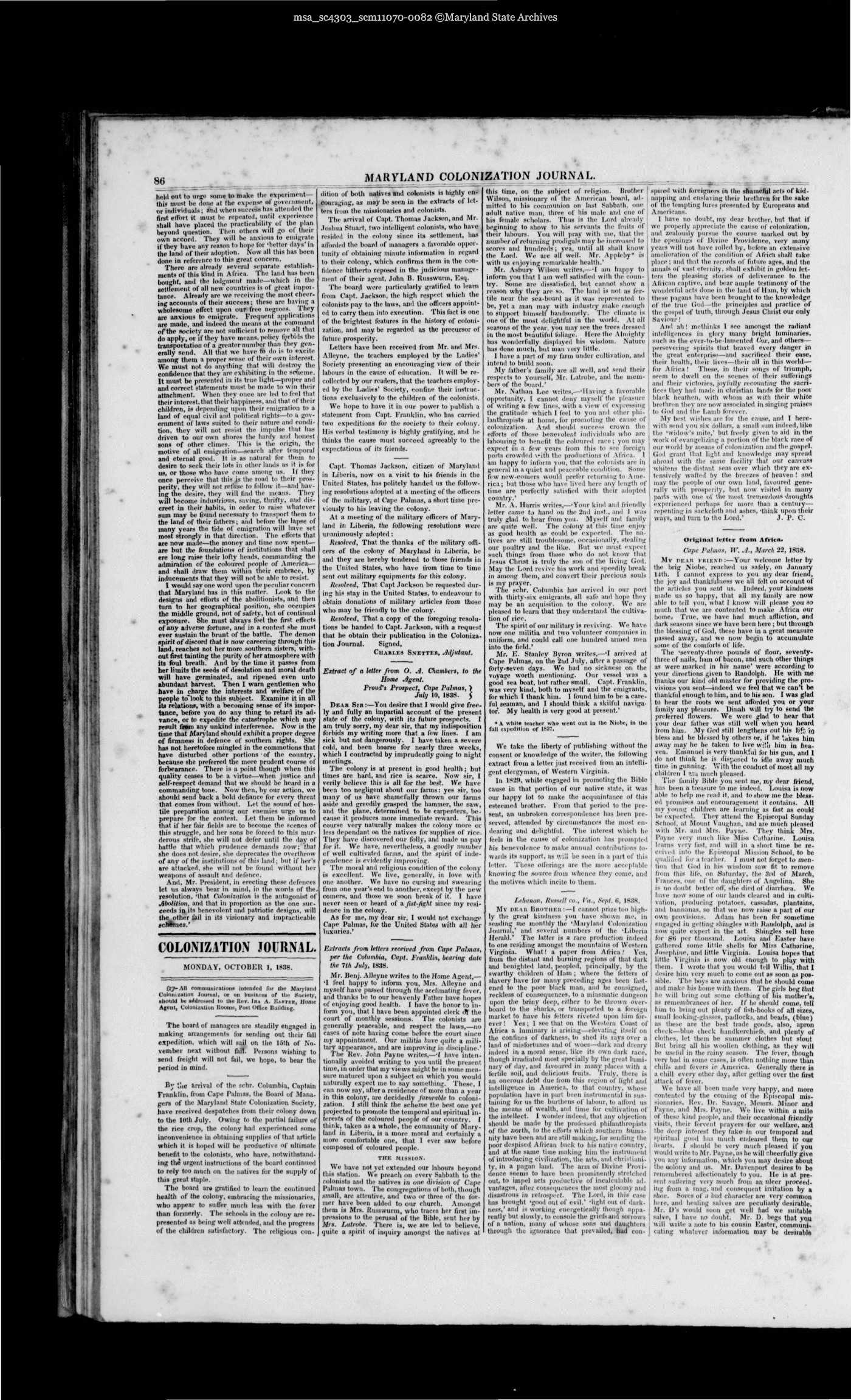
| 86 held out to urge some to make the experiment— this must be done ,,t the expense ol government, or indiviiluals; and when success has attended the first effort it must ho repeated, until experience shall haye placed the practicability ol the plan beyond question. Then others will go ol their own accord. They will he anxious to emigrate if they have any reason to hope for •better days' in the land of their adoption. Now all this has been done in reference to this great concern. There are already several separate establish- ments of this kind in Africa. The land has beet) bought, and the lodgment made—which in the settlement of all new countries is of great itnpoi- tance. Already are we receiving the most cheer- ing accounts of their success; these are having a wholesome clfect upon our free negroes. They are anxious to emigrate. Frequent application! are made, and indeed the means at the command of the society are not sufficient to remove all that do apply, or if they have means, policy forbids the transportation of a greater number than they gen- erally send. All that we have to do is to excite among them a proper sense of their own interest. Wc must not do anything that will destroy the confidence that they'are exhibiting in the scheme It must be presented in its true light—proper and and correct statements must be made to win their attachment. When they once are led to feel that their interest, that their happiness, and that of their children, is depending upon their emigration to a land of equal civil and political rights—to a gov- ernment of laws suited to their nature and condi- tion, thev will not resist the impulse that has driven to our own shores the tiiirdv and honest sons of other climes. This is the origin, the motive of all emigration—.search after temporal and eternal good. It is as natural for them to desire to seek their lots in other lands as it is for us, or those who have come among us. ll they once perceive that this is the road to their pros- perity, they will not refuse to follow it—and hav- ing the desire, they will find the mi ans. They will become industrious, saving, thrifty, and dis- creet in their habits, in order to raise whatever sum may be tbuud necessary to transport them to the lancf of their fathers; and before the lapse of many years the tide of emigration will have set most strongly in that direction. The efforts that are now made—the money ami time now spent— are but the foundations of institutions that shall ere long raise their lofty heads, commanding the admiration of the coloured people of America— and shall draw them within their embrace, by inducements that they will not he able to resist. I would say one word upon the peculiar concern that Maryland has in this matter. Look to the designs and etibrts of the abolitionists, and then turn to her geographical position, she occupies the middle ground, not of safety, but id' continual exposure. She must always feel the first etfects of any adverse fortune, and in a contest she must ever sustain the brunt of the battle. The demon spirit of disconl that is now careering through this land, reaches not her more southern sisters, with- out first tainting the purify of her atmosphere with its foul breath. And by"the time it passes from her limits the seeds of desolation and moral death will have germinated, and ripened even unto abundant harvest. Then I warn gentlemen who have in charge the interests and welfare of the people to'look to this subject. Examine it in all Jts relations, with a becoming sense of its impor- tance, before you do any thing to retard its ad- vance, or to expedite the catastrophe which may result from any unkind interference. Now is the time that Mary land should exhibit a proper degree of firmness in defence of southern rights. She has not heretofore mingled in the commotions that have disturbed other portions of the country, because she preferred the more prudent course of forbearance. There is a point though when this quality ceases to be a virtue—when justice and self-respect demand that we should bo heard in a commanding tone. Now then, hy our action, we should send back a bold defiance for every threat that comes from without. Let the sound of hos- tile preparation among our enemies urge us to prepare for the contest. Let them be informed that if her fair fields are to become the scenes of this struggle, and her sons he forced to this mur- derous strife, she will not defer until the day of battle that which prudence demands now; that she does not desire, she deprecates the overthrow of any of the institutions of this land ; but if her's are attacked, she will not be found without her weapons of assault and defence. And, Mr. President, in erecting these defences let us always bear in mind, in the words of the. resolution, 'that Colwiiztitiim is the antagonist of Abolition, and that in proportion as the one suc- ceeds hi its benevolent and patriotic design.;. will the other fail in its visionary and impracticable schemes.' MARYLAND COLONIZATION JOURNAL. COLONIZATION JOURNAL. MONDAY, OCTOBER 1, 1838. All communications intended for the Maryland Colonization Journal, or on business of the Society, should be addressed to the Rev. Ira A. EASTER, Home Agent, Colonization Rooms, Post office Building. The board of managers are steadily engaged in making arrangements for sending out their fall expedition, which will sail on the 15th of No- vember next without fall. Persons wishing to send freight will not fail, we hope, to bear the period in mind. By the Arrival of the schr. Columbia, Captain Franklin, from Cape I'almas, the Hoard of Mana. gers of the Maryland State Colonization Society, have received despatches from their colony down to the 10th July. Owing to the partial failure of the rice crop, the colony had experienced some inconvenience in obtaining supplies of that article which it is Imped will be productive of ultimate benefit to the colonists, who have, notwithstand- ing the urgent instructions of the board continued to rely too much on the natives for the supply of this great stiiple. The board are gratified to learn the continued health of the colony, embracing the missionaries, who appear to suffer much less with the fever than formerly. The schools in the colony are re- presented as being well attended, and the progress of the children satisfactory. The religious con- ditioti of both natives and colonists is highly en- couraging, as may be seen in the extracts of let- ters from the missionaries and colonists. The arrival of Capt. Thomas Jackson, and Mr. Joshua Stuart, two intelligent colonists, who have resided in the colony since its settlement, has airorded the board of managers a favorable oppor- tunity of obtaining minute information in regard to their colony, which confirms them in the con- fidence hitherto reposed in the judicious manage- ment of their agent. John B. Kusswurm, Esq. The board were particularly gratified to learn from Capt. Jackson, the high resp'ct which the colonists pay to the laws, and the officers appoint- ed to carry them into execution. This fact is one of the brightest features in the history of coloni- zation, and may be regarded as the precursor of future prosperity. Letters have been received from Mr. anil Mrs. Alleyne, the teachers employed by the Ladies' Society presenting an encouraging view of their labours in the cause of education. It will be re- collected by our readers, that the teachers employ- ed by the Ladies' Society, confine their instruc- tions exclusively to the children of the colonists. We hope to have it in our power to publish a statement from Capt, Franklin, who has carried two expeditions for the society to their colony. His verbal testimony is highly gratifying, and he thinks the cause must succeed agreeably to the expectations of its friends. Capt. Thomas Jackson, citizen of Maryland in Liberia, now on a visit to his friends in the United States, has politely handed us the follow- ing resolutions adopted at a meeting of the officers of the military, at Cape Palmas, a short time pre- viously to his leaving the colony. At a meeting of the military officers of Mary- land in Liberia, the following resolutions were unanimously adopted; Resolved. That the thanks of the military offi- cers of the colony of Maryland in Liberia, be and they are hereby tendered to those friends in the United States, who have from time to time sent out military equipments for this colony. Resolved, That Capt Jackson be requested dur- ing his stay in the United Xtat«9, to endeavour to obtain donations of military articles (mm those who may be friendly to the colony. Resolved, That a copy of the foregoing resolu- tions be handed to Capt. Jackson, with a request that he obtain their publication in the Coloniza- tion Journal. Signed, Charles Snetter, Adjutant. Extract of a letter from O. A. Chambers, to the Home Agent. Proud's Prospect, Cape Palmas, July 10, 1838. Dear Sir :—You desire that I would give free- ly and fully an impartial account of the present state of the colony, with its future prospects. 1 am truly sorry, my dear sir, that my indis]iosition forbids my writing more that a few lines. I am sick hut not dangerously. I have taken a severe cold, and been hoarse for nearly three weeks, which I contracted by imprudently going to night meetings. The colony is at present in good health; but times are hard, and rice is scarce. Now sir, 1 verily believe this is all for the best. We have been too negligent about our farms : yes sir, too many of us have shamefully thrown our farms aside and greedily grasped the hammer, the saw, and the plane, determined to be carpenters, be- cause it produces more immediate reward. This course very naturally makes the colony more or less dependant on the natives for supplies of rice. They have discovered our folly, anil made us pay for it. We have, nevertheless, a goodly number of well cultivated farms, and the spirit of inde- pendence is evidently improving. The moral and religious condition of the colony is excellent. We live, generally, in love with one another. We have no cursing and swearing from one year's end to another, except by the new comers, and those we soon break of it. I have never seen or heard of a fist-fight since my resi- dence in the colony. As for me, my dear sir, I would not exchange Cape I'almas, for the United States with all her luxuries.' Extracts from letters received from Cape Palmas, per the Columbia, Capt. Franklin, bearing date the 7th July, 1838. Mr. Benj. Alleyne writes to the Home Agent,— 'I feel happy to inform you, Mrs. Alleyne and myself have passed through the acclimating fever, and thanks be to our heavenly Father have hopes of enjoying good health. I have the honor to in- form you, that I have been appointed clerk i»' the court of monthly sessions. The colonists arc generally peaceable, and respect the laws,—no cases of note having come before the court since my appointment. Our militia have quite a mili- tary appearance, and are improving in discipline.' The Rev. John Payne writes,—'I have inten- tionally avoided writing to you until the present time, in order that my views might be in some mea- sure matured upon a subject on which you would naturally expect me to say .something. These, I can now say, alter a residence of more than a year in this colony, are decidedly faenrable to coloni- zation. 1 still think the scheme the best one yet projected to promote the temporal and spiritual in- terests of the coloured people of our country. I think, taken as a whole, the community of Mary- land in Liberia, is a more moral and certainly a more comfortable one, that 1 ever saw before composed of coloured people. THE MISSION. We have not yet extended our labours beyond this station. We preach on every Sabbath to the colonists and the natives in one division of Cape Palmas town. The congregations of both, though small, are attentive, anil two or three of the tor mer have been added to our church. Amongst them is Mrs. Russwurm, who traces her first im- pressions to the perusal of the Bible, sent her by Mrs. Latrobe. There is, we are led to believe, quite a 3pirit of inquiry amongst the natives at this time, on the subject of religion. Brother Wilton, missionary of the American hoard, ad- mitted to his communion on last Sabbath, one adult native man, three of his male and one of his female scholars. Thus is the Lord already I beginning to show to his servanls the fruits ol their labours. You will pray with me, that the number of returning prodigals may be increased lo scores and hundreds; yea. until all shall know the Lord. We are all well. Mr. Appleby* is with us enjoying remarkable health.' Mr. Asbury Wilson wiitcs,—•( am happy to inform you that I am well satisfied with the coun- try. Some are dissatisfied, but cannot show a reason why they are so. Tin- laud is not as tor- tile near the sea-board as it was represented to be, yet a man may with industry make enough to support himself handsomely. 'The climate is one ol the most delightful in'the world. At all seasons of the year, you may see the trees dressed in the most beautiful foliage. Here the Almighty has wonderfully displayed his wisdom. Nature has done much, but man very little. 1 have a part of my faun under cultivation, and intend to build soon. My father's family are ill well, and send their respects to yourself) Mr. Latrobe, and the mem- bers of the board.' Mr. Nathan Lee writes,—'Having a favorable opportunity, 1 cannot deny myself the pleasure of writing a few lines, with a view of expressing the gratitude which 1 feel to yon and other phi- lanthropists at home, for promoting the cause of colonization. And should sneeess crown the efforts of those benevolent individuals who are labouring to benefit thi'coloured race; you may expect in a lew years from this to see foreign ports crowded vith the production! of Africa. 1 am happy to inform you, that the colonists are in general in a quiet and peaceable condition, Some few new-comers would prefer returning to Ame- rica ; but those who have lived here any length of time are perfectly satisfied with their adopted country.' Mr. A. Harris writes,—'Your kind and friendly letter came to hand on the 2nd inst.. and I ms truly glad to hear from you. Myself and family are quite well. The colony at this time enjoy as good health as could be expected. The na- tives are still troublesome, occasionally, stealing our poultry and the like, lint we must expeel such things from those who do not know that Jesus Christ is truly the son of the living God. May the Lord revive his work ami speedily break in among them, ami convert their precious souls is my prayer. The schr. Columbia has arrived in our port with thirty-six emigrants, all safe and hope they may be an acquisition to the colony. We are pleased to learn that they understand the cultiva- tion of rice. The spirit of our military is reviving. We have now one militia and two volunteer companies hi uniform, and could call one hundred armed nun into the field.' Mr. E. Stanley Byron writes,—'I arrived at Cape Palmas, on the 2nd July, alter a passage of forty-seven days. We had no sickness on the voyage worth mentioning. Our vessel was a good sea boat, but rather small. Capt. Franklin, was very kind, both to myself ami the emigrants, for which 1 thank him. I found him to be a care- ful seaman, and I should think a skilful na\ iga- tor. My health is very good at present.' *A white teacher who went out in the Niobe, in the fall expeditions of 1837. spued with foreigners in the shameful acts of kid- napping and enslaving their brethren lor the sake ol Hie tempting lures presented by F.uropeatis and Americans. 1 have no doubt, my dear brother, but that if we properly appreciate the cause of colonization, and zealously pursue the course marked out by the openings of Divine Providence, very many years will not, have rolled hy, before an extensive amelioration of the condition of Africa shall take place; anil that the records of future ages, and the annals of vast eternity, shall exhibit in golden let- ters the pleasing stories of deliverance to the African captive, and bear ample testimony of the wonderful acts done in the land of Ham. by which these pagans have been brought to the knowledge of tin' line God—the principles and practice of the gospel of truth, through Jesus Christ our only Saviour.' And ah! inethinks 1 see amongst the radiant intelligences in glory many bright luminaries, such as the cver-to-belamenteil t.'o.i, and others— persevering spirits that braved every danger in the great enterprise—and sacrificed their case, thru health, their lives—their all in this World— for Africa .' These, in their songs of triumph, seem to dwell on the scenes id' their Sufferings and their victories, joyfully recounting the sacri- fice- they had made in" christian lands for the poor black heathen, with whom as with their white brethren thev are now associated in singing praises to God and (he Lamb forever. My lust wishes are tin the cause, and I here- with send you six dollars, a small sum indeed, like the -widow's mil,.,' hut freely given to aid in the work of evangelizing a portion of the black race of our world by means of colonization and the gospel. God grant thai light and knowledge may spread al.....id with the same facility that our canvass whitens the distant seas over which they are ex- tensively wafted by the breezes of heaven I and may thi' people of our own land, favoured gene- rally with prosperity, but now visited in many parts with one of the most tremendous droughts experienced perhaps for more than a ccntuiy— repenting in sackcloth and ashes, 'think upon their ways, and turn to the Lord.' J. P. C. We take the liberty of publishing without the consent or knowledge of the wiiter, the following extract from a letter just received from an intelli- gent clergyman, of Western Virginia. In 1829, while engaged in promoting the Bible cause in that portion of our native state, it Was our happy lol to make the acquaintance ot this esteemed brother. From that period to tin' pre- sent, an unbroken correspondence has been pre- served, attended by circumstances the meet en- dearing and delightful. The interest which he Icels in the cause of colonization has prompted his benevolence to make annual contributions to- wards its support, as will be seen in a part of this letter. These offerings are the more acceptable knowing the source liom whence they come, and the motives which incite to theui. Lebanon, Russell co. Va., Sept. 6, 1838. My dear Brother: —I cannot prize too high- ly the great kindness you have shown me, in sending me monthly the 'Matyland Colonization Journal,1 and several numbers of the •Liberia Herald.' The latter is a rare production indeed to one residing amongst the mountains ol Western Virginia. What! a paper from Africa! Ves, from the distant and burning regions of that dark and benighted land, peopled, principally, by the swarthy children of Ham ; where the fatten ol slavery have for many preceding ages been List- ened to the poor black man, and lie consigned, reckless of consequences, to a miasmatic dungeon upon the briny deep, either to be thrown Over- board to the sharks, or transported to a foreign market to have his tetters riveted upon him for- ever! Yes; 1 see that on the Western Coast of Africa a luminary is arising—elevating Itself on the confines of darkness, to shed its lays over a land of misfortunes and of woes—dark and dreary indeed in a moral sense, like its own dark race, though irradiated most special!} by the great lumi- nary of day, and favouredin many places with a lertile soil, and delicious fruits. Truly, there is an onerous debt due from this region of light and intelligence in America, to that country, whose population have in part been Instrumental in sus- taining for us the burthens of labour, to aftbrd us the mean.- of wealth, and time lor cultivation of the intellect. 1 wonder indeed, that any objection should be made by the professed philanthropists of the north, lo the efforts which southern huma- nity have been ami are still making, for sending the poor despised African back to his native country, and at the same time making him the instrument of introducing civilization, the arts, and Christiani- ty, In a pagan land. The arm of Divine Provi- dence seems to have been prominently stretched out, to impel acts productive of incalculable ad. vantages, alter consequences the most gloomy and disastrous in retrospect. The Lord, in this case has brought 'good out of evil.' 'light out of dark- ness,'and is working energetically though appa- rently but slowly, to console the griefs and sorrows , of a nation, many of whose sons and daughters through the ignorance that prevailed, bad con- Original letter from Africa. Cape Palmas.W. A., March 22, 1838, Mv hear VRiExn:—Your welcome letter by the brig Niobe, reached us safely, on January |«th. 1 cannot express to you my dear friend, the joy and thankfulness we all Ml on account of the articles you sent us. Indeed, your kindness made us so happy, that all my family are now able to tell you, what I know will please you SO much that we are contented to make Africa our home. True, we have had much affliction, and dark seasons since we have been here ; but through tic Meeting of God, these have in a great measure passeil away, and we now begin to accumulate some of the comforts of life. The 'seventy-three pounds of flour, seventy- three of nails, ham of bacon, and such other things as were marked in his name' were according to your directions given to Randolph. He with me thanks our kind old master for providing the pro- visions you sent—indeed we leel that we can't be thankful enough to him, and to his son. I was glad to hear the roots we sent allbrded you or your family any pleasure. Dinah will try to send the preferred Bowes*. We were glad to hear that your dear lather was still well when you heard ironi him. My Qod still lengthens out his life \fi blsss and be blessed by others or, if he ',,,'Kes him away may he be taken to live with him in hea- ven. Emanuel is very thankful for his gun, and I do not think he is disposed to idle away much time in gunning. With the conduct of most all my children Iam much pleased The family Bible you sent me, my dear friend, has been a treasure to me indeed. Lotties, is now able to help me read it, and to show me the bless- ed promises and encouragement it contains. All my young children are learning as last as could be expected. They attend the Episcopal Sunday School, at Mount V aiighan, and are much pleased with Mr. and .Mrs. Payne. They think Mrs. Payne very much like Hits Catharine. Louisa learns very fast, and will in a short time be re- ceived into the Episcopal Mis.-ion School, to be qualified for a teacher. I musl not forget to men- tion that God in his wisdom saw fit to remove from this life, on Saturday, the 3rd ot March, Frances, one of the daughters of Angelina. She is no doubt better oil, she died of diarrhiea. We have now some of our lauds cleared and in culti- vation, producing potatoes, cassadas, plantains, and baiinanas, so that we now raise a pait of our own provisions. Adam has been for sometime engaged in getting shingles with Randolph, and is now quite expert in the ait Shingles sell here for S'ti pec thousand. Louisa and Easter have gathered some little shells for Miss Catharine, Josephine, and little Virginia. Louisa hopes that little Virginia is now old enough to play with them. I wrote that you would tell Willis, that I desire him very much to come out as soon as pos- sible. The boys are anxious that he should come and make his home with them. The girls beg that he will bring out some clothing of his mother's, SI remembrances of her. If he should come, tell him to hung out plenty of fish-hooks of all sizes, small looking-glasses, padlock., and beads, (blue) as these are the best trade goods, also, apron check—blue cluck handkerchiefs, and plenty of clothes, let them be summer clothes but stout But bring all his woollen clothing, as they will be useful in the rainy season. The lover, though very had in some cases, is often nothing more than chilli and levers in America. Generally there is a chill every other day, after getting over the first attack of (over. We have all been made very happy, and more contented by the coming of the Episcopal mis- sionaries, Rev. Dr. Savage. Messrs. Minor and Payne, and Mrs. Payne. U'e live within a mile of these kind people, and their occasional friendly visits, their fervent prayers for our wellare, and the deep Interest they take in our temporal and spiritual good has much endeared them, to our hearts, I shook! be very much pleased if you would write to Mr. Payne, as he will cheerfully give you any Information, which you may desire about the uoloiiy and us. Mr. Davenport desires to be remembered affectionately to you, He is at pre- sent suffering very much from an ulcer proceed- ing from a snag, and consequent irritation by a shoe. Sores of a bad char.ictei are very common hi re. and boding salves are peculiarly desirable, .Mr. It's would soon get well had we suitable salve, I have no doubt. Mr. D. begs that yqu will wide a note to his cousin Easter, communi- cating whatever information may be desirable |