 |
|
|
 |
|
 |
|
|||
|
||||
|
||||
|
Maryland State Archives Maryland Colonization Journal Collection MSA SC 4303 msa_sc4303_scm11070-0083 Enlarge and print image (4M) |
|
|
|
|
|
|
|
|||
|
||||
|
||||
|
Maryland State Archives Maryland Colonization Journal Collection MSA SC 4303 msa_sc4303_scm11070-0083 Enlarge and print image (4M) |
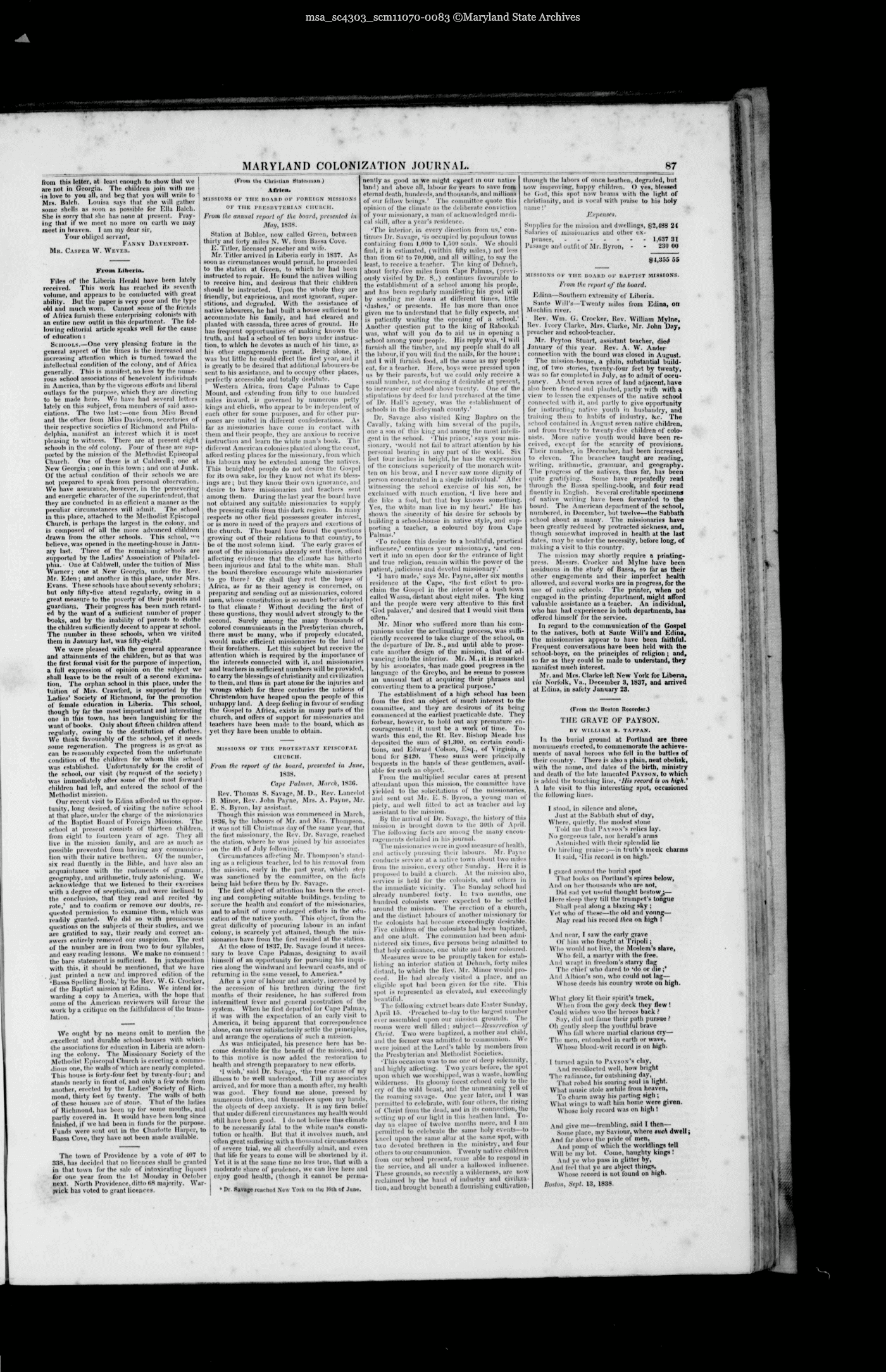
| MARYLAND COLONIZATION JOURNAL. 87 from this letter, at tall enough to show that we are not in Georgia. The children join with me in love to yon all, and bag that yon will wrile to Mrs. Balch. Louisa says that she will gather some shells as soon as possihle lor Ella Balch. She is sorry that she has none at present. Pray- ing that if we meet no more on earth we may meet in heaven. 1 am my dear sir, Your obliged servant, Fanny Davenport. Mr. Casper W. Wever. From Liberia Files of the Liberia Herald have been lately received. This work has reached its seventh volume, and appeals to he conducted with grant ability. Hut the paper is very poor and the type old and much worn. Cannot some of the friends of Africa furnish these enterprising colonists with an entile new outfit in this department. The fol- lowing editorial article speaks well for the cause of education : SCHOOLS.—One very pleasing feature in the general aspect of the times is tin; increased and increasing attention which is turned toward the intellectual condition of the colony, and of Africa generally. This is manifest, no lata t>y the nume- rous school associations of heuevoleut individuals in America, than by the vigorous clients and liberal outlays for the purpose, which they are directing to be made here. We have had several letters lately on this subject, from members of said asso- ciations. The two last: —one from Miss Brand and the other from Miss Davidson, secretaries, of their respective societies of Richmond ami Phila- delphia, manifest an interest which it is most pleasing to witness. There are at present eight schools In the oM colony. Four of these are sup- ported by the mission of the Methodist Episcopal Church. tine of these is at Caldwell; one at New Georgia ; one in this town ; and one at Junk. Of the actual condition of their schools we are not prepared to speak from personal observation. We nave assurance, however, in the persevering and energetic character of the superintendent, that they are conducted in as ellieient a manner as the peculiar circumstances will admit. The school in this place, attached to the Methodist Episcopal Church, is perhaps the largest in the colony, and is composed of all the mora advanced children drawn from the other schools. This school, we believe, was opened in the meeting-house in Janu- ary last. Three of the remaining schools are supported by the Ladies' Association of Philadel- phia. One at Caldwell, under the tuition of Miss Warner; one at New Georgia, under the Rev. Mr. F.den ; and another in this place, under Mrs. Evans. These schools have about seventy scholars; but only filly-five attend regularly, owing ill a great measure to the poverty of their parents anil guardians. Their pragnai has been much retard- ed by the want of a sullicicnt number of proper books, ami by the inability of parents to cloths the children siilliciently decent to appear at school. The number in these schools, what we visited them in January last, was fifty-eight. (From the Christian Statesman.) Africa. MISSIONS OF THE BOARD OF FOREIGN MISSIONS OF THE PRESBYTERIAN CHURCH. From the annual report of the board, presented in May, 1838. Station at Boblee, now called Gren, between thirty ami forty miles N. W. from Bum Cove. E, Tiller, licensed preacher ami wife. Mr. Tiller arrived in Liberia early in 1837. As soon as circumstances would permit, be proceeded to tbi! station at Green, to which he had lieen instructed to repair. He Ibiind the natives willing to receive him, and desirous that their children should be Instructed,. Upon the whole they ire friendly, hut capricious, and most ignorant, super- stitious, and degraded. With the assistance of native lahourers, he had huilt a house sufficient to accommodate his family, and had cleared and planted with cassada, three acres of ground, Bl lias frequent opportunities of making known the truth, and had a school of ten hoys under instruc- tion, to which lie devotes as much of his time, a- his other engagements permit. Being alone, it was hut little he could etli ct the fust year, and it is greatly to be desired that additional labourers he sent to his assistance, and to occupy other places, perfectly accessible and totally destitute. Western Africa, from Cape Palmas to Cape Mount, and extending from filly to one hundred miles inward, is governed by numerous pettj kings and chiefs, who appear to be independent of each other tor some purposes, and for other pur- poses are united in different confederations. As tar as missionaries have come in contact with them and their people, they are anxious to receive instruction and learn the white man's book. The dilferenl American colonies planted along the coast, afford resting places for the missionary, from which his labours may be extended among the natives. This benighted people do not desire the Gospel for its own sake, for they know not what its Mess- lags are; but they know their own ignorance,and desire to have missionaries and leachen lent anion"; them. During the last year the board have not obtained any suitable missionaries to supply the pressing calls from this dark region. In many respects no other field possesses greater interest, or is more in need of the prayers and exertions of the church. The hoard have found the questions growing out of their relations to that country, to be ol the most solemn kind. The early gravel of most of the missionaries already sent there, afford affecting evidence that the climate has hitherto been injurious and fatal to the white man. Shall the hoard therefore encourage white missionaries to pa there- Or shall tiny rest the hopes "f Africa, as far as their agency is concerned, on preparing and tending out as missionaries, colored men, whose constitution is so much better adapted to that climate I Without deciding the first of these tpiestions, they would advert strongly to the second. Surely among the many thousands id colored communicants in the Presbyterian church, there must be many, who if properly educated, would make efficient missionaries to the laud of their forelatbers. Let this subject hut receive the attention which is required by the importance ol the interests connected with it, and missionaries and teachers in sufficient numbers will he provided, to carry tin- blessings of Christianity ami civilization to them, and thus in part atone lor the injuries and wrongs which lor three centuries the nations of Christendom have heaped upon the people of this unhappy land. A deep fading in favour of sending the Gospel to Africa, exists in many parts of the church, and oilers of support for missionaries and teachers have been made to the board, which as yet they have been unable to obtain. We were pleased with the general appearance and attainments of the children, but as that was the first formal visit for the purpose of inspection, a full expression of opinion on the subject we .shall leave to be the result of a second examina- tion. The orphan school in this place, under the tuition of Mrs. Crawford, is supported by the Ladies' Society of Hichiuond, for the promotion of female education in Liberia. This school, though by far the most important and Interesting one in this town, has been languishing for the want of books. Only about fifteen < hildren attend regularly, owing to the destitution of clothes. We think liivourably of the school, yet it needs .some regeneration. The progress is as neat as can be reasonably expected from the unfortunate condition of the children for whom this school was established. I'nl'orlunately for the credit id' the school, our visit (by request of the society) was immediately after some of the most forward children had left, and entered the school of the Methodist mission. Our recent visit to I'.dina afforded us the oppor- tunity, long desired, of visiting the native school at that place, under the charge of the missionaries of the Baptist Board of Foreign Missions. The school at present consists of thirteen children, from eight to fourteen vears of age. They all live in the mission family, and are as much as possible prevented from having any communica- tion with their native brethren, til the number, six read tluetitlv in the Bible, and have also an acquaintance with the rudiments of grammar, geography, and arithmetic, truly astonishing, We acknowledge that we listened to their exercises with a degree of scepticism, ami were inclined to the conclusion, that they read and recited 'by rote,' and to confirm or remove our doubts, re- quested permission to examine them, which was readily granted. We did so with promiscuous questions on the subjects of their studies, and we are gratified to say, their ready and correct an- swers entirely removed our suspicion. The rest ol the number are in from two to four syllables, and easy reading lessons. We make no comment I the hare statement la sufficient. In juxtaposition with this, it should he mentioned, tiiat we hive just printed a new am! improved edition of the 'Bassa Spelling Book,' by the Rev. W. G. Crocker, of the Baptist mission at I'.dina. We intend for- warding a eot>] to America, with the hope that some of the American reviewers will favour the work by a critique on the faithfulness of the trans- lation. We ought by no means omit to mention the excellent and durable school-houses with which the associations for education in Liberia are adorn- ing the colony. The Missionary Society of the Methodist Episcopal Church is erecting a commo- dious one, the walls of which are nearly completed. This house is forty-four feet by twenty-four; and stands nearly in front of. and only a font rods from another, erected by the Ladies' Society of Rich- mond, thirty feet by twenty. The walls ,,t both of these houses are of stone. That of the ladies of Richmond, has been up for some months, and partly covered in. It would have been long since finished, if we had been in funds lor the purpose. Funds were sent out in the Charlotte Harper, to Bassa Cove, they have not been made available. The town of Providence by a vote of 407 to 338, has decided that no licences shall be granted in that town for the sale of intoxicating liquors for one year from the 1st Monday in October next. North Providence, ditto 68 majority, War- wick has voted to grant licences. MISSIONS OF THE Protestant episcopal CHURCH. From the report of the board, presented in June, 1838. Cape Palmas, March, 1836. Rev. Thomas S. Savage, M. D., Rev. Lancelot B. Minor, Rev. John Payne, Mrs. A. Payne, Mr. E. S. Byron, lay assistant. Though this mission was commenced in March, l836, by the labours of Mr. and Mrs. Thompson, it was not till Christmas day of the same year,thai the liist missionary, the Rev. Dr. Savage, reached the station, when he was joined by his associate on the 4th of July following. Circumstances affecting .Mr. Thompson's stand- ing as a religious teacher, led to his removal from the mission, rarly in the past year, which etep was sanctioned by the committee, on tlii- lads being laid before them by Dr. Savage. The first object of attention has been the erect- ing and completing suitable buildings, tending to secure the health and comfort of the missionaries, anil to admit of more enlarged efforts in tbe edu- cation of the native youth. This object, from the great difficulty of procuring labour in an infant colony, is scarcely yet attained, though tin' mis- sionaries have from the fust resided at the station At the close of 1837 Dr. Savage found it neces- sary to leave Cape Palmas, designing to avail himself of an opportunity for pursuing his inqui- ries along the windward and leeward coasts,and of returning in the same vessal, to America.* After a year of labour and anxiety, increased by the accession of his brethren during th.' first months of their residence, he has suffered from intermittent fever end general prostration of the system. Whan he first departed for Cape Palmas, it was with the expectation of an early visit to America, it being apparent that correspondence alone, can never satisfactorily set tie the principles, and arrange the operations of such a mission. As was anticipated, his presence here has be- come desirable for the benefit of the mission, and to this motive is now added the restoration to health and strength preparatory to new efforts. 'I wish,' said Dr. Savage, 'the true cause of my illness to be well understood. Till my associates arrived, and for more than a month after, my health was good. They found ne alone, pressed by numerous duties, and themselves upon mv hands, the objects of deep anxiety. It is my hrm belief that under different circumstances mv health would still have been good. I do not believe tins climate to be necessarily latal to the white man's consti- tution or health. Hut that it involves much, ami often great sulleriug with a thousand circumstances ol severe trial, we all cheerfully admit, and even that life for year- to conn' will he shortened by it. Yet it is at the same time no less true, th.rt with a moderate share of prudence, we can live bats and enjoy good health, (though it cannot be perma- * Dr Savage reached New York on the 16th of June. ncnlly as good as we might expect in our native land) and above all. labour for years to save front eternal death, hundreds,and thousands, and millions of our fellow beings.' The committee quote this opinion of tin- climate as the deliberate conviction of your missionary, a man of acknowledged medi- cal skill, alter a year's residence. "The interior, in every direction from us.' con- linue. Dr. Savage, 'is occupied by populous towns containing from 1,000 to l,500 souls. We should find, it is estimated, (within fifty miles,) not less than from 60 to 70,000, and all willing, to say the least, to receive a teacher. The king of Dehneh, about forty-five miles from Cape Palmas, (previ- ously visited by Dr. S.,) continues favourable to the establishment of a school among ids people, and has been regularly manifesting bis good will by sending me down at different times, little 'dashes,' or presents. Ho has more than once given ine to understand that he fully expects, and is patiently waiting the opening of a school.' Another question put to the king of itabookali was. what will you do to aid us in opening a school among your people. His reply was, '1 will furnish all Hie timber, and my people shall do all (he labour, if you will find the nails, lor the house ; and I will furnish food, all the same as my people eat. for a teacher, line, boyi were pressed upon us by their parents, but we could only receive a small number, not deeming it desirable at present, to increase our school above twenty. One of the stipulations by deed for land purchased at the time of Dr. Hall's agency, was the establishment of schools in the Berleymah county.' Dr. Savage also visited King Baphro on the Cavally, taking with him several of the pupils, one a son of this king and among the most Intelli- gent in the sebool. 'This prince,' s,iys your mis. sionary, 'would not fail to attract attention by bis personal hearing in any part of the world. Six foe! loir inches in height, he has the expression of the conscious superiority of the monarch wiit- teu on his brow, and I never saw more dignity of person concentrated in a single individual.' After Witnessing the school exercise of his son, he exclaimed with much emotion, '1 live here and die like a fool, but that boy knows something. Yes, the while man live in my heart.' He has shown the sincerity of his desire liir schools by building a school-house in native style, and sup- porling a teacher, a coloured boy from Cape Palmas.' 'To reduce this desire to a healthful, practical influence,' continues your missionary, 'and con. vaft it into an open door for the entrance of light and true religion, remain within the power ol the patient, judicious and devoted missionary.' •1 have made,' says .Mr. Payne, after six months residence at the Cape, 'the first ellbit to pro- claim the Gospel in the interior of a bush town called Wassa, distant about eight miles. The king and the people were very attentive to this first •God palaver,' and desired that 1 would visit them often' Mr. Minor who suffered more than his com- panions under the acclimating process, was suffi- ciently recovered to take charge of the school, on the departure of Dr. S., and until able to prose- cute another design of the mission, that of ad- vancing into the interior. Mr. M., it is remarked by his associates, 'has made good progress in the Language of the Greybo, and he seems to possess an unusual tact at acquiring their phrases and converting them to a practical purpose.' The establishment of a high school has been from the first an object of much interest to the committee, and they are desirous of its being commenced at the earliest practicable date. They forbear, however, to bold out any premature en- courairoiuent; it must be a work of'time. To- wards this end, the Rt. Rev. Bishop Meade has deposited the sum of $1,300, on certain condi- tions, and Edward Colson, Esq., oi" Virginia, a bond for $420. These sums were principally bequests in the bands of these gentlemen, avail- able for such an object, From the multiplied secular cares at present attendant upon this mission, the committee have yielded to the solicitations of the missionaries, and sent out Mr. E. S. Byron, a young man of piety, and well fitted to act as teacher and lay assistant to the mission. By the arrival of Dr. Bavage, the history of this mission is brought down to the Both oi April. The following facts are among Hie many encou- ragements detailed in his journal. T'he missionaries w ere in good meaaure ofhealth, and actively pursuing their labours. Mr. Payne conducts service at a native town about two miles from the mssion, every other Sunday. Here it is proposed to build a church. Al llie mission also. service is held lor the colonists, and others in the immediate vicinity. The Sunday school hail already numbered billy. In two months, one hundred colonists were expected to be settled around the mission. 'I'he erection of a church, and the distinct labours of another missionary fin Hie colonists had become exceedingly desirable, five children of the colonists had been baptised, and one adult. The communion had been admi- nistered six times, live persons being admitted to that holy ordinance, one white and lour coloured. Measures were to hi' promptly taken for estab- lishing an interior station at Debmh, forty miles distant, to which the Rev. Mr. Minor would pro- ceed. He had already visited a place, and all eligible spot had been given fol Hie site. This spol is represented as elevated, and exceedingly beautiful. I'he following i (tract heal- date f. ister Sunday, April 15. 'Preached to-day to the largest number ever assembled upon our mission grounds. The rooms were well Idled: subject -Resurrection of Christ. Two were baptized, a mother and child, an.I the former was admitted to communion. We were joined at the Lord's table by members from the Presbyterian and Methodist Societies. • This occasion was to me one ol deep solemnity, and highly affecting. Two years before, the -j..ii u|.....which ma worshipped,was a waste, howling Wilderness. Its gloom} forest echoed only to the cry of the wd i b, sat, and the unmeaning yell of the roaming savage, "ne year later, and I was permitted to celebrate, with four others, Hie ii-iii; of Christ from llie dead, and in its connection,the selling up of our light in lliis heathen land. To- day III elapse of twelve mouth, more, and I am permitted to celebrate the same holy event! to kneel upon the same altar al Hie same -pot, with two devoted brethren in Hie ministry, and four others to our communion. Twenty native children front our school present, some able to respond in tie. seivice. and all under a hallowed inllueiice. rie-e grounds, so reei nth a wilderness, are now reclaimed Iiy the band of industry and civiliza- tion, and brought beneath a flourishing cultivation, through the labors of once heathen, degraded, but now improving, happy children. O yes, blessed be God, this spot now beams with the light of Christianity, and is vocal with praise to his holy name!' Expenses. Supplies for the mission and dwellings, $2,488 24 Salaries of missionaries and other ex- penses, .......1,637 31 Passage and outfit of Mr. Byron, - - 230 00 $1,355 55 Missions of the Board of Baptist missions. From the report of the board. Edina—Southern extremity of Liberia. Saute Will's—Twenty miles from Edina, on Mechlin river. Rev. Win. G. Crocker, Ilev. William Mylne, Rev. Ivory Clarke, Mrs. Clarke, Mr. John 'Day, preacher and school-teacher. Mr. Peyton Stuart, assistant teacher, died January of this year. Ilev. A. W. Ander connection with the board was closed in August. The mission-house, a plain, substantial build- ing, of two stories, twenty-four feet by twenty, was so far completed in July, as to admit of occu- pancy. About seven acres of land adjacent, have also been fenced and planted, partly with with a view toleesenthe expenses of the native school connected with il, and partly to give opportunity for instructing native youth iii husbandry, and training them fo habits of industry. Str. The school contained in August seven native children, and from twenty to twenty-five children of colo- nist-. More native youth would have been re- ceived, except for the scarcity of provisions. Their number, in December, had been increased lo eleven. The branches taught are reading, writing, arithmetic, grammar, and geography. The progress of the natives, thus far, has been quite gratifying. Some have repeatedly read through the Bassa spelling-book, and four read fluently in English. Several creditable specimens of native writing have been forwarded to the board. The American department of the school, numbered, in December, but twelve.—the Sabbath school about as many. The missionaries have been greatly reduced by protracted sickness, and, though somewhat improved in health at the last dates, may be under the necessity, before long, of making a visit to this country. The mission may shortly require a printing- press. Messrs. Crocker and Mylne have been a-siduoiis in the study of Bassa, so far as their oilier engagements and their imperfect health allowed, ami several works are in progress, for the use of native schools. The printer, when not engaged in the printing department, might afford valuable assistance as a teacher. An individual, who has had experience in both departments, has offered himself for the service. In regard to the communication of the Gospel to the natives, both at Saute Will's and Edina, the missionaries appear to have been faithful. Frequent conversations have been held with the school-boys, on the principles of religion; and, so far as they could he made to understand, they manifest much interest. Mr. and Mrs. Clarke left New York for Liberia, cm Norfolk, Ya., December 3, 1837, and arrived at Edina, in safety January 23. (From the Boston Recorder.) THE GRAVE OF PAYSON. By William B. Tappan. In the burial ground at Portland are three monuments erected, to commemorate the achieve- ments of naval heroes who fell in the battles of their country, There is also a plain, neat obelisk, with the name, and dates of the birth, ministry and death of the lata lamented Payson, to which is added the touching line, 'His record is on high.' A late visit to this interesting spot, occasioned the following lines. I stood, in silence and alone, .Inst at the Sabbath shut of day, Where, quietly, the modest stone 'fold me that I' m -nv's relics lay. No gorgcorM tale, noi herald's arms Astonished with their splendid lie (ti hireling praise;—In truth's meek charms It said, -ilis record is on high.' I gazed around the burial spot Thai looks on Portland'! spires below. And on her thousands who are not. Did sail yet useful thought bestow^— Here sleep they till the trumpet's tongue Shall peal along a bluing sky ; Vet who of these—tin' old and young— May read his record then on high ! Ami near, I saw the early grave Of him who fought at Tripoli; Who would not live, the Moslem's slave, U'Iiii fell, a martyr with the free. And wrapt in freedom's starry flag The chief who dared to 'do or die;' A lei Album's son, who could not lag— Whose deeds his country wrote on high. What glory lit their spirit's track, When from the gory deck they flew! Could w iahca woo the heroes back } S i\, did not lame their path pursue .' (Mi gently sleep the youthful brave Who I.dl while martial clarions cry— The men, entombed in earth or wave. Whose blood-writ record is on high. I turned again to Pwsos's clay, \nd recollected well, bow bright 'I'll.' radiance, tttoutshining day, That robed his soaring soul in light. Whit music stole awhile from heaven, To eh n in awav his parting sigh; What wings to wait hiin home were given. Whose holy record was on high ! And give mo—trembling, said I then— Some place, my Saviour, where »ucA dwell; And far ahioe the pride of men, \n I pomp of winch the worldlings tell Will he my lot. Come, haughty kings '. And ye who pass in glitter by. And Iri 1 that ye are abject things. Whose record is not found on high. Boston, Sept. 13, 1838. |