 |
|
|
 |
|
 |
|
|||
|
||||
|
||||
|
Maryland State Archives Maryland Colonization Journal Collection MSA SC 4303 msa_sc4303_scm11070-0084 Enlarge and print image (5M) |
|
|
|
|
|
|
|
|||
|
||||
|
||||
|
Maryland State Archives Maryland Colonization Journal Collection MSA SC 4303 msa_sc4303_scm11070-0084 Enlarge and print image (5M) |
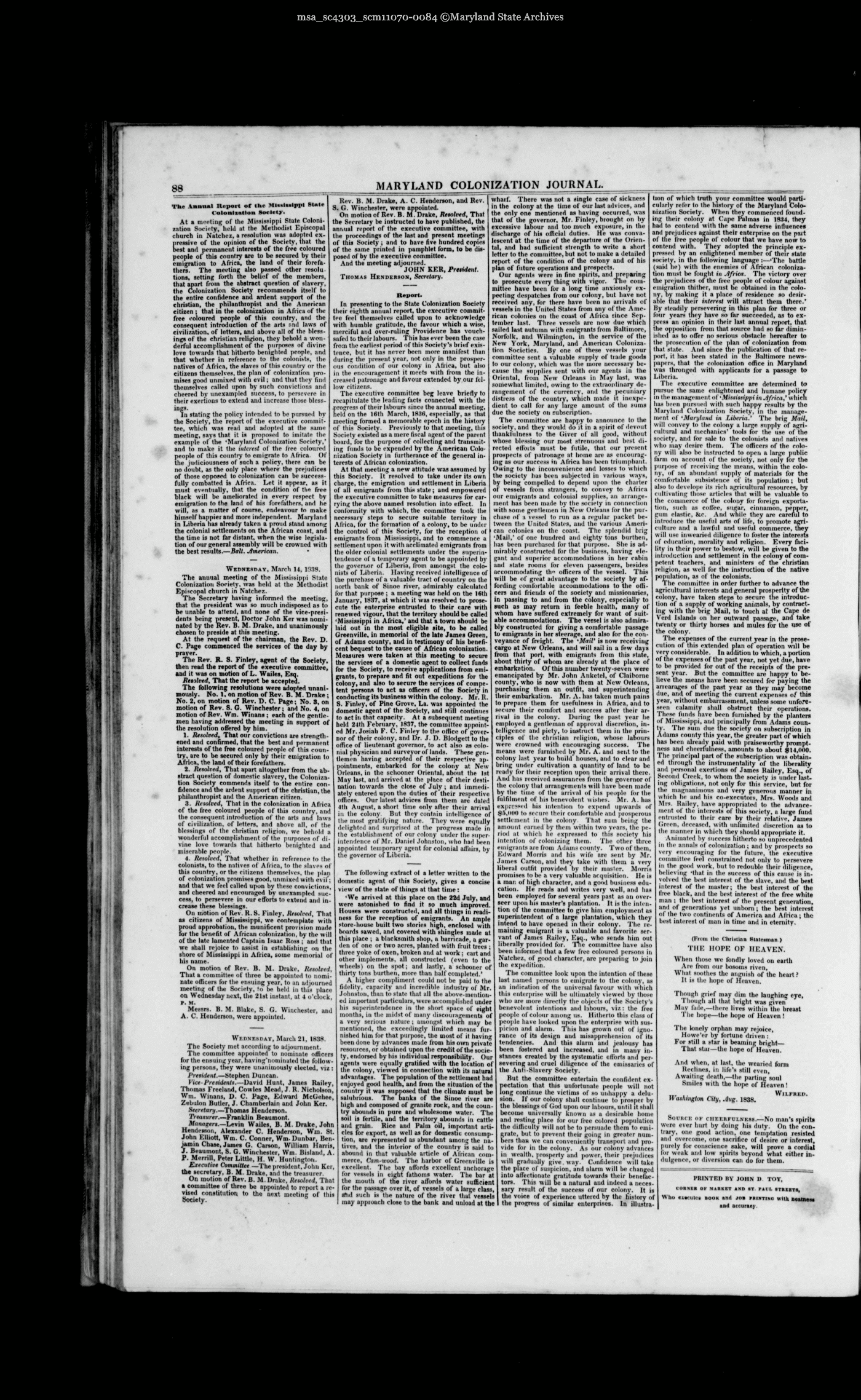
| 88 MARYLAND COLONIZATION JOURNAL. The Annual Report of the Mississippi State Colonization Society. At a meeting of the Mississippi State Coloni- zation Society, held at the Methodist Episcopal church in Natchez, a resolution was adopted ex- pressive of the opinion of the Society, that the best and permanent interests of the free coloured people of this country are to be secured by their emigration to Africa, the land of their forefa- thers. The meeting also passed other resolu. tions, setting forth the belief of the members, that apart from the abstract question of slavery, the Colonization Society recommends itself to the entire confidence and ardent support of the christian, the philanthropist and the American citizen ; that in the colonization in Africa of tin- free coloured people of this country, and the consequent introduction of the arts and laws of civilization, of letters, and above all of the bless- ings of the christian religion, they behold a won- derful accomplishment of the purposes of divine love towards that hitherto benighted people, and that whether in reference to the colonists, the natives of Africa, the slaves of this country or the citizens themselves, the plan of colonization pro- mises good unmixed with evil; and that they find themselves called upon by such convictions and cheered by unexampled success, to persevere in their exertions to extend and increase those bless- ings. In stating the policy intended to be pursued by the Society, the report of the executive commit- tee, which was read and adopted at the same meeting, says that it is proposed to imitate the example of the 'Maryland Colonization Society,' and to make it the interest of the free coloured people of this country to emigrate to Africa Of the judiciousness of such a policy, there can be no doubt, as the only place where the prejudices of those opposed to colonization can be success- fully combatted is Africa. Let it appear, as it must eventually, that the condition of the free black will be ameliorated in every respect by emigration to the land of his forefathers, and he will, as a matter of course, endeavour to make himself happier and more independent. Maryland in Liberia has already taken a proud stand among the colonial settlements on the African coast, and the time is not far distant, when the wise legisla- tion of our general assembly will be crowned with the best results.—Balt. American. • Wednesday, March 14, 1838. The annual meeting of the Mississippi State Colonization Society, was held at the Methodist Episcopal church in Natchez. The Secretary having informed the meeting, that the president was so much indisposed as to be unable to attend, and none of the vice-presi- dents being present, Doctor John Ker was nomi- nated by the Rev. B. M. Drake, and unanimously chosen to preside at this meeting. At the request of the chairman, the Rev. D. C. Page commenced the services of the day by prayer. The Rev. R. S. Finley, agent of the Soeiety, then read the report of the executive committee, and it was on motion of L. Wailes, Esq. Resolved, That the report be accepted. The following resolutions were adopted unani- mously. No. 1, on motion of Rev. B. M. Drake; No. 2, on motion of Rev. D. C. Page; No. S, on motion of Rev. S. G. Winchester; and No. 4, on motion of Rev. Wm. Winans ; each of the gentle- men having addressed the meeting in support of the resolution offered by him. 1. Resolved, That our convictions are strength- ened and confirmed, that the best and permanent interests of the free coloured people of this coun- try, are to be secured only by their emigration to Africa, the land of their forefathers. 2. Resolved, That apart altogether from the ab- stract question of domestic slavery, the Coloniza- tion Society commends itself to the entire con- fidence and the ardent support of the christian, the philanthropist and the American citizen. 3. Resolved, That in the colonization in Africa of the free coloured people of this country, and the consequent introduction of the arts and laws of civilization, of letters, and above all, of the blessings of the christian religion, we behold a wonderful accomplishment of the purposes of di- vine love towards that hitherto benighted and miserable people. 4. Resolved, That whether in reference to the colonists, to the natives of Africa, to the slaves of this country, or the citizens themselves, the plan of colonization promises good, unmixed with evil'; and that we feel called upon by these convictions, and cheered and encouraged by unexampled suc- cess, to persevere in our efforts to extend and in- crease these blessings. On motion of Rev. R.S. Finley, Resolved, That as citizens of Mississippi, we contemplate with proud approbation, the munificent provision made for the benefit of African colonization, by the will of the late lamented Captain Isaac Ross ; and that we shall rejoice to assist in establishing on the shore of Mississippi in Africa, some memorial of his name. On motion of Rev. B. M. Drake, Resolved, That a committee of three be appointed to nomi- nate officers for the ensuing year, to an adjourned meeting of the Society, to be held in this place on Wednesday next, the 21st instant, at 4 o'clock, P. M. Messrs. B. M. Blake, S. G. Winchester, and A. C. Henderson, were appointed. Wednesday, March 21, 1838. The Society met according to adjournment. The committee appointed to nominate officers for the ensuing year, having'nominated the follow- ing persons, they were unanimously elected, viz : President.—Stephen Duncan. Vice-Presidents.—David Hunt, James Railey, Thomas Freeland, Cowles Mead, J. R. Nicholson, Wm. Winans, D. C. Page, Edward McGehee, Zebulon Butler, J. Chamberlain and John Ker. Secretary.—Thomas Henderson. Treasurer__Franklin Beaumont. Managers.—Levin Wailes, B. M. Drake, John Henderson, Alexander C. Henderson, Wm. St. John Elliott, Wm. C. Conner, Wm. Dunbar, Ben- jamin Chase, James G. Carson, William Harris, J. Beaumont, S. G. Winchester, Wm. Bisland, A. P. Merrill, Peter Little, H. W. Huntington. Executive Committee —The president, John Ker, the secretary, B. M Drake, and the treasurer. On motion of Rev. B. M. Drake, Resolved, That a committee of three be appointed to report a re- vised constitution to the next meeting of this Society. Rev. B. M. Drake, A. C. Henderson, and Rev. S. G. Winchester, were appointed. On motion of Rev. B. M. Drake, Resolved, That the Secretary be instructed to have published, the annual report of the executive committee, with the proceedings of the last and present meetings of this Society ; and to have five hundred copies of the same printed in pamphlet form, to be dis- posed of by the executive committee. And the meeting adjourned. JOHN KER, President. Thomas Henderson, Secretary. Report- In presenting to the State Colonization Society their eighth annual report, the executive commit- tee feel themselves called upon to acknowledge with humble gratitude, the favour which a wise, merciful and over-ruling Providence has vouch- safed to their labours. This has ever been the case from the earliest ppriod of this Society's brief exis- tence, but it has never been more manifest than during the present year, not only in the prosper- ous condition of our colony in Africa, but also in the encouragement it meets with from the in- creased patronage ami favour extended by our fel- low citizens. The executive committee beg leave briefly to recapitulate the leading facts connected with the progress of their labours since the annual meeting, held on the 16th March, 1836, especially, as that meeting formed a memorable epoch in the history of this Society. Previously to that meeting, this Society existed as a mere fiscal agent of the parent board, for the purpose of collecting and transmit- ing funds to be expended by the American Colo- nization Society in furtherance of the general in- terests of African colonization. At that meeting a new attitude was assumed by this Society. It resolved to take under its own charge, the emigration and settlement in Liberia of all emigrants from tin- state; and empowered the executive committee to take measures for car- rying the above named resolution into effect. In conlonnity with which, the committee took the necessary steps to secure suitable territory in Africa, for the formation of a colony, to be under the control of this Society, for the reception of emigrants from Mississippi, and to commence a settlement upon it with acclimated emigrants from the older colonial settlements under the superin- tendence of a temporary agent to be appointed by the governor of Liberia, from amongst the colo- nists of Liberia. Having received intelligence of the purchase of a valuable tract of country on the north bank of Sinoe river, admirably calculated for that purpose ; a meeting was held on the 16th January, 1837, at which it was resolved to prose- cute the enterprise entrusted to their tare with renewed vigour, that the territory should be called 'Mississippi in Africa,' and that a town should be laid out in the most eligible site, to be called Greenville, in memorial of the late James Green, of Adams county, and in testimony of his benefi- cent bequest to the cause of African colonization. Measures were taken at this meeting to secure the services of a domestic agent to collect funds for the Society, to receive applications from emi- grants, to prepare and fit out expeditions for the colony, and also to secure the services of compe- tent persons to act as officers of the Society in conducting its business within the colony. Mr. R. S. Finley, of Pine Grove, La. was appointed the domestic agent of the Society, and still continues to act in that capacity. At a subsequent meeting held 24th February, 1837, the committee appoint- ed Mr. Josiah F. C. Finley to the office of gover- nor of their colony, and Dr. J. D. Blodgett to the office of lieutenant governor, to act also as colo- nial physician and surveyor of lands. These gen- tlemen having accepted of their respec'ive ap- pointments, embarked for the colony at New Orleans, in the schooner Oriental, about the 1st May last, and arrived at the place of their desti- nation towards the close of July ; anil immedi- ately entered upon the duties of their respective offices. Our latest advices from them are dated 4th August, a short time only after their arrival in the colony But they contain intelligence of the most gratifying nature. They were equally delighted anil surprised at the progress made in the establishment of our colony under the super- intendence of Mr. Daniel Johnston, who had been appointed temporary agent for colonial affairs, by the governor of Liberia. The following extract of a letter written to the domestic agent of this Society, gives a concise view of the state of things at that time: 'We arrived at this place on the 22d July, and were astonished to find it so much improved. Houses were constructed, and all things in readi- ness fur the reception of emigrants. An ample store-house built two stories high, enclosed with boards sawed, and covered with shingles made at this place ; a blacksmith shop, a barricade, a gar- den of one or two acres, planted with fruit trees ; three yoke of oxen, broken and at work ; cart and other implements, all constructed (even to the wheels) on the spot; and lastly, a schooner of thirty tons burthen, more than half completed.' A higher compliment could not be paid to the fidelity, capacity and incredible industry of Mr. Johnston, than to state that all the above-mention- ed important particulars, were accomplished under his superintendence in the short space of eight months, in the midst of many discouragements of a very serious nature ; amongst which may be mentioned, the exceedingly limited means fur- nished him for that purpose, the most of it having been done by advances made from his own private resources, or obtained upon the credit of the socie- ty, endorsed by his individual responsibility. Our agents were equally gratified with the location of the colony, viewed in connection with its natural advantages. The population of the settlement had enjoyed good health, and from the situation of the country it was supposed that the climate must be salubrious. The banks of the Sinoe river are high and composed of granite rock, and the coun- try abounds in pure and wholesome water. The soil is fertile, and the territory abounds in cattle and grain. Rice and Palm oil, important arti- cles for export, as well as for domestic consump- tion, are represented as abundant among the na- tives, and the interior of the country is said to abound in that valuable article of African com- merce, Cam-wood. The harbor of Greenville is excellent. The bay affords excellent anchorage for vessels in eight fathoms water. The bar at the mouth of the river affords water sufficient for the passage over it, of vessels of a large class, atid such is the nature of the river that vessels may approach close to the bank and unload at the wharf. There was not a single case of sickness in the colony at the time of our last advices, and the only one mentioned as having occurred, was that of the governor, Mr. Finley, brought on hy excessive labour and too much exposure, in the discharge of his official duties. He was conva- lescent at the time of the departure of the Orien- tal, and had sufficient strength to write a short letter to the committee, but not to make a detailed report of the condition of the colony and of his plan of future operations and prospects. Our agents were in fine spirits, and preparing to prosecute every thing with vigor. The com- mittee have been for a long time anxiously ex- pecting despatches from our colony, but have not received any, for there have been no arrivals of vessels in the United States from any of the Ame- rican colonies on the coast of Africa since Sep- tember last. Three vessels are now due which sailed last autumn with emigrants from Baltimore, Norfolk, and Wilmington, in the service of the New York, Maryland, and American Coloniza- tion Societies. By one of these vessels your committee sent a valuable supply of trade goods to our colony, which was tire more necessary be- cause the supplies seirt with our agents in the Orierrtal, from New Orleans in May last, was somewhat limited, owing to the extraordinary de- rangement of the currency, and the pecuniary distress of the country, which made it inexpe- dient to call for any large amount of the sums due the society on subscription. The committee are happy to annorrnce to the society, and they would do it in a spirit of devout thankfulness to the (liver of all good, without whose blessing our most strenuous and best di- rected efforts must be futile, that our present prospects of patronage at home are as encourag- rng as our srrccess in Africa has been triumphant. Owing to the inconvenience and losses to which the society has been subjected in various ways, by being compelled to depend upon the charter of vessels from strangers, to convey to Africa our emigrants and colonial supplies, an arrange- ment has been made by the society in connection with some gentlemen in New Orleans for the pur- chase of a vessel to run as a regular packet be- tween the United Statrs, arid the various Ameri- can colonies on the coast. The splendid brig 'Mail,' of one hundred and eighty tons burthen, has been purchased for that purpose. She is ad- mirably constructed for the business, having ele- gant and superior accommodations in her cabin and state rooms for eleven passengers, besides accommodating th° officers of the vessel. This will be of great advantage to the society by af- fording comfortable accommodations to the offi- cers and friends of the society and missionaries, in passing to and from the colony, especially to such as may return in feeble health, many of whom have suffered extremely for want of suit- able accommodations. The vessel is also admira- bly constructed for giving a comfortable passage to emigrants in her steerage, and also for the con- veyance of freight. The 'Mail' is now receiving cargo at New Orleans, and will sail in a few days from that port, with emigrants from this state, about thirty of whom are already at the place of embarkation.Of this number twenty-seven were emancipated by Mr. John Anketcl, of Claiborne county, who is now with them at New Orleans, purchasing them an outfit, and superintending their embarkation.Mr. A. has taken much pains to prepare them for usefulness in Africa, and to secure their comfort and success after their ar- rival in the colony. During the past year he employed a gentleman of approval discretion, in- telligence and piety, to instruct them in the prin- ciples of the christian religion, whose labours were crowned with encouraging success. The means were furnished by Mr. A. and sent to the colony last year to build houses, and to clear and bring under cultivation a quantity of land to be ready for their reception upon their arrival there. And has received assurances from the governor of the colony that arrangements will have been made by the time of the arrival of his people for the fulfilment of his benevolent wishes. Mr. A. has expressed bis intention to expend upwards of $5,000 to secure their comfortable and prosperous settlement in the colony That sum being the amount earned by them within two years, the pe- riod at which he expressed to this society his intention of colonizing them. The other three emigrants are from Adams county. Two of them, Edward Morris and his wife are sent by Mr. James Carson, and they take with them a very liberal outfit provided by their master. Morns promises to be a very valuable acquisition. He is a man of high character, and a good business edu- cation. He reads and writes very well, and has been employed for several years past as an over- seer upon his master's plantation. It is the inten- tion of the committee to give him employment as superintendent of a large plantation, which they intend to have opened in their colony. The re- maining emigrant is a valuable and favorite ser- vant of James Railey, Esq., who sends him out liberally provided for. The committee have also been informed that a few free coloured persons in Natchez, of good character, are preparing to join the expedition. The committee look upon the intention of these last named persons to emigrate to the colony, as an indication of the universal favour with which this enterprise will be ultimately viewed by those who are more directly the objects of the Society's benevolent intentions and labours, viz: the free people of colour among us. Hitherto this class of people have looked upon the enterprise with sus- picion and alarm. This has grown out of igno- rance of its design and misapprehension of its tendencies. And this alarm and jealousy has been fostered and increased, and in many in- stances created by the systematic efforts and per- severing and cruel diligence of the emissaries of the Anti-Slavery Society. But the committee entertain the confident ex- pectation that this unfortunate people will not long continue the victims of so unhappy a delu- sion. If our colony shall continue to prosper by the blessings of God upon our labours, until it shall become universally known as a desirable home and resting place for our free colored population the difficulty will not be to persuade them to emi- grate, but to prevent their going in greater num- bers than we can conveniently transport and pro- vide for in the colony. As our colony advances in wealth, prosperty and power, their prejudices will gradually give. way. Confidence will take the place of suspicion, and alarm will be changed into affectionate gratitude towards their benefac- tor*. This will be a natural and indeed a neces- sary result of the success of our colony. It is the voice of experience uttered by the history of the progress of similar enterprises. In illustra- tron of which truth your committee would parti- cularly refer to the history of the Maryland Colo- nization Society. When they commenced found- ing their colony at Cape Palmas in 1834, they had to contend with the same adverse influences and prejudices against their enterprise on the put of the free people of colour that we have now to contend with. They adopted the principle ex- pressed by an enlightened member of their state society, in the following language :—'The battle (said he) with the enemies of African coloniza- tion must be fought in Africa. The victory over the prejudices of the free people of colour against emigration thitlier, must be obtained in the colo- ny, by making it a place of residence so desir- able that their interest will attract them there.' By steadily persevering in this plan for three or four years they have so far succeeded, as to ex- press an opinion in their last annual report, that the opposition from that source had so tar dimin- ished as to offer no serious obstacle hereafter to the prosecution of the plan of colonization from that state. And since the publication of that re- port, it has been stated in the Baltimore news- papers, that the colonization office in Maryland was thronged with applicants for a passage to Liberia. The executive committee are determined to pursue the same enlightened and humane policy in the management of''Mississippi in Africa,' which has been pursued with such happy results by the -Maryland Colonization Society, in the manage- ment of 'Maryland in Liberia.' The brig Mail, will convey to the colony a large supply of agri- cultural and mechanics' tools for the use of the socirty, and for sale to the colonists and natives who may desire them. The officers of the colo- ny will also be instructed to open a large public farm on account of the society, not only for the purpose of receiving the means, within the colo- ny, of an abundant supply of materials for the comfortable subsistence of its population ; but also to develope its rich agricultural resources, by cultivating those articles that will be valuable to the commerce of the colony for foreign exporta- tion, such as coffee, sugar, cinnamon, pepper, gum elastic, &c. And while they are careful to introduce the useful arts of life, to promote agri- culture and a lawful and useful commerce, they will use inwearied diligence to foster the interests of education, morality and religion. Every faci- lity in their power to bestow, will be given to the introduction and settlement in the colony of com- petent teachers, and ministers of the christian religion, as well for the instruction of the native population, as of the colonists. The committee in order further to advance the agricultural interests and general prosperity of the colony, have taken steps to secure the introduc- tion of a supply of working animals, by contract- ing with the brig Mail, to touch at the Cape de Verd Islands on her outward passage, and take twenty or thirty horses and mules for the use ot the colony. The expenses of the current year in the prose- cution of this extended plan of operation will be very considerable. In addition to which, a portion of trie expenses of the past year, not yet due, have to be provided for out of the receipts of the pre- sent year. But the committee are happy to be- lieve the means have been secured for paying the anearages of the past year as they may become due, and of meeting the current expenses of this year, without embarrassment, unless some unfore- seen calamity shall obstruct their operations. These funds nave been furnished by the planters of Mississippi, and principally from Adams coun- ty. The sum due the society on subscription in Adams county this year, the greater part of which has been already paid with praiseworthy prompt- ness and cheerfulness, amounts to about $14,000. The principal part of the subscription was obtain- ed through the instrumentality of the liberality anil personal exertions of James Railey, Esq., of Second Creek, to whom the society is under last- ing obligations, not only for this service, but for the magnanimous and very generous manner in which he and his co-executors, Mrs. Woods and Mrs. Railey, have appropriated to the advance- ment of the interests of this society, a large fund entrusted to their rare by their relative, James Green, deceased, with unlimited discretion as to the maimer in which they should appropriate it. Animated by success hitherto so unprecedented in the annals of colonization ; and by prospects so very encouraging for the future, the executive committee feel constrained not only to persevere in the good work, hut to redouble their diligence, believing 'that in the success of this cause is in- volved the best interest of the slave, and the best interest of the master; the best interest of the free black, and the best interest of the free white man : the best interest of the present generation, and of generations yet unborn; the best interest of the two continents of America and Africa ; the best interest of man in time and in eternity. (From the Christian Statesman ) THE HOPE OF HEAVEN. When those we fondly loved on earth Are from our bosoms riven, What soothes the anguish of the heart ? It is the hope of Heaven. Though grief may dim the laughing eye. Though all that bright was given May fade,—there lives within the breast The hope—the hope of Heaven ! The lonely orphan may rejoice, Howe'er by fortune driven : For still a star is beaming bright— That star—the hope of Heaven. And when, at last, the wearied form Reclines, in life's still even, Awaiting death,—the parting soul Smiles with the hope of Heaven! Wilfred. Washington City, Aug. 1838. Source of cheerfulness.—No man's spirits were ever hurt by doing his duty. On the con- trary, one good action, one temptation resisted and overcome, one sacrifice of desire or interest, purely for conscience sake, will prove a cordial for weak and low spirits beyond what either in- dulgence, or diversion can do for them. PRINTED BY JOHN D TOY, CORNER OF MARKET AND ST PAUL STREETS, Who executes Book and Job printing with neatness and accuracy. |