 |
|
|
 |
|
 |
|
|||
|
||||
|
||||
|
Maryland State Archives Maryland Colonization Journal Collection MSA SC 4303 msa_sc4303_scm11070-0121 Enlarge and print image (5M) |
|
|
|
|
|
|
|
|||
|
||||
|
||||
|
Maryland State Archives Maryland Colonization Journal Collection MSA SC 4303 msa_sc4303_scm11070-0121 Enlarge and print image (5M) |
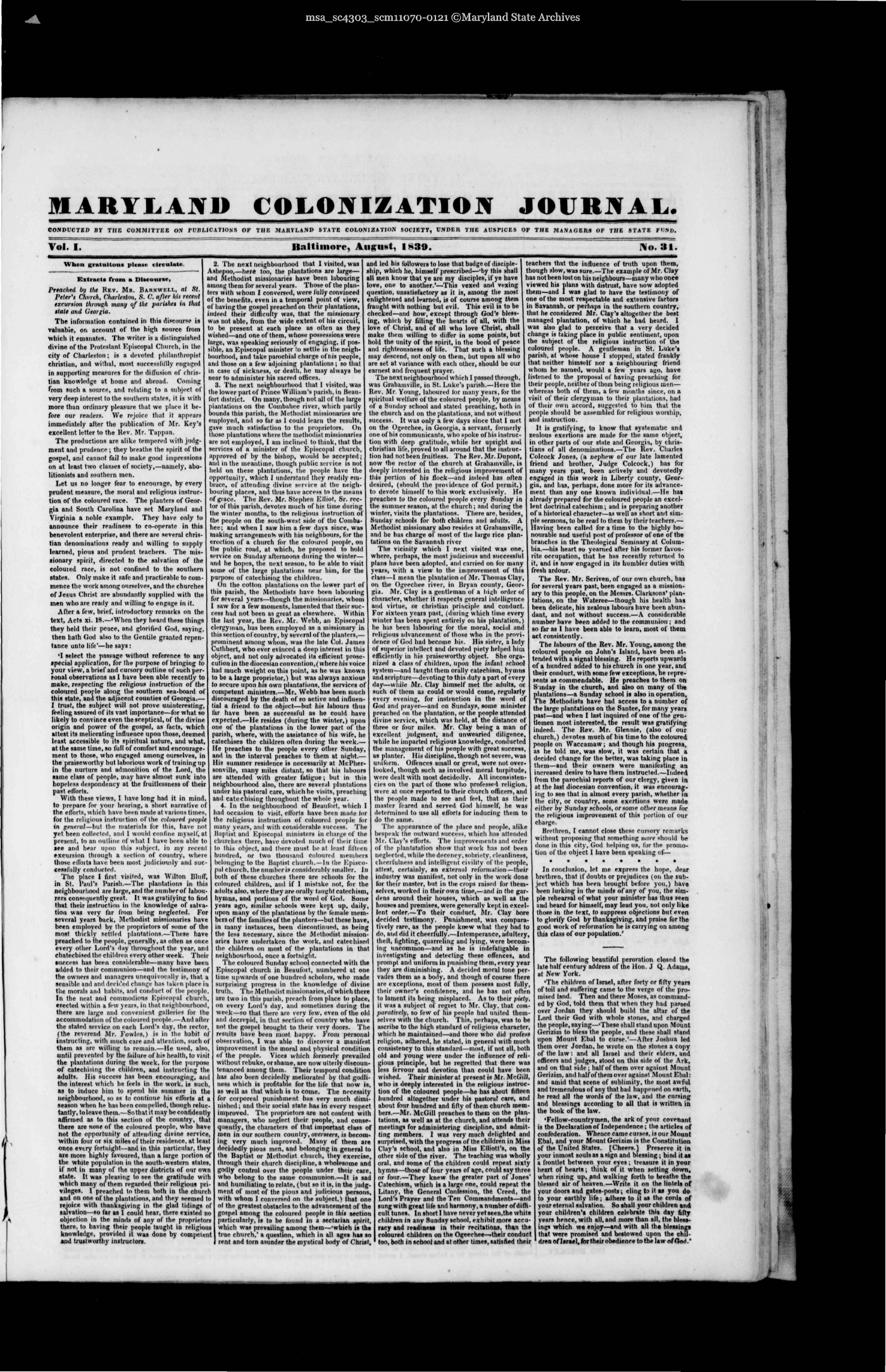
| MARYLAND COLONIZATION JOURNAL. CONDUCTED BY THE COMMITTEE ON PUBLICATIONS OF THE MARYLAND STATE COLONIZATION SOCIETY, UNDER THE AUSPICES OF THE MANAGERS OF THE STATE FUND. Vol. I. Baltimore, August, 1839. No. 31. When gratuitous please circulate. Extracts from a Discourse, Preached by the Rev. Mr. Barnwell, at St. Peter's Church, Charleston, S. C. after his recent excursion through many of the parishes in that slate and Georgia. The information contained in this discourse is valuable, on account of the high source from which it emanates. The writer is a distinguished divine of the Protestant Episcopal Church, in the city of Charleston; is a devoted philanthropist christian, and withal, most successfully engaged in supporting measures for the division of chris- tian knowledge at home and abroad. Coining from such a source, and relating to a subject of very deep interest to the southern states, it is with more than ordinary pleasure that we place it be- fore our readers. We rejoice that it appears immediately alter the publication of Mr. Key's excellent letter to the Rev. Mr. Tappan. The productions arc alike tempered with judg- ment and prudence; they breathe the spirit of the gospel, and cannot fail to make good impressions on at least two classes of society,—namely, abo- litionists and southern men. Let us no longer fear to encourage, by every prudent measure, the moral and religious instruc- tion of the coloured race. The planters of Geor- gia and South Carolina have set Maryland and Virginia a noble example. They have only to announce their readiness to co-operate in this benevolent enterprise, and there are several chris- tian denominations ready and willing to supply learned, pious and prudent teachers. The mis- sionary spirit, directed to the salvation of the coloured race, is not confined to the southern states. Only make it safe and practicable to com- mence the work among ourselves, and the churches of Jesus Christ are abundantly supplied with the men who are ready and willing to engage in it. After a few, brief, introductory remarks on the text, Acts xi. 18.—'When they heard these things they held their peace, and glorified God, saying, then hath God also to the Gentile granted repen- tance unto life'—he says: 'I select the passage without reference to any •pedal application, for (he purpose of bringing to your view, a brief and cursory outline of such per- sonal observations as I have been able recently to make, respecting the religious instruction of the coloured people along the southern sea-board of this state, and the adjacent counties of Georgia.— I trust, the subject will not prove uninteresting, feeling assured of its vast importance—for what so likely to convince even the sreptical, of the divine origin and power of the gospel, as facts, which attest its meliorating influence upon those, deemed least accessible to its spiritual nature, and what, at the same time, so full of comfort and encourage- ment to those, who engaged among ourselves, in the praiseworthy but laborious work of training up in the nurture and admonition of the Lord, the same class of people, may have almost sunk into hopeless despondency at the fruitlessness of their past efforts. With these views, I have long had it in mind, to prepare for your hearing, a short narrative of the elibrts, which have been made at various times, for the religious instruction of the coloured people in general—but the materials for this, have not yet been collected, and 1 would confine myself, at present, to an outline of what I have been able to see and hear upon this subject, in my recent excursion through a section of country, when' those ell'oits have been most judiciously and suc- cessfully conducted. The place 1 first visited, was Wilton Blulf, in St. Paul's Parish.—The plantations in this neighbourhood are large, and the number of labou- rers consequently great. It was gratifying to find that their instruction in the knowledge of salva- tion was very far from being neglected. For several years back, Methodist missionaries have been employed by the proprietors of some of the most thickly settled plantations.—These have preached to the people, generally, as often as once every other Lord's day throughout the year, and chatechised the children every other week. Their success has been considerable—many have been added to their communion—and the testimony of the owners and managers unequivocally is, that a sensible and and decided change has taken place in the morals and habits, and conduct of the people. In the neat and commodious Episcopal church, erected within a few years, in that neighbourhood, there are large and convenient galleries for the accommodation of the coloured people.—And after the stated service on each Lord's day, the rector, (the reverend Mr. Fowles,) is in the habit of instructing, with much care and attention, such of them as are willing to remain.—He used, also, until prevented by the failure of his health, to visit the plantations during the week, for the purpose of catechising the children, and instructing the adults. His success has been encouraging, and the interest which he feels in the work, is such, as to induce him to spend his summer in the neighbourhood, so as to continue his efforts at a season when he has been compelled, though reluc- tantly, to leave them.—So that it may be confidently affirmed as to this section of the country, that there are none of the coloured people, who have not the opportunity of attending divine service, within four or six miles of their residence, at least once eviry fortnight—and in this particular, they are more highly favoured, than a large portion of the white population in the south-western states, if not in many of the upper districts of our own state. It was pleasing to see the gratitude with which many of them regarded their religious pri- vileges. I preached to them both in the church and on one of the plantations, and they seemed to rejoice with thanksgiving in the glad tidings of salvation—so far as I could hear, there existed no objection in the minds of any of the proprietors there, to having their people taught in religious knowledge, provided it was done by competent and trustworthy instructors. 2. The next neighbourhood that 1 visited, was Ashepoo,—here too, the plantations are large— and Methodist missionaries have been labouring among them tor several years. Those of the plan- ters with whom I conversed, were fully convinced of the benefits, even in a temporal point of view, of having the gospel preached on their plantations, indeed their difficulty was, that the missionary was not able, from the wide extent of his circuit, to be present at each place as often as they wished—and one of them, whose possessions were large, was speaking seriously of engaging, if pos- sible, an Episcopal minister 'o settle in the neigh- bourhood, and take parochial charge of his people, and those on a few adjoining plantations; so that in case of sickness, or death, he may always be near to administer his sacred offices. 3. The next neighbourhood that I visited, was the lower part of Prince William's parish, in Beau- fort district. On many, though not all of the large plantations on the Coinbahee river, which partly bounds this parish, the Methodist missionaries are employed, anil so far as 1 could learn the results, gave much satisfaction to the proprietors. On those plantations where the methodist missionaries are not employed, I am inclined to think, that the services ot a minister of the Episcopal church, approved of by the bishop, would be accepted; and in the meantime, though public service is not held on these plantations, the people have the opportunity, which I understand they readily em- brace, of attending divine service at the neigh- bouring places, and thus have access to the means of grace. The Kev. Mr. Stephen Elliot, Sr. rec- tor of this parish, devotes much of his time during the winter months, to the religious instruction of the people on the south-west side of the Coinba- hee; and when I saw him a few days since, was making arrangement* with his neighbours, for the erection of a church for the coloured people, on the public road, at which, he proposed to hold service on Sunday afternoons during the winter— and he hopes, the next season, to be able to visit some of the large plantations near him, for the purpose of catechising the children. On the cotton plantations on the lower part of this paiish, the Methodists have been labouring for several years—though the missionaries, whom I saw for a few moments, lamented that their suc- cess had not been as great as elsewhere. Within the last year, the Rev. Mr. Webb, an Episcopal clergyman, has been employed as a missionary in this section of country, by several of the planters,— prominent among whom, was the late Col. James Cuthhert, who ever evinced a deep interest in this object, and not only advocated its efficient prose- cution in the diocesian convention,; where his voice hail much weight on this point, as he was known to be a large proprietor,) out was always anxious to secure upon his own plantations, the services of competent ministers.—Mr. Webb has been much discouraged by the death of so active and influen- tial a (fiend to the object—but his labours thus far have been as successful as he could have expected.—He resides (during the winter,) upon one of the plantations in the lower part of the parish, where, with the assistance of his wife, he catechises the children often during the week.— He preaches to the people every other Sunday, anil in the interval preaches to them at niirht.— His mi mine i residence is necessarily at Mcl'her- sonville, many miles distant, so that bis labours are attended with greater fatigue; but in this neighbourhood also, there are several plantations under his pastoral care, which he visits, preaching and catecliising throughout the whole year. 4. In the neighbourhood of Beaulbrt, which 1 had occasion to visit, ellbrts have been inacie tor the religious instruction of coloured people for many years, and with considerable success. The Baptist and Episcopal ministers in charge of the churches there, have devoted much of their time to this object, and there must be at least fifli en hundred, or two thousand coloured members belonging to the Baptist church. —In the Kpisco- pal chinch, the numberis considerably smaller, in both of these churches there are schools for the coloured children, and if I mistake not, for the adults also, where they are orally taught catechism, hymns, and portions of the word of tiod. Some years ago, similar schools were kept up, daily, upon many of the plantations by the lemale mem- bers of the families of the planters—but these have, in many instances, been discontinued, as being the less necessary, since the Methodist mission- aries have undertaken the work, and catechised the children on most of the plantations in that neighbourhood, once a fortnight. The coloured Sunday school connected with the Episcopal church in Beaufoit, numbered at one lime upwards of one hundred scholars, who made surprising progress in the knowledge of divine truth. The Methodist missionaries,of which there are two in this parish, preach from place to place, on every Lord's day, and sometimes during the week—so that there are very few, even of the old and decrepid, in that section of country who have not the gospel brought to their very doors. The results have been most happy. From personal observation, I was able to discover a manifest improvement in the moral and physical condition »l the people. Vices which formerly prevailed without rebuke, or shame, are now ulteily discoun- tenanced among them. Their temporal condition has also been decidedly meliorated by that godli- ness which is profitable for the life that now is, as well as that which is to come. The necessity for corporeal punishment has very much dimi- nished; and their social state has in every respect improved. The proprietors are not content with managers, who neglect their people, and conse- quently, the characters of that important class of men in our southern country, overseers, is becom- ing very much improved. Many of them are decidedly pious men, and belonging in general to the Baptist or Methodist chinch, they exercise, through their church discipline, a wholesome and godly control over the people under their care, who belong to the same communion.—It is sad and humiliating to relate, (but so it is, in the judg- ment of most of the pious and judicious persons, with whom J conversed on the subject,) that one ol the greatest obstacles to the advancement of the gospel among the coloured people in (Ail section particularly, is to be found in a sectarian spirit, which was prevailing among them—'which is the true church,' a question, which in all ages has so rent and torn asunder the mystical body of Christ, and led his followers to lose that badge of disciple- ship, which he, himself prescribed—'by this shall all men know that ye are my disciples, if ye have love, one to another.'—This vexed and vexing question, unsatisfactory as it is, among the most enlightened and learned, is of course among them fraught with nothing but evil. This evil is to be checked—and how, except through God's bless- ing, which by fdling the hearts of all, with the love of Christ, and of all who love Christ, shall make them willing to differ in some points, but hold the unity of the spirit, in the bond of peace and righteousness of life. That such a blessing may descend, not only on them, but upon all who are set at variance with each other, should be our earnest and frequent prayer. The next neighbourhood which I passed through, was Grshamvilie, in St. Luke's parish.—Here the Rev. Mr. Young, laboured lor many years, for the spiritual welfare of the coloured people, by means of a Sunday school and stated preaching, both in the church and on the plantations, and not without success. It was only a few days since that I met on the Ogeechee, in Georgia, a servant, formerly one of his communicants, who spoke of his instruc- tion with deep gratitude, while her upright arid christian life, proved lo all around that the instruc- tion had no! been fruitless. The Rev. Mr. Dupont, now the rector of the church at Grahainville, is deeply interested in the religious improvement of this portion of his flock—and indeed has often desired, (should the providence of God permit,) to devote himself to this work exclusively. He preaches to the coloured people every Sunday in the summer season, at tire church; anil during the winter, visits the plantations. There are, besides, .Sunday schools for both children and adults. A Methodist missionary also resides at Grahamville, and he Iras charge of most of tire Urge rice plan- tations on the Savannah river The vicinity which I next visited was one, where, perhaps, the most judicious and successful plans have been adopted, and carried on lor many years, with a view to the improvement of this class—I mean the plantation of Mr. Thomas Clay, on the Ogeechee river, in Bryan county, Geor- gia. Mr. Clay is a gentleman of a liimh order of character, whether it respects general intelligence and virtue, or christian principle and conduct. For sixteen years past, (dining which time every winter has been spent entirely on his plantation,) he has been labouring for the moral, social and religious advancement of those who in the provi- dence of God had become hi,--. His sister, a lady of superior intellect and devoted piety helped him efficiently in his praiseworthy object. She orga- nized a class of children, upon the infant school system—and taught them orally catechism, hymns aird scripture—devoting to this duty a part of every day—while Mr. Clay himself met the adults, or such of them as could or would come, regularly every evening, for instruction in the word of God ami prayer—and on Sundays, some minister preached on the plantation, or the people attended divine service, which was held, at the distance of three or (bur miles. Mr. Clay being a man of excellent judgment, and unwearied diligence, while he imparted religious knowledge, conducted the management of his people with great success, as planter. His discipline, though not severe, was umlurrn. Offences small or great, were not over- looked, though such as involved moral turpitude, were dealt with most decidedly. All inconsisten- cies on the part of those who professed religion, were at once reported to their church officers, and the people made to see and feel, that as their master feared and served God himself, he was determined to use all efforts for inducing them to do the same. The appearance of the place and people, alike bespeak the outward success, which has attended Mr. ('lay's efforts. The improvements and order of the plantatation show that work has not been neglected, while the decency, sobriety, cleanliness, cheerfulness and intelligent civility of the people, attest, certainly, an external reformation—their industry was manifest, not only in the work done lor their master, but irr the crops raised for them- selves, worked in their own time,—and in the gar- dens around their houses, which as well as the houses and premises, were generally kept in excel- lent order.—To their conduct, Sir. Clay bore decided testimony. Punishment, was compara- tively rare, as the people knew what they had to do, and did it cheerfully.—Intemperance, adultery, ihelt, fighting, quarreling and lying, were becom- ing uncommon—and as he is indefatigable in investigating and detecting these offences, and prompt and uniform in punishing them, every year they are diminishing. A decided moral tone per- vades thern as a body, and though of course there are exceptions, most of them possess most fully, their owner's confidence, and he has not often to lament its being misplaced. As to their I'iety, it was a subject of regret to Mr. Clay, that com- piinitirely, so few of his people had united them- selves with the church. This, perhaps, was to be ascribe to the high standard of rcligrous character, which he maintained—and those who did profess religion, adhered, he stated, in general with much consistency to this standard—most, if not all, both old and young were under the influence of reli- gious principle, but he regretted that there was less fervour and devotion than could have been wished. Their minister at present is Mr. McGill, who is deeply interested in the religious instruc- tion of the coloured people—he has about fifteen hundred altogether under his pastoral care, and about four hundred and fifty of them church mem- bers.—Mr. McGill preaches to them on the plan- tations, as well as at the church, and attends their meetings for administering discipline, and admit- ting members. I was very much delighted and surprised, with the progress of the children in Miss Clay's school, and also in Miss Elliott's, on the other side of the river. The teaching was wholly oral, and some of the children could repeat sixty hymns—those of four years of age, could say three or four.—They knew the greater part of Jones' Catechism, which is a large one, could repeat the Litany, the General Confession, the Creed, the Lord's Prayer and the Ten Commandments—and sung with great life and harmony, a number of diffi- cult tunes. In short I have never yet seen,the white children in any Sunday school, exhibit more accu- racy and readiness in their recitations, than the coloured children on the Ogeechee—their conduct too, both in school and at other times, satisfied their teachers that the influence of truth upon them, though slow, was sure.—The example of Mr. Clay has not been lost on his neighbours—many who once viewed his plans with distrust, have now adopted them—and 1 was glad to have the testimony of one of the most respectable and extensive factors in Savannah, or perhaps in the southern country, that he considered Mr. Clay's altogether the best managed plantation, of which he bad heard. I was also glad to pciceive that a very decided change is taking place in public sentiment, upon the subject of the religious instruction of the coloured people. A gentleman in St. Luke's parish, at whose house I stopped, stated frankly that neither himself nor a neighbouring friend whom he named, would a few years ago, have listened to the proposal of having preaching for their people, neitherof them being religious men— whereas both of them, a few months since, on a visit of their clergyman to their plantations, had of their own accord, suggested to him that the people should be assembled for religious worship, and instruction. It is gratifying, to know that systematic and zealous exertions are made for the same object, in other parts of our state and Georgia, by chris- tians of all denominations.—The Rev. Charles Colcock Jones, (a nephew of our late lamented friend and brother, Judge Colcock,) has for many years past, been actively and devotedly engaged in this work in Liberty county, Geor- gia, and has, perhaps, done more for its advance- ment than any one known individual.—He has already prepared for the coloured people an excel- lent doctrinal catechism; and is preparing another of a historical character—as well as short and sim- ple sermons, to be read to them by their teachers.— Having been called for a time to the highly ho- nourable and useful post of professor of one of the branches in the Theological Seminary at Colum- bia.—his heart so yearned after his former favou- rite occupation, that he has recently returned to it, and is now engaged in its humbler duties with fresh ardour. The Rev. Mr. Scriven, of our own church, has for several years past, been engaged as a mission- ary to this people, on the Messrs. Clarksons' plan- tations, on the Wateree—though his health has been delicate, his zealous labours have been abun- dant, and not without success.—A considerable number have been added fo the communion ; and so far as I have been able to learn, most of them act consistently. The labours of the Rev. Mr. Young, among the coloured people on John's Island, have been at- tended with a signal blessing. He reports upwards of a hundred added to his church in one year, and their conduct, with some few exceptions, he lepre- sents as commendable. He preaches to them on Sinday in the church, and also on many of the plantations—a Sunday school is also in operation. The Methodists have had access to a number of the large plantations on the Santee, for many years past—and when I last inquired of one of the gen- tlemen most interested, the result was gratifying indeed. The Rev. Mr. Glennie, (also of our church.) devotes much of his time to the coloured people on Waccamaw; and though his progress, as he told me, was slow, it was certain that a decided change for the better, was taking place in them—and their owners were manifesting an increased desire to have them instructed.—Indeed from the parochial reports of our clergy, given in at the lasi diocesian convention, it was encourag- ing to see that in almost every parish, whether in the city, or country, some exertions were made eifher by Sunday schools, or some other means for the religious improvement of this portion of our charge. Brethren, I cannot close these cursory remarks without proposing that something more should be done in this city, God helping us, for the promo- tion of the object I have been speaking of— In conclusion, let me express the hope, dear brethren, that if doubts or prejudices (on the sub- ject which has been brought before you,) have been lurking in the minds of any of you, the sim- ple rehearsal of what your minister lias thus seen and heard for himself, may lead you, not only like those in the text, to suppress objections but even to glorify God by thanksgiving, and praise for the good work of reformation he is carrying on among this class of our population.' The following beautiful peroration closed the late half century address of the Hon. J Q. Adams, at New York. 'The children of Israel, after forty or fifty years of toil and suffering came to the verge of the pro- mised land. Then and there Moses, as command- ed by God, told them that when they had passed over Jordan they should build the altar of the Lord their God with whole stones, and charged the people, saying—'These shall stand upon Mount Genzim to bless the people, and these shall stand upon Mount Ebal to curse.'—After Joshua led them over Jordan, he wrote on the stones a copy of the law: and all Israel and their elders, and officers and judges, stood on this side of the Ark, and on that side; half of them over against Mount Geriziin, and half of them over against Mount Ebal: and amid that scene of sublimity, the most awful and tremendous of any that had happened on earth, he read all the words of the law, and the cursing and blessings according to all that is written in the book of the law. 'Fellow-countrymen, the ark of your covenant is the Declaration of Independence; the articles of confederation. Whence came curses, is our Mount Ebal, and your Mount Gerizim is the Constitution of the United States. [Cheers.] Preserve it in your inmost souls as a sign and blessing; bind it as a frontlet between your eyes; treasure it in your heart of hearts; think of it when setting down, when rising up, and walking forth to breathe the blessed air of neaven.—Write it on the lintels of your doors and gates-posts; cling to it «s you do to your earthly life; adhere to it as the cords of your eternal salvation. So shall your children and your children's children celebrate this day fifty years hence, with all, and more than all, the bless- ings which we enjoy—and with all the blessings that were promised and bestowed upon the chil- dren of Israel, for their obedience to the law of God.* |