 |
|
|
 |
|
 |
|
|||
|
||||
|
||||
|
Maryland State Archives Maryland Colonization Journal Collection MSA SC 4303 msa_sc4303_scm11070-0122 Enlarge and print image (5M) |
|
|
|
|
|
|
|
|||
|
||||
|
||||
|
Maryland State Archives Maryland Colonization Journal Collection MSA SC 4303 msa_sc4303_scm11070-0122 Enlarge and print image (5M) |
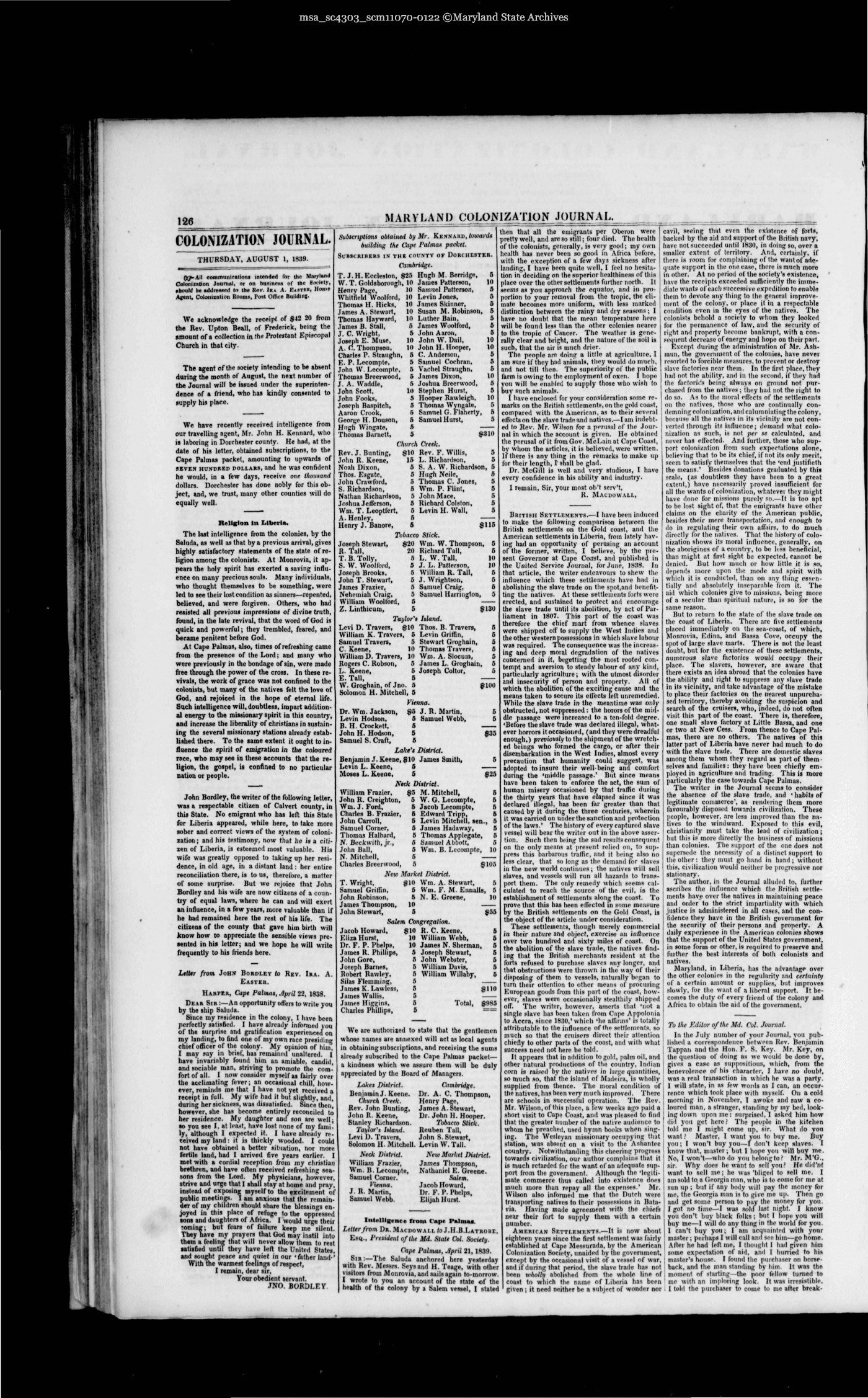
| 126 MARYLAND COLONIZATION JOURNAL.______ COLONIZATION JOURNAL. THURSDAY, AUGUST 1, 1839. All communications intended for the Maryland Colonization Journal, or on business of the Society, should be addressed to the Rev. Ira A Easter, Home Agent, Colonization Rooms, Post Office Building. We acknowledge the receipt of $42 20 from the Rev. Upton Beall, of Frederick, being the amount of a collection in the Protestant Episcopal Church in that city. The agent of the society intending to be absent during the month of August, the next number of the Journal will be issued under the superinten- dence of a friend, who has kindly consented to supply his place. Subscriptions obtained by Mr. Kennard, towards building the Cape Palmas packet. Subscribers in the county of Dorchester. We have recently received intelligence from our travelling agent, Mr. John H. Kennard, who is laboring in Dorchester county. He had, at the date of his letter, obtained subscriptions, to the Cape Palmas packet, amounting to upwards of seven hundred pollars, and he was confident he would, in a few days, receive one thousand dollars. Dorchester has done nobly for this ob- ject, and, we trust, many other counties will do equally well. Religion In Liberia, The last intelligence from the colonies, by the Saluda, as well as that by a previous arrival, gives highly satisfactory statements of the state of re- ligion among the colonists. At Monrovia, it ap- pears the holy spirit has exerted a saving influ- ence on many precious souls. Many individuals, who thought themselves to be something, were led to see their lost condition as sinners—repented, believed, and were foigiven. Others, who had resisted all previous impressions of divine truth, found, in the late revival, that the word of God is quick and powerful; they trembled, feared, and became penitent before God. At Cape Palmas, also, times of refreshing came from the presence of the Lord; and many who were previously in the bondage of sin, were made free through the power of the cross. In these re- vivals, the work of grace was not confined to the colonists, but many of the natives felt the love of God, and rejoiced in the hope of eternal life. Such intelligence will, doubtless, impart addition- al energy to the missionary spirit in this country, and increase the liberality of christians in sustain- ing the several missionary stations already estab- lished there. To the same extent it ought to in- fluence the spirit of emigration in the coloured race, who may see in these accounts that the re- ligion, the gospel, is confined to no particular nation or people. John Bordley, the writer of the following letter, was a respectable citizen of Calvert county, in this State. No emigrant who has left this State for Liberia appeared, while here, to take more sober and correct views of the system of coloni- zation; and his testimony, now that he is a citi- zen of Liberia, is esteemed most valuable. His wife was greatly opposed to taking up her resi- dence, in old age, in a distant land : her entire reconciliation there, is to us, therefore, a matter of some surprise. But we rejoice that John Bordley and his wife are now citizens of a coun- try of equal laws, where he can and will exert an influence, in a few years, more valuable than if he had remained here the rest of his life. The citizens of the county that gave him birth will know how to appreciate the sensible views pre- sented in his letter; and we hope he will write frequently to his friends here. Lttter from John Bordley to Rev. Ira. A. Easter. Harper, Cape Palmas, April 22, 1838. Dear Sir :—An opportunity offers to write you by the ship Saluda. Since my residence in the colony, I have been perfectly satisfied. I have already informed you of the surprise and gratification experienced on my landing, to find one of my own race presiding chief officer of the colony. My opinion of him, I may say in brief, has remained unaltered. I have invariably found him an amiable, candid, and sociable man, striving to promote the com- fort of all. I now consider myself as fairly over the acclimating fever; an occasional chill, how- ever, reminds me that I have not yet received a receipt in full. My wife had it but slightly, and, during her sickness, was dissatisfied. Since then, however, she has become entirely reconciled to her residence. My daughter and son are well; so you see I, at least, have lost none of my fami- ly, although I expected it. I have already re- ceived my land: it is thickly wooded. I could not have obtained a better situation, nor more fertile land, had I arrived five years earlier. I met with a cordial reception from my christian brethren, and have often received refreshing sea- sons from the Lord. My physicians, however, strive and urge that I shall stay at home and pray, instead of exposing myself to the excitement of public meetings. I am anxious that the remain- der of my children should share the blessings en- joyed in this place of refuge to the oppressed sons and daughters of Africa. I would urge their •oming; but fears of failure keep me silent. They have my prayers that God may instil into thtm a feeling that will never allow them to rest satisfied until they have left the United States, and sought peace and quiet in our 'father land'' With the warmest feelings of respect, I remain, dear sir, Your obedient servant, JNO. BORDLEY We are authorized to state that the gentlemen whose names aie annexed will act as local agents in obtaining subsciiptions, and receiving the sums already subscribed to the Cape Palmas packet— a kindness which we assure them will be duly appreciated by the Board of Managers. Lakes District. Cambridge. Benjamin J. Keene. Dr. A. C. Thompson, Church Creek. Henry Page, Rev. John Bunting, James A.Stewart, John R. Keene, Dr. John H. Hooper. Stanley Richardson. Tobacco Stick. Taylor's Island. Reuben Tall, Levi D. Travers, John S. Stewart, Solomon H. Mitchell. Levin W. Tall. Neck District. New Market District. William Frazier, James Thompson, Wm. B. Lecompte, Nathaniel E. Greene. Samuel Corner. Salem. Vienna. Jacob Howard, J. R. Martin, Dr. F. P. Phelps, Samuel Webb. Elijah Hurst. then that all the emigrants per Oberon were pretty well, and arc so still; four died. The health of the colonists, generally, is very good; my own health has never been so good in Africa before, with the exception of a few day* sickness after landing, I have been quite well, I feel no hesita- tion in deciding on the superior healthiness of this place over the other settlements further north. It seems as you approach the equator, and in pro- portion to your removal from the tropic, the cli- mate becomes more uniform, with less marked distinction between the rainy and dry seasons ; I have no doubt that the mean temperature here will be found less than the other colonies nearer to the tropic of Cancer. The weather is gene- rally clear and bright, and the nature of the soil is such, that the air is much drier. The people are doing a little at agriculture. I am sure if they had animals, they would do much, and not till then. The superiority of the public farm is owing to the employment of oxen. I hope you wili be enabled to supply those who wish to buy such animals. I have enclosed for your consideration some re- marks on the British settlements, on the gold coast, compared with the American, as to their several effects on the slave trade and natives.—lam indebt- ed to Rev. Mr. Wilson for a perusal of the Jour- nal in which the account is given. He obtained the perusal of it from Gov. McLain at Cape Coast, by whom the articles, it is believed, were written. If there is anything in the remarks to make up for their length, I shall be glad. Dr. McGill is well and very studious, I have every confidence in his ability and industry. I remain, Sir, your most ob't serv't, R. Macdowall, Intelligence from Cape Palmas. Letter from Dr. Macdowall to J.H.B. Latrobe, Esq., President of the Md. State Col. Society. Cape Palmas, April 21,1839. Sir:—The Saluda anchored here yesterday with Rev. Messrs. Seys and H. Teague, with other visitors from Monrovia, and sails again to-morrow. I wrote to you an account of the state of the health of th« colony by a Salem vessel, I stated British Settlements.—I have been induced fo make the following comparison between the British settlements on the Gold coast, and the American settlements in Liberia, from lately hav- ing had an opportunity of perusing an account of the former, written, I believe, by the pre- sent Governor at Cape Cojst, and published in the United Service Journal, for June, 18.'t8. In that article, the writer endeavours to shew the influence which these settlements have had in abolishing the slave trade on the spot,and benefit- ting the natives. At these settlements forts were erected, and sustained to protect and encourage the slave trade until its abolition, by act of Par- liament in 1807. This part of the coast was therefore the chief mart from whence slaves were shipped ofl" to supply the West Indies and the other western possessions in which slave labour was required. The consequence was the increas- ing and deep moial degradation of the natives concerned in if, begetting the most rooted con- tempt and aversion to steady labour of any kind, particularly agriculture; with the utmost disorder and insecurity of person and property. All of which the abolition of the exciting cause and the means taken to secure its effects left unremedied. While the slave trade in the meantime was only obstructed, not suppressed : the horors of the mid- dle passage were increased to a ten-fold degree. 'Before the slave trade was declared illegal, what- ever horrors it occasioned, (and they were dreadful enough,) previously to the shipment of the wretch- ed beings who formed the cargo, or after their disembarkation in the West Indies, almost every precaution that humanity could suggest, was adopted to insure their well-being and comfort during the 'middle passage.' But since means have been taken to enforce the act, the sum of human misery occasioned by that traffic during the thirty years that have elapsed since it was declared illegal, has been far greater than that caused by it during the three centuries, wherein it was carried on under the sanction and protection of the laws.' The history of every captured slave vessel will bear the writer out in the above asser- tion. Such then being the sad results consequent on the only means at present relied on, to sup- press this barbarous traffic, and it being also no less clear, that so long as the demand for slaves in the new world continues; the natives will sell slaves, and vessels will run all hazards to trans- port them. The only remedy which seems cal- culated to reach the source of the evil, is the establishment of settlements along the coast. To prove that this has been effected in some measure by the British settlements on the Gold Coast, is the object of the article under consideration. These settlements, though merely commercial in their nature and object, exercise an influence over two hundred and sixty miles of coast. On the abolition of the slave trade, the natives find- ing that the British merchants resident at the forts refused to purchase slaves any longer, and that obstructions were thrown in the way of their disposing of them to vessels, naturally began to turn their ottcntion to other means of procuring European goods from this part of the coast, how- ever, slaves were occasionally stealthily shipped off. The writer, however, asserts that 'not a single slave has been taken from Cape Appolonia to Accra, since 1830,' which 'he affirms' is totally attributable to the influence of the settlements, so much so that the cruisers direct their attention chiefly to other parts of the coast, and with what success need not here be told. It appears that in addition to gold, palm oil, and other natural productions of the country, Indian corn is raised by the natives in large quantities, so much so, that the island of Madeira, is wholly supplied from thence. The moral condition of the natives, has been very much improved. There are schools in successlul operation. The Rev. Mr. Wilson, of this placp, a few weeks ago paid a short visit to Cape Coast, and was pleased to find that the greater number of the native audience to whom he preached, used hymn books when sing- ing. The Wesleyan missionary occupying that station, was absent on a visit to the Ashantee country. Notwithstanding this cheering progress towards civilization, our author complains that it is much retarded for the want of an adequate sup- port from the government. Although the 'legiti- mate commerce thus called into existence does much more than repay all the expenses.' Mr. Wilson also informed me that the Dutch were transporting natives to their possessions in Bata- via. Having made agreement with the chiefs near their fort to supply them with a certain number. American Settlements.—It is now about eighteen years since the first settlement was fairly established at Cape Messurada, by the American Colonization Society, unaided by the government, except by the occasional visit of a vessel of war, and if during that period, the slave trade has not been wholly abolished from the whole line of coast to which the name of Liberia has been given ; it need neither be a subject of wonder nor cavil, seeing that even the existence of forts, backed by the aid and support of the British navy, have not succeeded until 1830, in doing so, over a smaller extent of territory. And, certainly, if there is room for complaining of the want of ade- quate support in the one ease, there is much more in other. At no period of the society's existence, have the receipts exceeded sufficiently the imme- diate wants of each successive expedition to enable them to devote any thing to the eencral improve- ment of the colony, or place it in a respectable condition even in the eyes of the natives. The colonists behold a society to whom they looked for the permanence of law, and the security of right and property become bankrupt, with a con- sequent decrease of energy and hope on their part. Except during the administration of Mr. Ash- mun, the government of the colonies, have never resorted to forcible measures, to prevent or destroy slave factories near them. In the first place, they had not the ability, anil in the second, if they had the factories being always on ground not pur- chased from the natives ; they hail not the right to do so. As to the moral effects of the settlements on the natives, those who arc continually con- demning colonization, and calumniating the colony, because all the natives in its vicinity are not con- verted through its influence; demand what colo- nization as such, is not per se calculated, and never has effected. And further, those who sup- port colonization from such expectations alone, believing that to be its chief, if not its only merit, seem to satisfy themselves that the 'end justifieth the means.' Besides donations graduated by this scale, (as doubtless they have been to a great extent,) have necessarily proved insufficient for all the wants of colonization, whatever they might have done for missions purely so.—It is too apt to be lost sight of, that the emigrants have other claims on the charity of the American public, besides their mere transportation, and enough to do in regulating their own affairs, to do much directly for the natives. That the history of colo- nization shows its moral influence, generally, on the aborigines of a country, to be less beneficial, than might at first sight be expected, cannot be denied. But how much or how little it is so, depends more upon the mode and spirit with which it is conducted, than on any thinjr essen- tially and absolutely inseparable from it. The aiil which colonies give to missions, being more of a secular than spiritual nature, is so for the same reason. But to return to the state of the slave trade on the coast of Liberia. There are five settlements placed immediately on the sea-coast, of which, Monrovia, Edina, and Bassa Cove, occupy the spot of large slave marts. There is not the least doubt, but for the existence of these settlements, numerous slave factories would occupy their place. The slavers, however, are aware that there exists an idea abroad that the colonies have the ability and right to suppress any slave trade in its vicinity, and take advantage of the mistake to place their factories on the nearest unpurcha- sed territory, thereby avoiding the suspicion and search of the cruisers, who, indeed, do not olten visit this part of the coast. There is, therefore, one small slave factory at Little Bassa, and one or two at New Cess. From thence to Cape Pal- mas, there arc no others. The natives of this latter part of Liberia have never had much to do with the slave trade. There are domestic slaves among them whom they regard as part of them selves and families: they have been chiefly em- ployed in agriculture and trading. This is more particularly the case towards Cape Palmas. The writer in the Journal seems to consider the absence of the slave trade, and ' habits of legitimate commerce', as rendering them more favourably disposed towards civilization. These people, however, are less improved than the na- tives to the windward. Exposed to this evil, Christianity must take the lead of civilization; but this is more directly the business of missions than colonies. The support of the one does not supersede the necessity of a distinct support to the other: they must go hand in hand; without this, civilization would neither be progressive nor stationary. The author, in the Journal alluded to, further ascribes the influence which the British settle- ments have over the natives in maintaining peace anil order to the strict impartiality with which justice is administered in all cases, and the con- fidence they have in the British government for the security of their persons and property. A daily experience in the American colonies shows that the support of the United States government, in some form or other, is required to preserve and fuither the best interests of both colonists and natives. Maryland, in Liberia, has the advantage over the other colonies in the regularity and certainty of a certain amount or supplies, but improves slowly, for the want of a liberal support. It be- comes the duty of every friend of the colony and Africa to obtain the aid of the government. To the Editor of the Md. Col. Journal. In the July number of your Journal, you pub- lished a correspondence between Rev. Benjamin Tappan and the Hon. F. S. Key. Mr. Key, on the question of doing as we would be done by. gives a case as suppositious, which, from the benevolence of his character, I have no doubt, was a real transaction in which he was a party. 1 will state, in as few words as I can, an occur- rence which took place with myself. On a cold morning in November, 1 awoke and saw a co- loured man, a stranger, standing by my bed, look- ing down upon me: surprised, I asked him how dil you get here; The people in the kitchen told me I might come up, sir. What do you want | Master, I want you to buy me. fiuy you ; I won't buy you—I don't keep slaves. I know that, master; but I hope you will buv me. No, I won't—who do you belong to? Mr. M'G.. sir. Why docs he want to sell you? He did'nt want to sell me; he was 'bliged to sell me. I am sold to a Georgia man, who is to come for me at sun up ; but if any body will pay the money for me, the Georgia man is to give me up. Then go and get some person to pay the money for you. I got no time—I was sold last night. I know you don't buy black folks ; but 1 hope you will buy me—I will do any thing in the world for you I can't buy you; I am acquainted with your master; perhaps I will call and sec him—go home. After he had left me, I thought I had given him some expectation of aid, and I hurried to his master's house. I found the purchaser on horse- back, and the man standing by him It was the moment of starting -the poor fellow turned to me with an imploring look. It was irresistible. I told the purchaser to come to me alter break Cambridge. T. J. H. Eccleston, $25 Hugh M. Berridge, 5 \V. T. Goldsborough, 10 James Patterson, 10 Henry Page, 10 Samuel Patterson, 5 Whitfield Woolford, 10 Levin Jones, 6 Thomas H. Hicks, 10 James Skinner, 5 James A. Stewart, 10 Susan M. Robinson, 5 Thomas Hayward, 10 Luther Bain, 5 James B. Stall, 5 James Woolford, 6 J. C. Wright, 5 John Aaron, 5 Joseph E. Muse, 10 John W. Dail, 10 A. C. Thompson, 10 John H. Hooper, 10 Charles P. Straughn, 5 C. Anderson, 5 E. P. Lecompte, 5 Samuel Cochran, 5 John W. Lecompte, 5 Vachel Straughn, 5 Thomas Breerwood, 5 James Dixon, 10 J. A. Waddle, 5 Joshua Breerwood, 5 John Scott, 10 Stephen Hurst, 5 John Fooks, 5 Hooper Rawleigh, 10 Joseph Baspitch, 5 Thomas Wyngate, 5 Aaron Crook, 6 Samuel G. Flaherty, 5 George H. Douson, 5 Samuel Hurst, 5 Hugh Wingate, 5 ------ Thomas Barnett, 5 $310 Church Creek. Rev. J. Bunting, $10 Rev. F. Willis, 5 John R. Keene, 15 L. Richardson, 5 Noah Dixon, 5 S. A. W. Richardson, 5 Thos. Esgate, 5 Hugh Neile, 6 John Crawford, 6 Thomas C. Jones, 5 S. Richardson, 5 Win. P. Flint, 5 Nathan Richardson, 5 John Mace, 5 Joshua Jefferson, 5 Richard Colston, 5 Wm. T. Leoptfert, 5 Levin H. Wall, 5 A. Henley, 5 ------ Henry J. Banore, 5 $115 Tobacco Stick. Joseph Stewart, $20 Wm. W. Thompson, 5 R. Tall, 20 Richard Tall, 5 T.B. Tolly, 5 L. W. Tall, 10 S. W. Woolford, 5 J. L. Patterson, 10 Joseph Brooks, 5 William R. Tall, 5 John T. Stewart, 5 J. Wrightson, 5 James Frazier, 5 Samuel Craig, 6 Nehemiah Craig, 5 Samuel Harrington, 5 William Woolford, 5 ----- Z. Linthicum, 5 $130 Taylor's Island. Levi D. Travers, $10 Thos. B. Travers, 5 William K. Travers, 5 Levin Griffin, 5 Samuel Travers, 5 Stewart Groghain, 5 C. Keene, 10 Thomas Travers, 5 William D. Travers, 10 Wm. A. Slocum, 5 Rogers C. Robson, 5 James L. Groghain, 5 L. Keene, 5 Joseph Coltor, 5 E.Tall, 5 ------ W. Groghain, of Jno. 5 $100 Solomon H. Mitchell, 5 Vienna. Dr. Wm. Jackson, $5 J. R. Martin, 5 Levin Hodson, 5 Samuel Webb, 5 B. H. Crockett, 5 ------ John H. Hodson, 5 $35 Samuel S. Craft, 5 Lake's District. Benjamin J. Keene, $10 James Smith, 5 Levin L. Keene, 5 ------ Moses L. Keene, 5 $25 Neck District. William Frazier, $5 M.Mitchell, 5 John R. Creighton, 5 W. G. Lecompte, 5 Win. J. Ford, 5 Jacob Lecompte, 5 Charles B. Frazier, 5 Edward Tripp, 5 John Carroll, 5 Levin Mitchell, sen., 5 Samuel Corner, 5 James Hadaway, 5 Thomas Halhard, 5 Thomas Applegate, 5 N. Beckwith, jr., 5 Samuel Abbott, 5 John Ball, 5 Wm. B. Lecompte, 10 N. Mitchell, 5 ------ Charles Breerwood, 5 $105 NewMarket District. T. Wright, $10 Wm. A. Stewart, 5 Samuel Griffin, 5 Wm. F. M. Ennalls, 5 John Robinson, 5 N. E. Greene, 10 James Thompson, 10 ------ John Stewart, 5 $55 Salem Congregation. Jacob Howard, $10 R. C. Keene, 5 Eliza Hurst, 10 William Webb, 5 Dr. F. P. Phelps, 10 James N. Sherman, 5 James R. Phillips, 5 Joseph Stewart, 5 John Gore, 5 John Webster, 5 Joseph Barnes, 5 William Davis, 5 Robert Rawley, 5 William Willaby, 5 Silas Flemming, 5 ------ James K. Lawless, 5 $110 James Wallis, 5 ------ James Higgins, 5 Total, $985 Charles Phillips, 5 == |