 |
|
|
 |
|
 |
|
|||
|
||||
|
||||
|
Maryland State Archives Maryland Colonization Journal Collection MSA SC 4303 msa_sc4303_scm11070-0123 Enlarge and print image (5M) |
|
|
|
|
|
|
|
|||
|
||||
|
||||
|
Maryland State Archives Maryland Colonization Journal Collection MSA SC 4303 msa_sc4303_scm11070-0123 Enlarge and print image (5M) |
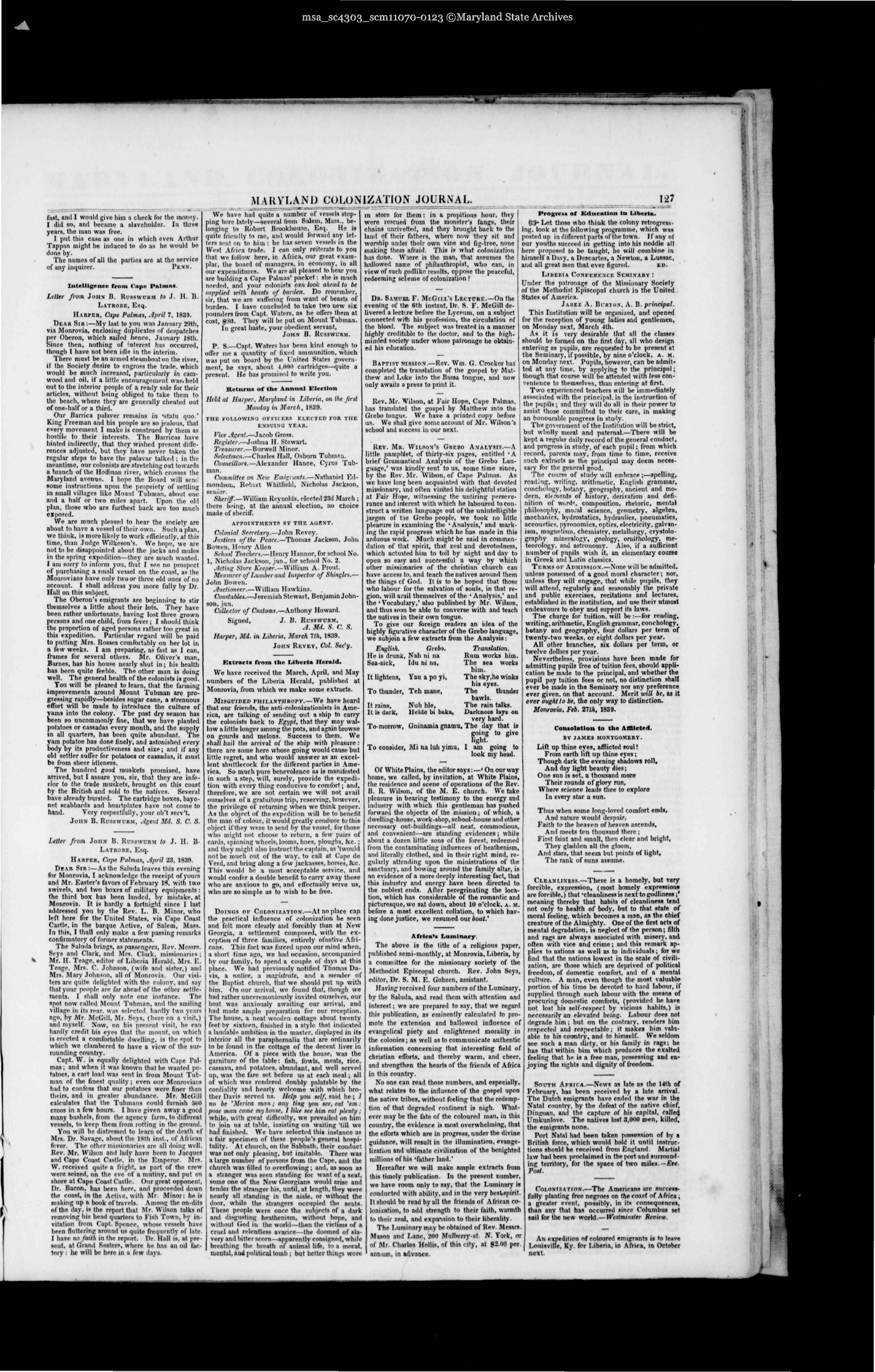
| MARYLAND COLONIZATION JOURNAL fast, and I would give him a check for the money. I did so, and became a slaveholder. In three years, the man was free. I put this case as one in which even Arthur Tappan might be induced to do as he would be done by. The names of all the parties are at the service of any inquirer. Penn. Intelligence from Cape Palmas. Letter from John B. Russwurm to J. H. B. Latrobe, Esq. Harper, Cape Palmas, April 7, 1839. Dear Sir:—My last to you was January 29th, via Monrovia, enclosing duplicates of despatches per Obcron, which sailed hence, January lSth. Since then, nothing of 'nterest has occurred, though I have not been idle in the interim. There must be an armed steamboat on the river, if the Society desire to engross the trade, which would be much increased, particularly in cam- wood and oil, if a little encouragement was. held out to the interior people of a ready sale for their articles, without being obliged to take them to the beach, where they are generally cheated out of one-half or a third. Our Barrica palaver remains in 'statu quo.' King Freeman and his people are so jealous, that every movement I make is construed by them as hostile to their interests. The Barncas have hinted indirectly, that they wished present diffe- rences adjusted", but they have never taken the regular steps to have the palavar talked ; in the meantime, our colonists are stretching out towards a branch of the Hoffman river, which crosses the Maryland avenue. I hope the Board will sem some instructions upon the propriety of settling in small villages like Mount Tubman, about one and a half or two miles apart. Upon the old plan, those who are furthest back are too much exposed. We are much pleased to hear the society are about to have a vessel of their own. Such a plan, we think, is more likely to work efficiently, at thi.s time, than Judge Willieson's. We hope, we are not to be disappointed about the jacks and mules in the spring expedition—they are much wanted. I am sorry to inform you, that I see no prospect of purchasing a small vessel on the coast, as the Monrovians have only two or three old ones of no account. I shall address you more fully by Dr. Kail on this subject. The Oberon's emigrants are beginning to stir themselves a little about their lots. They have been rather unfortunate, having lost three grown persons and one child, from fever; I should think the proportion of aged persons rather too great in this expedition. Particular regard will be paid to putting Mrs. Rosses comfortably on her lot in a few weeks. I am preparing, as fast as I can, frames for several others. Mr. Oliver's man, Barnes, has his house nearly shut in; his health has been quite feeble. The other man is doing well. The general health of the colonists is good. You will be pleased to learn, that the farming improvements around Mount Tubman are pro- gressing rapidly—besides sugar cane, a strenuous effort will be made to introduce the culture of yams into the colony. The past dry season has been so uncommonly fine, that we have planted potatoes or cassadas every month, and the supply in all quarters, has been quite abundant. The yam potatoe has done finely, and astonished every body by its productiveness and size; and if any old settler suffer for potatoes or cassadas, it must be from sheer idleness. The hundred good muskets promised, have arrived, but I assure you, sir, that they are infe- rior to the trade muskets, brought on this coast by the British and sold to the natives. Several have already bursted. The cartridge boxes, bayo- net scabbards and heartplates have not come to hand. Very respectfully, your ob'l serv't, John B. Russwurm, Agent Md. S. C. S. We have had quite a number of vessels stop- ping here lately—several from Salem, Mass.. be- longing to Robert Brookhouse, Esq. He is quite friendly to me, anil would fbrwaid any let- ters sent on to him : he has seven vessels in the West Africa trade. I can only reiterate to you that we follow here, in Africa, our great exam- plar, the board of managers, in economy, in all our expenditures. We are all pleased to hear you are building a Cape Palmas' packet: she is much needed, and your colonists can look ahead to be supplied vil/i beasts of burden. Do remember, sir, that we are suffering from want of beasts of burden. I have concluded to take two new six pounders from Capt. Waters, as be offers them at cost, $80. They will be put on Mount Tubman. In great haste, your obedient servant, John B. Russwurm. p. S.—Capt. Waters has been kind enough to offer me a quantity of fixed ammunition, which was put on board by the United States govern- ment, he says, about 4,000 cartridges—quite a present. He has promised to write you. Returns of the Annual Election Held at Harper, Maryland in Liberia, on the first Monday in March, 1839. THE FOLLOWING OFFICERS ELECTED FOR THE ENSUING YEAR. Vice Agent.—Jacob Gross. Register.—Joshua II. Stewart. Treasurer.—Burwell Minor. Selectmen.—Charles Hall, Osborn Tubman. Councillors.—Alexander Hance, Cyrus Tub- man. Committee on New Emigrants.—Nathaniel Eil- mondson, Robert Whitfield, Nicholas Jackson, senior. Sheriff.—William Reynolds, elected 23d March ; there being, at the annual election, no choice made of sheriff. APPOINTMENTS BY THE AGENT. Colonial Secretary.—John Revey. Justices of the Peace.—Thomas Jackson, John Bowen, Henry Allen School Teachers.—Henry Hannor, for school No. 1, Nicholas Jackson, JOB., for school No. 2. Acting Store Keeper.—William A. Front. Measurer of Lumber and Inspector of Shingles.— John Bowen. Auctioneer.—William Hawkins. Constables.—Jeremiah Stewart, Benjamin John- son, in n. Collector of Customs.—Anthony Howard. Signed, J. B. Russwurm A. Md. S. C. S. Harper, Md. in Liberia, March 1th, 1839. John Revey, Col. Sec'y. Letter from John B. Russwurm to J. H. B. Latrobe, Esq. Harper, Cape Palmas, April 23, 1839. Dear Sir:—As the Saluda leaves this evening for Monrovia, I acknowledge the receipt of yours and Mr. Easter's favors of February 18, with two swivels, and two boxes of military equipments: the third box has been landed, by mistake, at Monrovia. It is hardly a fortnight since I last addressed you by the'Rev. L. B. Minor, who left here for the United States, via Cape Coast Castle, in the barque Active, of Salem, Mass. In this, I thall only make a few passing remarks confirmatory of former statements. The Saluda brings, as passengers, Rev*. Messrs. Seys and Clark, and Mrs. Clark, missionaries; Mr. II. Teage, editor of Liberia Herald, Mrs E. Teage, Mrs. C. Johnson, (wife and sister,) and Mrs Mary Johnson, allot Monrovia. Our visi- ters are quite delighted with the colony, and say that your people are fur ahead of the other settle- ments. I shall only note one instance. The spot now called Mount Tubman, and the smiling village in its rear, was selected hardly two years ago, by Mr. McGill, Mr. Seys, (here on n visit,) and myself. Now, on his present visit, he ran hardly credit bis eyes that the mount, on which is erected a comfortable dwelling, is the spot to which we clambered to have a view of the sur- rounding country. Capt. W. is equally delighted with Cape Pal- mas; and when it was known that he wanted po- tatoes, a cart load was sent in from Mount Tub- man of the finest quality; even our Monrovians had to confess that our potatoes were finer than theirs, and in greater abundance. Mr. McGill calculates that the Tubmans could furnish 500 croos in a few houn. I have given away a goal many bushels, from the agency farm, to different vessels, to keep them from rotting in the ground. You will be distressed to learn of the death of Mrs. Dr. Savage, about the 18th inst, of Afiican fever. The other missionaries are all doing well. Rev. Mr. Wilson and lady hare been to Jacques and Cape Coast Castle, in the Emperor. Mrs. W. received quite a fright, as part of the crew were seized, on the eve of a mutiny, and put on shore at Cape Coast Castle. Our great opponent, Dr. Bacon, has been here, and proceeded down the coast, in the Active, with Mr. Minor: he is making up a book of travels. Among the on-dits of the day, is tbe report that Mr. Wilson talks of removing his bead quarters to Fish Town, by in- vitation from Capt. Spence, whose vessels have been fluttering around us quite frequently of late. I have no faith in the report. Dr. Hall is, at pre- sent, at Grand Sesters, where he has an oil fac- tory : he will be here in a few days. Extracts from the Liberia Herald. We have received the March, April, and May numbers of tbe Liberia Herald, published at Monrovia, from which we make some extracts. Misguided philanthropy.—We have heard that our friends, the anti-colonizationists in Ame- rica, are talking of sending out a ship to carry the colonists back to Egypt, that they may wal- low a little longer among the pots, and again browse on gourds and melons. Success to them. We shall hail the arrival of the ship with pleasure: there are some here whose going would cause but little regret, and who would answer as an excel- lent shuttlecock for the dillerent parties in Ame- rica. So much pure benevolence as is manifested in such a step, will, surely, provide the expedi- tion with every thing conducive to comfort ; and, therefore, we are not certain we will not avail ourselves of a gratuitous trip, reserving, however, the privilege of returning when we think proper. As the object of the expedition will be to benefit the man of colour, it would greatly conduce to this object if they were to send by the vessel, for those who might not choose to return, a few pairs of cards, spinning wheels,looms, hoes, ploughs, he.: and they might also instruct the captain, as'twould not be much out of the way, to call at Cape de Verd, and bring along a few jackasses, horses, fee. This would be a most acceptable service, and would confer a double benefit to carry away those who are anxious to go, and effectually serve us, who are so simple as to w ish to be free. Doings of Colonization.—At no place can the practical influence of colonization be seen and felt more clearly and forcibly than at New Georgia, a settlement composed, with the ex- ception of three families, entirely of'native Afri- cans. This fact was forced upon our mind when, a short time ago, we had occasion, accompanied by our family, to spend a couple of days at this place. We had previously notified Thomas Da- vis, a native, a magistrate, and a member of the Baptist cburch, that we should put up with him. On our arrival, we found that, though we had rather unceremoniously invited ourselves, our host was anxiously awaiting our arrival, and had made ample preparation for our reception. The house, a neat wooden cottage about twenty feet by sixteen, finished in a style that indicated a laudable ambition in the master, displayed in its interior all the paraphernalia that are ordinarily to be found in the cottage of the decent liver in America. Of a piece with the house, was the garniture of the table: fish, fowls, meats, rice, cassava, and potatoes, abundant, and well served up, was the fare set before us at each meal; all of which was rendered doubly palatable by the cordiality and hearty welcome with which bro- ther Davis served us. Help you self, said he; I no be 'Mrrica man; any ting you see, eat 'em: pose man come my house, J like see him eat plenty ; while, with great difficulty, we prevailed on him to join us at table, insisting on waiting 'till we had finished. We have selected this instance as a fair specimen of these people's general hospi- tality. At church, on the Sabbath, their conduct was not only pleasing, but imitable. There was a large number of persons from the Cape, and the church was filled to overflowing; and, as soon as a sti anger was seen standing for want of a seat, some one of the New Georgians would arise and tender the stranger his, until, at length, they were nearly all standing in the aisle, or without the door, wdiile the strangen occupied the seats. These people were once the subjects of a dark and disgusting heathenism, without hope, and without God in the world—then the victims of a cruel and relentless avarice—the doomed of sla- very and bitter scorn—apparently consigned, while breathing the breath of animal life, fa a moral, mental, and political tomb ; but better things were in store lor them: in a propitious hour, they were rescued from the monster's fangs, their chains unrivetted, and they brought back to the land of their fathers, where now they sit and worship undei their own vine and fig-tree, none making them afraid. This is what colonization has done. Wiere is the man, that assumes the hallowed nan.e of philanthropist, who can, in view of such godlike results, oppose the peaceful, redeeming scl.enie of colonization > Dr. Samuel F. McGill's Lecture.—On the evening of the 6th instant, Dr. S. F. McGill de- livered a tecti re before the Lyceum, on a subject connected with his profession, the circulation of the blood. The subject was treated in a manner highly creditable to the doctor, and to the high- minded society under whose patronage he obtain- ed his education. Baptist mission.—Rev. Win. G. Crocker has completed the translation of the gospel by Mat- thew and Luke into the Bassa tongue, and now only awaits a press to print it. Rev. Mr. Wilson, at Fair Hope, Cape Palmas, has translated the gospel by Matthew into the Grebo tongue. We have a printed copy before us. We shaJ give some account ot Mr. Wilson's school and success in our next. Rev. Mr. Wilson's Grebo Analysis.—A little pamphlet, of thirty-six pages, entitled 'A brief Grammatical Analysis of the Grebo Lan- guage,* was kindly sent to us, some time since, by the Rev. Mr. Wilson, of Cape Palmas. As we have Ion; been acquainted with that devoted missionary, tnd often visited his delightful station at Fair Hope, witnessing the untiring perseve- rance and interest with which he laboured to con- struct a written language out of the unintelligible jargon of tie Grebo people, we took no little pleasure in examining the 'Analysis,' and mark- ing the rapid progress which he has made in this arduous woik. Much might he said in commen- dation of tl.at spirit, that zeal and devotedness, which actuvted him to toil by night and dav to open so easy and successful a way by which other inissbnaries of the christian church can have access to. and teach the natives around them the things rf God. It is to be hoped that those who labour for the salvation of souls, in that re- gion, will a.'ail themselves of the ' Analysis,' and the ' Vocabulary,'also published by Mr. Wilson, anil thus so:>n be able to converse with and teach the natives in their own tongue. To give our foreign readers an idea of the highly figurative character of the Grebo language, we subjoin a few extracts from the Analysis: English. Grebo. Translation. He is drunk, Nah ni na Rum works him. Sea-sick, Idu ni na, The sea works him. It lightens, Yau a po yi, The sky.he winks his eyes. To thunder, Teh mane, The thunder bawls. It rains. Null hie, The rain talks. Il is dark, Heide bi baka, Darkness lays on very hard. Tomorrow, Gninamia gnamu, The day that is going to give fight. To consider, Mi na lull yimu, I am going to look my head. 127 Progress of EducationIn Liberia. Let those who think the colony retrogress- ing, look at the following programme, which was posted up in different parts of the town. If any of our youths succeed in getting; into his noddle all here proposed to be taught, ne will combine in himself a Davy, a Descartes, a Newton, a Lussac, and all great men that ever figured. ED. Liberia Conference Seminary : Under the patronage of the Missionary Society of the Methodist Episcopal church in the United States of America. Jabez A. Burton, A. B. principal. Tbis Institution will be organized, and opened for the reception of young ladies and gentlemen, on Monday next, March 4th. As it is very desirable that all the classes should be formed on the first day, all who design entering as pupils, are requested to be present at the Seminary, if possible, by nine o'clock, A. M. on Monday next. Pupils, however, can be admit- ted at any time, by applying to the principal; though that course will be attended with less con- venience to themselves, than entering at first. Two experienced teachers will be immediately associated with the principal, in the instruction of the pupils ; and they w ill do all in their power to assist those committed to their care, in making an honourable progress in study. The government of the Institution will be strict, but wholly moral and paternal.—There will be kept a regular daily record of the general conduct, and progress in study, of each pupil; from which record, parents may, from time to time, receive such extracts as the principal may deem neces- sary for the general good. The course of study will embrace ;—spelling, reading, writing, arithmetic, English grammar, conchclogy, botany, geography, ancient and mo- dern, elements of hisfory, derivation and defi- nition of word", composition, rhetoric, mental philosophy, mo.'al science, geometry, algebra, mechanics, hydrostatics, hydraulics, pneumatics, accoustics, pyronomics. optics, electricity, galvan- ism, magnetism, chemistry, metallurgy, crystolo- graphy mineralogy, geology, ornithology, me- teorology, and astronomy. Also, if a sufficient number of pupils wish it, an elementary course in Greek and Latin classics. Terms of Admission.—None will be admitted, unless possessed of a good moral character; nor, unless they will engage, that while pupils, they will attend, regularly and seasonably the private and public exercises, recitations and lectures, established in the institution, and use their utmost endeavours to obey and support its laws. The charge for tuition, will be :—for reading, writing, arithmetic, English grammar, conchology, botany and geography, four dollars per term of twenty-two weeks, or eight dollars per year. All other branches, six dollars per term, or twelve dollars per year. Nevertheless, provisions have been made for admitting pupils free of tuition fees, should appli- cation be made to the principal, and whether the pupil pay tuition fees or not, no distinction shall ever be made in the Seminary nor any preference ever given, on that account. Merit will be, as it ever ought to be, the only way to distinction. Monrovia, Feb. 27th, 1839. Of White Plains, the editor says:—• On our way home, we called, by invitation, at White Plains, the residence and scene of operations of the Rev. B. R. Wilson, of the Bi. E. church. We take pleasure in bearing testimony to the energy and industry with which this gentleman has pushed forward the objects of the mission; of which, a dwelling-house, work-shop, school-house and other necessary out-buildings—all neat, commodious, and convenient—are standing evidences; while about a dozen little sons of the forest, redeemed from the contaminating influences of heathenism, and literally clothed, and in their right mind, re- gularly attending upon the ministrations of the sanctuary, and bowing around the family altar, is an evidence of a more deeply interesting fact, that this industry and energy have been directed to the noblest ends. After peregrinating the loca- tion, which has considerable of the romantic and picturesque, we sat down, about 10 o'clock, A. M. before a most excellent collation, to which hav- ing done justice, we resumed our boat.' Africa's Luminary. The above is the title of a religious paper, published semi-monthly, at Monrovia, Liberia, by a committee for the missionary society of the Methodist Episcopal church. Rev. John Seys, editor, Dr. S. M. E. Goheen, assistant. Having received four numbers of the Luminary, by the Saluda, and read them with attention and interest; we are prepared to say, that we regard this publication, as eminently calculated to pro- mote the extension and hallowed influence of evangelical piety and enlightened morality in the colonies; as well as to communicate authentic information concerning that interesting field of christian efforts, and thereby warm, and cheer, and strengthen the hearts of the friends of Africa in this country. No one can read those numbers, and especially, what relates to the influence of the gospel upon the native tribes, without feeling that the redemp- tion of that degraded continent is nigh. What- ever may be the fate of the coloured man, in this country, the evidence is most overwhelming, that the efforts which are in progress, under the divine guidance, will result in the illumination, evange- lization and ultimate civilization of the benighted millions of his 'father land.' Hereafter we will make ample extracts from this timely publication. In the present number, we have room only to say, that the Luminary is conducted with ability, and in the very bestspirit. It should he read by all the friends of African co- lonization, to add strength to their faith, warmth to their zeal, and expansion to their liberality. The Luminary m?.y be obtained of Rev. Messrs. Mason and Lane, 200 Mulherry-st. N. York, or of Mr Charles Hollis, of this city, at 82.00 per. annum, in advance. Consolation to the Afflicted. BY JAMES MONTGOMERY. Lift up thine eyes, afflicted soul! From earth lift up thine eyes; Though dark the evening shadows roll, And day light beauty dies; One sun is set, a thousand more Their rounds of glory run. Where science leads thee to explore In every star a sun. Thus when some long-loved comfort ends. And nature would despair, Faith to the heaven of heaven ascends, And meets ten thousand there; First faint and small, then clear and bright, They gladden all the gloom, And stars, that seem but points of light, The rank of suns assume. Cleanliness.—There is a homely, but very forcible, expression, (most homely expressions are forcible,) that 'cleanliness is next to godliness;' meaning thereby that habits of cleanliness tend not only to health of body, but to that state of moral feeling, which becomes a man, as the chief creature of the Almighty. One of the first acts of mental degradation, is neglect of the person; filth and rags are always associated with misery, and often with vice and crime; and tbis remark ap- plies to nations as well as to individuals; for we find that the nations lowest in the scale of civili- zation, are those which are deprived of political freedom, of domestic comfort, and of a mental culture. A man, even though the most valuable portion of his time be devoted to hard labour, if supplied through such labour with the means of procuring domestic comforts, (provided he have not lost his self-respect by vicious habits,) is necessarily an elevated being. Labour does not degrade him; but on the contrary, renders him respected and respectable; it makes him valu- able to his country, and to himself. We seldom see such a man dirty, or his family in rags; he has that within him which produces the exalted feeling that he is a free man, possessing and en- joying the rights and dignity of freedom. South Africa.—News as late as the 14th of February, has been received by a late arrival. The Dutch emigrants have ended the war in the Natal country, by the defeat of the native chief, Dingoan, and the capture of his capital, called, Umkunlove. The native! lost 3,000 men, killed, the emigrants none. Port Natal had been taken possession of by a British force, which would hold it until instruc- tions shonld be received from England. Martial law had been proclaimed in the port and surround- ing territory, for the space of two miles— Eve. Pott. Colonization.—The Americans are success- fully planting free negroes on the coast of Africa; a greater event, possibly, in its consequences, than any that has occurred since Columbus set sail for the new world —Westminster Review. An expedition of coloured emigrants is to leave Louisville, Ky. for Liberia, in Africa, in October next. |