 |
|
|
 |
|
 |
|
|||
|
||||
|
||||
|
Maryland State Archives Maryland Colonization Journal Collection MSA SC 4303 msa_sc4303_scm11070-0124 Enlarge and print image (5M) |
|
|
|
|
|
|
|
|||
|
||||
|
||||
|
Maryland State Archives Maryland Colonization Journal Collection MSA SC 4303 msa_sc4303_scm11070-0124 Enlarge and print image (5M) |
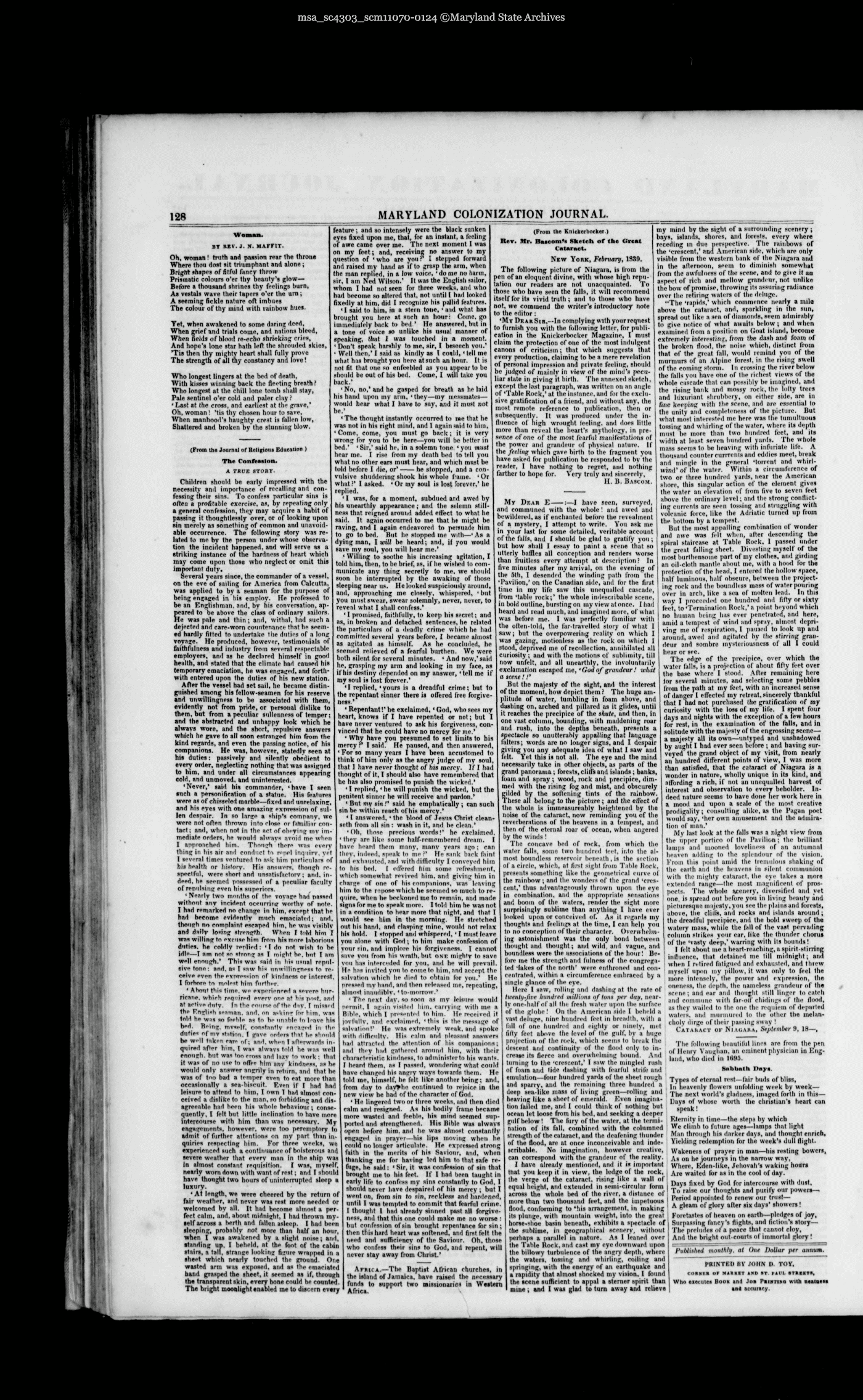
| 12ft MARYLAND COLONIZATION JOURNAL. Woman. BY REV. J. N. MAFFIT. Oh, woman I truth and passion rear the throne Where thou dost sit triumphant and alone ; Bright shapes of fitful fancy throw Prismatic colours o'er thy beauty's glow— Before a thousand shrines thy feelings burn, As vestals wave their tapers o'er the urn; A seeming fickle nature oft imbues The colour of thy mind with rainbow fmei. Yet, when awakened to some daring deed. When grief and trials come, and nations bleed, When fields of blood re-echo shrieking cries, And hope's lone star hath left the shrouded skies, 'Tis then thy mighty heart shall fully prove The strength of all thy constancy and love! Who longest lingers at the bed of death, With kisses winning back the fleeting breath? Who longest at the chill lone tomb shall stay, Pale sentinel o'er cold and paler clay ? ' Last at the cross, and earliest at the grave,' Oh, woman I 'tis thy chosen hour to save. When manhood's haughty crest is fallen low, Shattered and broken by the stunning blow. (From the Journal of Religious Education ) The Confession. A TRUE STORY. Children should be early impressed with the necessity and importance of recalling and con- fessing their sins. To confess particular sins is often a profitable exercise, as, by repeating only a general confession, they may acquire a habit of passing it thoughtlessly over, or of looking upon sin merely as something of common and unavoid- able occurrence. The following story was re- lated to me by the person under whose observa- tion the incident happened, and will serve as a striking instance of the hardness of heart which may come upon those who neglect or omit this important duty. Several years since, the commander of a vessel, on the eve of sailing for America from Calcutta, was applied to by a seaman for the purpose of being engaged in his employ. He professed to be an Englishman, and, by his conversation, ap- peared to be above the class of ordinary sailors. He was pale and thin ; and, withal, had such a dejected and care-worn countenance that he seem- ed hardly fitted to undertake the duties of a long voyage. He produced, however, testimonials of faithfulness and industry from several respectable employers, and as he declared himself in good health, and stated that the climate had caused his temporary emaciation, he was engaged, and forth- with entered upon the duties of his new station. After the vessel had set sail, he became distin- guished among his fellow-seamen for his reserve and unwillingness to be associated with them, evidently not from pride, or personal dislike to them, but from a peculiar sullenness of temper; and the abstracted and unhappy look which he always wore, and the short, repulsive answers which he gave to all soon estranged him from the kind regards, and even the passing notice, of his companions. He was, however, statedly seen at his duties: passively and silently obedient to every order, neglecting nothing that was assigned to him, and under all circumstances appearing cold, and unmoved, and uninterested. 'Never,' said his commander, 'have I seen such a personification of a statue. His features were as of chisseled marble—fixed and unrelaxing, and his eyes with one amazing expression of sul- len despair. In so large a ship's company, we were not often thrown into close or familiar con- tact; and, when not in the act of obeying mv im- mediate orders, he would always avoid me when I approached him. Though there was every thing in his air and conduct to r»pel inquiry, yet I several times ventured to ask him particulars of his health or history. His answers, though re- spectful, were short and unsatisfactory; ami. in- deed, he seemed possessed of a peculiar faculty of repulsing even his superiors. * Nearly two months of the voyage hail passed without any incident occurring worthy of note. I had remarked no change in him. except that he had become evidently much emaciated; and, though no complaint escaped him, he was visibly and daily lo»ing strength. When I told hirn I was willing to excuse him from his more laborious duties, he coldly replied : ' I do not wisb to he idle—T am not sn strong as I might be, but I am well enough.' This was said in Mi usual repul- sive tone; and, as I saw Ills unwillingness to re- ceive even the expression of kindness or interest. I forbore to molest him further. ' About this time, we experienced a severe hur- ricane, which required every one at his post, and at active dutv. In the course of the d iv. I missed the English seaman, and. on asking for him. was told he was so fepble as to be unable to I -ave his bed. Being, myself, constantly engaged in the duties of my station. I gave orders that he should be wdl taken care of; and, when I afterwards in- quired after him, I was always told he was well enough, hut was too cross and Ia7.v to work | that it was of no use to offer him any kindness, as he would only answer angrily in return, and that he was of too bad a temper even to eat more than occasionally a sea-biscuit. Even if I had had leisure to attend to him, I own I had almost con- ceived a dislike to the man, so forbidding and dis- agreeable had been his whole behaviour; conse- quently, I felt but little inclination to have more intercourse with him than was necessary. My engagements, however, were too peremptory to admit of further attentions on my part than in- quiries respecting him. For thrpe wpeks, we experienced such a continuance of boisterous and severe weather that every man In the ship was In almost constant requisition. I was, myself, nearly worn down with want of rest; and I should have thought two hours of uninterrupted sleep a luxury. ' At length, we were cheered by the return of fair weather, and never was rest more needed or welcomed by all. It had become almost a per- fect calm, and, about midnight, I had thrown my- self across a berth and fallen asleep. I had been sleeping, probably not more than half an hour, when I was awakened by a slight noise; and, standing up. I beheld, at the font of the cabin stairs, a tall, strange looking figure wrapped in a sheet which nearly touched the ground. One wasted arm was exposed, and as the emaciated band grasped the sheet, it seemed as if, through the transparent skin, every bone could be counted. The bright moonlight enabled me to discern every feature ; and so intensely were the black sunken eyes fixed upon me, that, for an instant, a feeling of awe came over me. The next moment I was on my feet; and, receiving no ariswer to my question of ' who are you ?' I stepped forward and raised my hand as if to grasp the arm, when the man replied, in a low voice, 'dome no harm, sir, I am Ned Wilson.' It was the English sailor, whom I had not seen for three weeks, and who had become so altered that, not until I had looked fixedly at him, did I recognize his pallid features. ' I said to him, in a stern tone, ' a id what has brought you here at such an hour: Come, go immediately hack to bed ' He answered, but in a tone of voice so unlike his usual manner of speaking, that 1 was touched in a moment. ' Don't speak harshly to me, sir, I beseech vou.' ' Well then.' I said as kindly as I coald, 'tell me what has brought you here at such an hour. It is not fit that one so enfeebled as you tppear to be should be out of his bed. Come, I will take you hack.' 'No, no,' and he gasped for breath as he laid his hand upon my arm, ' they—my messmates— would hear what I have to say, and it must not be.' 'The thought instantly occurred to me that he was not in his right mind, and I again-said to him, 'Come, come, you must go back; it is very wrong for you to be here—you will be better in bed.' 'Sir,' said he, in a solemn tone 'you MM. hear me. I rise from my death bed to tell you what no other ears must hear, and which must be told before I die, or'------he stopped, and a con- vulsive shuddering shook his whole Paine. 'Or what ?' I asked. ' Or my soul is lost forever,' he replied. ' I was, for a moment, subdued ard awed by his unearthly appearance; and the solemn still- ness that reigned around added effect to what he said. It again occurred to me that he might be raving, and I again endeavored to persuade him to go to bed. But he stopped me with—'As a dying man, I irill be heard; and, il you would save my soul, you will hear me.' ' Willing to soothe his increasing agitation, I told him, then, to be brief, as, if he wished lo com- municate any thing secretly to me, we should soon be interrupted by the awaking of those sleeping near us. He looked suspiciously around, and, approaching me closely, whispered, ' but you must swear, swear solemnly, never, never, to reveal what I shall confess.' 'I promised, faithfully, to keep his secret; and as, in broken and detached sentences, he related the particulars of a deadly crime which he had committed several years before, I became almost as agitated as himself. As he concluded, he seemed relieved of a fearful burthen. We were both silent for several minutes. ' And now,'said he, grasping my arm and looking in my face, as if his destiny depended on my answer, 'tell me if my soul is lost forever.' 'I replied, 'yours is a dreadful crime; but to the repentant sinner there is offered free forgive- ness ' ' Repentant!' he exclaimed, ' God, who sees my heart, knows if I have repented or not; but I have never ventured to ask his forgiveness, con- vinced that he could have no mercy for me.' • Why have you presumed to set limits to his mercy ?' I said. He paused, and then answered, ' For so many years I have been accustomed to think of him only as the angry judge of my soul, that I have never thought of his mercy. If I had thought of it, I should also have remembered that he has also promised to punish the wicked.' ' I replied,' he will punish the wicked, but the penitent sinner he will receive and pardon.' ' But my sin!' said he emphatically ; can such sin be within reach of his mercy.' ' I answered. • the blood of Jesus Christ clean- seth from all sin t wash in it, and he clean.' 'Oh, those precious words!' he exclaimed. ' they are like some half-remembered dream. I have heard them many, many years ago; can they, indeed, speak to me >' He sank bark faint and exhausted, and with difficulty I conveyed him to his bed. I offered him some refreshment, which somewhat revived him, and giving him in charge of one of his companions, was leaving him to the repose which he seemed so much to re- quire, when be beckoned me to remain, and made signs for me to speak more. I told him he was not in a condition to hear more that night, and that I would see him in the morning. He stretched out his hand, and clasping mine, would riot relax his hold. I stopped ami whispered, ' I must leave you alone with God ; to him make confession of your sin. and implore his forgiveness. I cannot save you from his wrath, but on*f. mighty to save vou has interceded for you, and he will prevail. He has invited vou to come to him, and accept the salvation which lie died to obtain for you.' He pressed my hand, and then released me, repeating, almost inaudiblv. ' to-morrow.' •The next day. so soon as my leisure would permit, I again visited him. carrying with me a Bible, which I presented to him. He received it lovf'illv. and exclaimed, 'this is the message of salvation!' He was extremely weak, and spoke with difficulty. His calm and pleasant answers had attracted the attention of his companions: and they bad gathered around him, with their characteristic kindness, to administer to his wants. I heard them, as I passed, wondering what could have changed his angry ways towards them. He told me, himself, he felt like another being; and, from day to day he continued to rejoice in the new view he had of the character of God. ' He lingered two or three weeks, and then died calm and resigned. As his bodily frame became more wasted and feeble, his mind seemed sup- ported and strengthened. His Bible was always open before him. and he was almost constantly engaged in prayer—his lips moving when he could no longer articulate. He expressed strong faith in the merits of his Saviour, and, when thanking me for having led him to that safe re- fuge, he said; 'Sir, it was confession of sin that brought me to his feet. If I had been taught in early life to confess my sins constantly to God, I should never have despaired of his mercy ; but I went on, from sin to sin, reckless and hardened, until I was tempted to commit that fearful crime. I thought I had already sinned past all forgive- ness, and that this one could make me no worse : but confession of sin brought repentance for sin ; then this hard heart was softened, and first felt the need and sufficiency of the Saviour. Oh, those who confess their sins to God, and repent, will never stay away from Christ.' (From the Knickerbocker.) Rev. Mr. Bascom's Sketch of the Great Cataract. New York, February, 1839. The following picture of Niagara, is from the pen of an eloquent divine, with whose high repu- tation our readers are not unacquainted. To those who have seen the falls, it will recommend itself for its vivid truth ; and to those who have not, we commend the writer's introductory note to the editor : 'My Dear Sir,—In complying with your request to furnish you with the following letter, for publi- cation in the Knickerbocker Magazine, I must claim the protection of one of the most indulgent canons of criticism; that which suggests that every production, claiming to be a mere revelation of personal impression and piivate feeling, should be judged of mainly in view of the mind's pecu- liar state in giving it birth. The annexed sketch, except the la.st paragraph, was written on an angle of 'Table Rock,' at the instance, and for the exclu- sive gratification of a friend, and without any, the most remote reference to publication, then or subsequently. It was produced under the in- fluence of high wrought leeling, and does little more than reveal the heart's mythology, in pre- sence of one of the most fearful manifestations of the power and grandeur of physical nature. If the feeling which gave birth to the fragment you have asked for publication be responded to by the reader, I have nothing to regret, and nothing farther to hope for. Very truly and sincerely, H. B. Bascom. My Dear E-----:—I have teen, surveyed. and communed with the whole ! and awed and bewildered, as if enchanted be lore the revealment of a mystery, I attempt to write. You ask me in your last for some detailed, veritable account of the falls, and I should be glad to gratify you; but how shall I essay to paint a scene that so utterly baffles all conception and rentiers worse than fruitless every attempt at description? In five minutes after my arrival, on the evening of the 5th, I desended the winding path from the '1'avilion,' on the Canadian side, and lor the first time in my life saw this unequalled cascade, Irom 'table rock;' the whole indescribable scene, in bold outline, bursting on my view at once. Iliad heard and read much, and imagined more, of what was before me. I was perlectly familiar with the often-told, the far-travelled story of what 1 saw; but the overpowering reality on which I was gazing, motionless as the rock on which I stood, deprived me o( recollection, annihilated all curiosity ; and with the motions of sublimity, till now unfelt, and all unearthly, the involuntarily exclamation escaped me, 'Godof grandeur.' what a scene ! !' But the majesty of the sight, and the interest of the moment, how depict them ? The huge am- plitude of water, tumbling in foam above, and dashing on, arched and pillared as it glides, until it reaches the precipice of the shute, and then, in one vast column, bounding, with maddening roar and rush, into the depths beneath, presents a spectacle so unutterably appalling that language falters; words are no longer signs, and I despair giving you any adequate idea of what I saw and felt. Vet this is not all. The eye and the mind necessarily take in other objects, as parts of the grand panorama ; forests, dill's and islands ; banks, foam and spray ; wood, rock and precipice, dim- med with the rising fog and mist, and obscurely gilded by the softening tints of the rainbow. 1 These all belong to the picture ; and the effect of the whole is immeasureably heightened by ttie noise of the cataract, now reminding you of the reverberations of the heavens in a tempest, and then of the eternal roar of ocean, when angered by the winds ! The concave bed of rork, from whirh the water falls, some two hundred leet, into the al- most boundless reservoir beneath , is the section of a circle, which, at first sight from Table Hock, presents something like the geometrical curve of the rainbow; and the wondeis of the grand 'cres- cent,' thus advantageously thrown upon the eye in combination, and the appropriate sensations and boom of the waters, render the sight more surprisingly sublime than anything I have ever looked upon or conceived of. As it regards my thoughts and feelings at the time, I can help you to no conception of their character. Overwhelm- ing astonishment was the only bond between thought and thought; and wild, and vague, and boundless were the associations of the hour! Be- fore me the strenglh and fulness of the congrega- ted 'lakes of the north' were enthroned and con- centrated, within a circumference embraced by a single glance of the eye. Here I saw, rolling and dashing at the rate of twenty-five hundred millions of tons per day, near- ly one-half of all the fresh water upon the surface of the globe! On the American side I beheld a vast deluge, nine hundred feet in breadth, with a fall of one hundred and eighty or ninety, met filty feet above the level of the gulf, by a huge projection of the rock, which seems to break the descent and continuity of the flood only to in- crease its fierce and overwhelming bound. And turning to the 'crescent,* I saw the mingled rush of foam and tide dashing with fearful strife and emulation—four hundred yards of the sheet rough and sparry, and the remaining three hundred a deep sea-like mass of living green—rolling and heaving like a sheet of emerald. Even imagina- tion failed me, and I could think of nothing but ocean let loose from his bed, and seeking a deeper gulf below'. The fury of the water, at the termi- nation of its fall, combined with the columned strength of the cataract, and the deafening thunder of the flood, are at once inconceivable and inde- scribable. No imagination, however creative, can correspond with the grandeur of the reality. I have already mentioned, and it is important that you keep it in view, the ledge of the rock, the verge ol the cataract, rising like a wall of equal height, and extended in semi-circular form across the whole bed of the river, a distance of more than two thousand feet, and the impetuous flood, conforming to 'his arrangement, in making its plunge, with mountain weight, into the great horse-shoe basin beneath, exhibits a spectacle of the sublime, in geographical scenery, without perhaps a parallel in nature. As 1 leaned over the Table Rock, and cast my eye downward upon the billowy turbulence of the angry depth, where the waters, tossing and whirling, coiling and springing, with the energy of an earthquake and a rapidity that almost shocked my vision, I found the scene sufficient to appal a sterner spirit than mine ; and I was glad to turn away and relieve my mind by the sight of a MinwndhM scenery ; bays, islands, shores, and forests, every where receding in due perspective. The rainbows of the 'crescent,' ann American side, which are only visible from the western hank of the Niagara and in the afternoon, seem to diminish somewhat from the awfulncss of the scene, and to give it an aspect of rich and mellow grandeur, not unlike the bow of promise, throwing its assuring radiance over the retiring waters of the deluge. "The 'rapids,* which commence nearly a mile above the cataract, and, sparkling in the sun, spread out like I sea of diamonds, seem admirably to give notice of what awaits below ; and when examined from a position on ('oat island, become extremely interesting, from the dash and loam of the broken flood, the noise which, distinct from that of the great fall, would remind you of the murmurs of an Alpine forest, in the rising swell of the coming storm. In crossing the river below the falls vou have one of Ihe richest views of the whole cascade that can possibly be imagined, anil the rising bank and mossy rock, the lofty trees and luxuriant shrubbery, on either side, are in fine keeping with the scene, and are essential to the unity and completeness of the picture. But what most interested me here was the tumultuous tossing and whirling of the water, where its depth must be more than two hundred feet, and its width at least seven hundred yards. The whole mass seems to be heaving with infuriate life. A thousand counter currrents and eddies meet, break and mingle in the general 'torrent and whirl- wind'of the water. Within a circumference of two or three hundred yards, near the American shore, this singular action of the clement gives the water an elevation of from five to seven feet above the ordinary level; and the strong conflict- ing currents are seen tossing and struggling with volcanic force, like the Adriatic turned up from the bottom by a tempest. But the most appalling combination of wonder and awe was felt when, alter descending the spiral staircase at Table Hock. 1 passed under the great falling sheet. Divesting myself of the most burlhensouie part of my clothes, and girding an oilcloth mantle about me, with a hood for the firntection of the head, I entered the hollow space, lalf luminous, half obscure, between the project- ing rock and the boundless mass of water pouring over in arch, like a sea of molten lead. In this way I proceeded one hundred and fifty or sixty feet, to'Termination Bock,'a point beyond which no human being has ever penetrated, and here, amid a tempest of wind and spray, almost depri- ving me of respiration, I paused to look up and around, awed and agitated by the stirring gran- deur and sombre inysteriousness of all I could hear or see. The edge of the precipice, over which the water falls, is a projection of about fifty feet over the base where I stood. Alter remaining here tor several minutes, ami selecting some pebbles from the path at my feet, with an increased sense of danger I effected my retreat, sincerely thankful that I had not purchased Ihe gratification of my curiosity with the lost of my life. I spent four days and nights with the exception of a few hours for rest, in the examination of the falls, and in solitude with the majesty of the engrossing scene— a majesty all its own—untyped and unshadowed by aught I had ever seen before ; and having sur- veyed the grand object of my visit, from nearly an hundred different points of view, I was more than satisfied, that the cataract of Niagara is a wonder in nature, wholly unique in its kind, and affording a rich, if not an unequalled harvest of interest and observation to every beholder. In- deed nature seems to have done fier work here in a mood and upon a scale of the most creative prodigality; consulting alike, as the Pagan poet would say, 'her own amusement and the admira- tion of man.' My last look at the falls was a night view from the upper portico of the Pavilion; the brilliant lamps and mooned loveliness of an autumnal heaven adding to the splendour of the vision. I'l'iui this point amid the tremulous shaking of the earth and the heavens in silent communion with the mighty cataract, the eye takes a more extended range—the most magnificent of pros- pects. The whole scenery, diversified ami vet one, is spxead out before you in living beauty and picturesque majesty, ynu see the pl.iinsand forests, above, the cliils, and rocks ami islands around ; the dreadful precipice, and the bold sweep of the watery mass, while the fall of the vast pervading column stiikes your car, like the thunder chorus of the 'vasty deep,' warring with its hounds! I felt about me a heart-reaching, a spirit-stirring influence, that detained me till midnight; and when 1 retired fatigued and exhausted, and threw myself upon my pillow, it was only to feel the more intensely, the power and expression, the oneness, the depth, the nameless grandeur of the scene; and ear and thought still linger to catch and commune with far-olf eludings of the flood, as they wailed to the one the requiem of departed waters, and murmured to the other the melan- choly dirge of their passing away ! Cataract of Niagara, September 9, 18—, The following beautiful linos are from the pen of Henry Vaughan, an eminent physician in Eng- land, who died in 1695. Sabbath Days Types of eternal rest—fair buds of bliss, In heavenly flowers unfolding week by week— The next world's gladness, imaged forth in this— Days of whose worth the christian's heart can speak! F.ternity in time—the step3 by which We cliinh to future ages—lamps that light Man through his darker days, and thought enrich, Yielding redemption for the week's dull flight. Wakeneis of prayer in man—his resting bowers, As on be journeys in the narrow way, Where, Eden-like, Jehovah's waking hours Are waited lor as in the cool of day. . Days fixed by God for intercourse with dust, I To raise our thoughts and purify our powers— I Period appointed to renew our trust— i A gleam of glory alter six days' showers! Foretastes of heaven on earth—pledges of joy. Surpassing fancy's flights, and fiction's story— The preludes of a peace that cannot cloy, And the bright outcourts of immortal glory! Africa.—The Baptist African churches, in the island of Jamaica, have raised the necessary funds to support two missionaries in Western Africa. Published monthly, at One Dollar per annum. PRINTED BY JOHN D. TOY, CORNER OF MARKRT AND ST. PAUL STREETS, Who executes Book and Job Printing with neatness and accuracy. |