 |
|
|
 |
|
 |
|
|||
|
||||
|
||||
|
Maryland State Archives Maryland Colonization Journal Collection MSA SC 4303 msa_sc4303_scm11070-0125 Enlarge and print image (5M) |
|
|
|
|
|
|
|
|||
|
||||
|
||||
|
Maryland State Archives Maryland Colonization Journal Collection MSA SC 4303 msa_sc4303_scm11070-0125 Enlarge and print image (5M) |
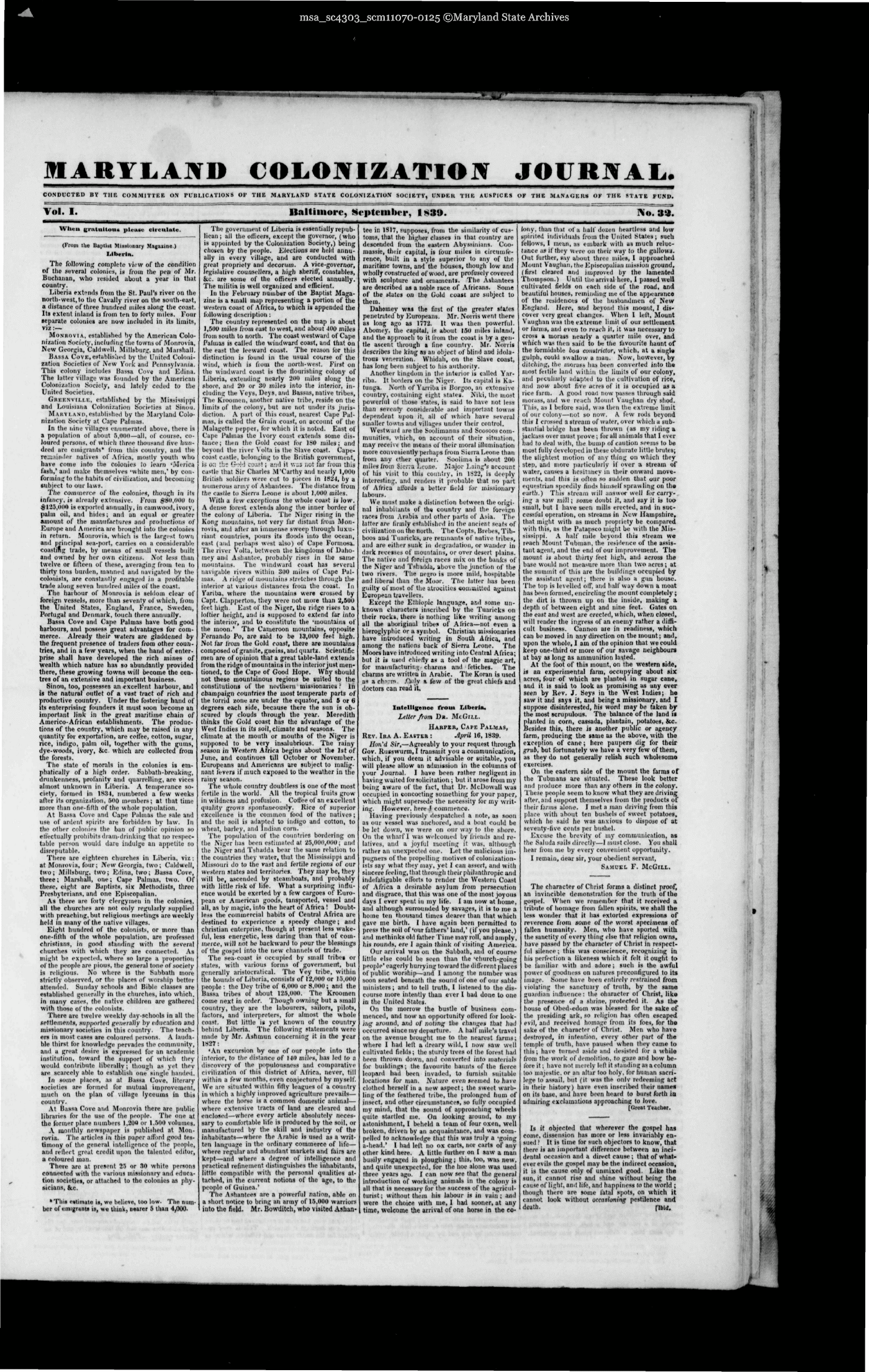
| MARYLAND COLONIZATION JOURNAL. CONDUCTED BY THE COMMITTEE ON PUBLICATIONS OF THE MARYLAND STATE COLONIZATION SOCIETY, UNDER THE AUSPICES OF THE MANAGERS OF THE STATE FUND. Vol. I. Baltimore, September, 1839. No. 32. When gratuitous please circulate. (From the Baptist Missionary Magazine ) Liberia. The following complete view of the condition of the several colonies, is from the pen of Mr. Buchanan, who resided, about a year in that country. Liberia extends from the St. Paul's river on the north-west, to the Cavally river on the south-east, a distance of three hundred miles along the coast. Its extent inland is from ten to forty miles. Four separate colonies are now included in its limits, viz:— Monrovia, established by (he American Colo- nization Society, including the towns of Monrovia, New Georgia, Caldwell, Millsburg, and Marshall. Bassa Cove, established by the United Coloni- zation Societies of New York and Pennsylvania. This colony includes Bassa Cove and Edina. The latter village was founded by the American Colonisation Society, and lalely ceded to the United Societies. Greenville, established by the Mississippi and Louisiana Colonization Societies at Sinou. Maryland,established by the Maryland Colo- nization Society at Cape I'aimas. In the nine villages enumerated above, there is a population of about 5,0iln—all, of course, co- loured persons, of which three thousand live hun- dred are emigrants* from this country, and the remainder natives of Africa, mostly youth who have come into the Colonies lo learn 'Merica fash,' and make themselves -white men,' by con- forming to the habits of civilization, and becoming subject to our laws. The commerce of the colonies, though in its infancy, is already extensive. From $80.000 to $123,000 is reported annually, in camwood, ivory, palm oil, and hides; and an equal or greater amount of the manufactures and productions of Europe and A merica are brought into the colonies in return. Monrovia, which is the largest town and principal sea-port, carries on a considerable coasting trade, by means of small vessels built and owned by her own citizens. Not less than twelve or fifteen of these, averaging from ten to thirty tons burden, manned and navigated by the colonists, are constantly engaged in a profitable trade along seven hundred mites of the coast. The harbour of Monrovia is seldom clear of foreign vessels, more than seventy of which, from the United States, England, France, Sweden, Portugal and Denmark, touch there annually. Bassa Cove and Cape I'aimas have both good harbours, and possess great advantages for com- merce. Already their waters are gladdened by the frequent presence ol traders from other coun- tries, and in a lew years, when the hand of enter- prise shall have developed the rich mines of wealth which nature has so abundantly provided there, these growing towns will become the cen- tres of an extensive and important business. Sinon, too, possesses an excellent harbour, anil is the natural outlet of a vast tract of rich and productive country. Under the fostering hand of Its enterprising founders it must soon become an important link in the great maritime chain of Americo-African establishments. The produc- tions of the country, which may be raised in any quantity for exportation, are colfee, cotton, sugar, rice, indigo, palm oil, together with the gums, dye-woods, ivory, &c which are collected from the forests. The state of morals in the colonies is em- phatically of a high order. Sabbath-breaking, drunkenness, profanity and quarrelling, are vices almost unknown in Liberia. A temperance so- ciety, formed in 1834, numbered a few weeks after its organization, 500 members | at that time more than one-filth of the whole population. At Bassa Cove and Cape I'aimas the sale and use of ardent spirits are forbidden by law. In the other colonies the ban of public opinion so effectually prohibitsdram-drinking that no respec- table person would dare indulge an appetite so disreputable. There are eighteen churches in Liberia, viz: at Monrovia, four; New Georgia, two; Caldwell, two; Millsburg, two; F.dina, two; Bassa Cove, three; Marshall, one; Cape I'aimas, two. Of these, eight are Baptists, six Methodists, three Presbyterians, and one F.piscopalian. As there are foity clergymen in the colonies, all the churches are not only regularly supplied with preaching, but religious meetings are weekly held in many of the native villages. Eight hundred of the colonists, or more than one-fifth of the, whole population, are professed christians, in good standing with the several churches with which they are connected. As might be expected, where so large a proportion of the people are pious, the general tone of society is religious. No where is the Sabbath more strictly observed, or the places of worship better attended. Sunday schools and Bible classes are established generally in the churches, into which. in many cases, the native children are gathered with those of the colonists. There are twelve weekly day-schools in all the settlements, supported generally by education and missionary societies in this country. The teach- ers in most cases are coloured persons. A lauda- ble thirst for knowledge pervades the community, and a great desire is expressed for an academic institution, toward the support of which they would contribute liberally ; though as yet thev are scarcely able to establish one single handed. In some places, as at Bassa Cove, literary societies are formed for mutual improvement, much on the plan of village lyceums in this country. At Bassa Cove and Monrovia there are public libraries for the use of the people. The one at the former place numbers 1,201 or 1.500 volumes. A monthly newspaper is published at Mon- rovia. The articles in this paper alfonl good tes- timony of the general intelligence of the people, and reflect great credit upon the talented editur, a coloured man. There are at present 23 or 30 white persons connected with the various missionary and educa- tion societies, or attached to the colonies as phy- sicians, &c. * This estimate is, we believe, too low- The num- ber ol'emigrant* «, we think, nearer 5 than 4,000. The government ol Liberia is essentially repub- lican; all the officers, except the governor, (who is appointed by the Colonization Society,) being chosen by the people. Elections are held annu- ally in every village, and are conducted with great propriety and decorum. A vice-governor, legislative counsellers, a high sheriff, constables, Sic. are some of the officers elected annually. The militia is well organized and efficient. In the February number of the Baptist Maga- zine is a small map representing a portion of the western coast of Africa, to which is appended the following description: The country represented on the map is about 1,500 miles from east to west, am! about 400 miles from south to north. The coast westward of Cape I'aimas is called the windward coast, and that on the east the leeward coast. The reason lor this distinction is found in the usual course of the wind, which is fiom the north-west. First on the windward coast is the nourishing colony of Liberia, extending nearly 200 miles along the shore, anil 20 or 30 miles into the interior, in- cluding the Veys, Deys, and Bassas, native tribes. The Krooinen, another native tribe, reside on the limits of llie colony, but are not under its juris- diction. A part of this coast, nearest Cape Pal- mas, is called the Grain coast, on account of the Malagette pepper, lor which it is noted. East of Cape I'aimas the Ivory coast extends some dis- tance ; then the Gold coast for ISO miles; and beyond the river Volta is the Slave coast. Cape- coast caatle, belonging to the British government, is on the Gold Coast; and it was not far from this castle that Sir Charles M'Cartby and nearly 1,000 British soldiers were cut to pieces in 1821, by a numerous army of Ashantees. The distance from the castle to Sierra Leone is about 1,000 miles. With a lew exceptions the whole coast is low. A dense forest extends along the inner horder of the colony of Liberia. The Niger rising in the Kong mountains, not very far distant from Mon- rovia, and after an immense sweep through luxu- riant countries, pours its floods into the ocean, east (and perhaps west also) of Cape Formosa. The river Volta, between the kingdoms of Daho- mey anil Ashantee, probably rises in the same mountains. The Windward coast has several navigable rivers within 300 miles of Cape I'ai- mas. A ridge of mountains stretches through the interior at Villous distances from the coast. In Variba, where the mountains were crossed by Capt. Clapperton, they were not more than 2,500 feet high. Last of the Niger, the ridge rises to a loftier height, and is supposed to extend far into the interior, and to constitute the 'mountains of the moon.' The Cameroon mountains, opposite Fernando Po, are said to be 13,000 feet high. Not far from the Gold coast, there are mountains composed of granite, gneiss, and quartz. Scientific men are of opinion (bat a great table-land extends from the ridge of mountains in the interior just men- tioned, to the Cape of Good Hope. Why should not these mountainous regions be suited to the constitutions of the northern missionaries! In champaign countries the most temperate parts of the torrid zone are under the equator, and 5 or 6 degrees each side, because there the sun is ob- scured by clouds through the year. Meredith thinks the Gold coast has the advantage of the West Indies in its soil, climate and seasons. The climate at the mouth or mouths of the Niger is supposed to be very insalubrious. The rainy season in Western Africa begins about the 1st of June, and continues till October or November. Europeans and Americans are subject to malig- nant levers if much exposed to the weather in the rainy season. The whole country doubtless is one of the most fertile in the world. All the tropical fruits grow- in wililness and profusion. Cotfee of an excellent quality grows spontaneously. Rice of superior excellence is the common food of the natives; and the soil is adapted to indigo and cotton, to wheat, barley, and Indian corn. The population of the countries bordering on the Niger lias been estimated at 25,000,000; ami the Niger and Tshadda bear the same relation to the countries they water, that the Mississippi and Missouri do to the vast and fertile regions of our western states and territories. They may be, they will be, ascended by steamboats, and probably with little risk of life. What a surprising influ- ence would be exerted by a few cargoes of Euro- pean or American goods, tansported, vessel and all, as by magic, Into the heart of Africa ! Doubt- less the commercial habits of Central Africa are destined to experience a speedy change; and christian enterprise, though at present less wake- ful, less energetic, less daring than that of com- merce, will not be backward lo pour the blessings of the gospel into the new channels of trade. The sea-coast is occupied by small tribes or states, with various forms of government, but generally aristocratical. The Vey tribe, within the bounds of Liberia, consists of 12,000 or 15,000 people : the Dey tribe of 1,000 or 8,000; and the Bassa tribes of about 125,000. The Krooinen come next in onier. Though owning but a small country, they are the labourers, sailors, pilots, factors, and interpreters, for almost the whole coast. But little is yet known of the country behind Liberia. The following statements were made by Mr. Ashmun concerning it in the year 1827: 'An excursion by one of our people into the interior, to the distance of NO miles, has led to a discovery of the populonsness and comparative civilization ol* this district of Africa, never, till within a few months, even conjectured by myself. We are situated within filly leagues of a country in which a highly improved agriculture prevails— where the horse is a common domestic animal— where extensive tracts of land are cleared and enclosed—where every article absolutely neces- sary to comfortable life is produced by the soil, or manufactured by the skill and industry of the inhabitants—where the Arabic is used as a writ- ten language in the ordinary commerce of life— where regular and abundant markets and fairs are kept—and where a degree of intelligence and practical refinement distinguishes the inhabitants, little compatible with the personal qualities at- tached, in the current notions of the age, to the people of Guinea.' The Ashantees are a powerful nation, able on a short notice to bring an army of 15,000 warriors into the field. Mr. Bowditch, who visited Ashan- tee in 1S17, supposes, from the similarity of cus- toms, that the higher classes in that country are descended from the eastern Abyssinians. Coo- massic, tin ir capital, is four miles in circumfe- rence, built in a style superior to any of the maritime towns, and the houses, though low and wholly constructed of wood, are profusely covered with sculpture and ornaments. The Ashantees are dcicribed as a noble race of Africans. Some of the .states on the Gold coast arc subject to them. Dahomey was (he first of (he greater states penetrated by Europeans. Mr. Norris went there as long ago as 1772. It was then powerful. Aborney, the capital, is about 150 miles inland, and the approach to it from the coast is by a gen- tle ascent through a fine country. Mr. Norris describes the king as an object of blind and idola- trous ven»ration. Whidab, on the Slave coast, has long been subject to his authority. Another kingdom in the interior is called Yar- riba. It borders on the Niger. Its capital is Ka- ttinga. North of Yarriba is Borgoo, an extensive country, containing eight states. Niki, the most powerful of those states, is said to have not less than seventy considerable and important towns dependent upon it. all of which have several smaller towns and villages under their control. Westwaid are the Soolimanas and Soosoos com- munities, which, on account of their situation. may receivi the means of their moral illumination more conveniently perhaps from Sierra Leone than from any (flier quaiter. Sooliina is about 200 miles Iroin S;or;a Leone. Major Laing's account of his visit to this country, in 1822, is deeply interesting, and renders it probable that no part of Africa alibi ds a better field for missionary labours. We must make a distinction between the origi- nal Inhabitant! of th« country and the foreign races from Arabia and other parts of Asia. The hitler are firmly established in the ancient seats of civilization on the north. The Copts, Brebes, Tib- boos and Tuaricka, are remnants of native Iribes, and are either sunk in degradation, or wander in dirk recesses of mountains, or over desert plains. The native ami foreign races mix on (he banks of the Niger and Tshadda, above the junction of the two rivers. The negro is more mild, hospitable and liberal than the Moor. The latter has been guilty of most of the atrocities eomiuitted ajjainst European travellers. Except the Etbiopic language, ami some un- known characters inscribed bv the Tuarieks on their rocks, there is nothing like writing among all the aboriginal tribes of Africa—not even a hieroglyphic or a symbol. Christian missionaries have introduced writing in South Africa, and among the nations back of Sierra Leone. The Moors have introduced writing into Central Africa; but it is used chiefly as a tool of the magic art, for maiiulacturiii'; charms and fetiches. The charms are written in Arabic. The Koran is used a» a ch-vm Only a lew of the great chiefs and doctors can read it, Intelligence from Liberia. Letter from Dr. McGill. Harper, Cape Palmas, Rev. Ira A. Easter : April 16, 1839. Hon'd Sir,—Agreeably to your request through Gov. Russwurm, I transmit you a communication, which, if you deem it advisable or suitable, you will please allow an admission in the columns of your Journal. I have been rather negligent in having waited for solicitation ; but it arose from my being aware of the fact, that Dr. McDowall was occupied in concocting something for your paper, which might supersede the necessity for my writ- ing. However, here I commence. Having previously despatched a note, as soon as our vessel was anchored, and a boat could be be let down, we were on our way to the shore. On the w barf I was welcomed by friends and re- latives, and a joyful meeting it was. although rather an unexpected one. Let the malicious iin- pugnevs of the propelling motives of colonization- ists say what they may, yet 1 can assert, and with sincere feeling, that through their philanthropic and indefatigable (fibril to render the Western Coast of Africa a desirable asylum from persecution and disgrace, that this was one of the most joyous days I ever spent in my life. I am now at home, and although surrounded by savages, it is to me a home ten thousand times dearer than that which gave me birth. I have again been permitted to press the soil of'our fathers' land,' (if you please.) and methinks old father Time may roll, and amply, his rounds, ere 1 again think of visiting America. Our arrival was on the Sabbath, ami of course little else could be seen than the 'church-going people' eagerly hurrying toward the different places of public worship—and 1 among the number was soon seated beneath the sound of one of our sable ministers; and to tell truth, I listened to the dis- course more intently than ever I had done to one in the United States. On the morrow the bustle of business com- menced, and now an opportunity offered for look- ing around, and of noting the changes that had occurred since my departure. A half mile's travel on the avenue brought me to the nearest farms; where I had left a dreary wild, I now saw well cultivated fields; the sturdy trees of the forest had been thrown down, and converted into materials for buildings; the favourite haunts of the fierce leopard had been invaded, to furnish suitable locations for man. Nature even seemed to have clothed herself in a new aspect; the sweet warb- ling of the feathered tribe, the prolonged hum of insect, and other circumstances, so fully occupied my mind, that the sound of approaching wheels quite startled me. On looking aiound, to my astonishment, I beheld a team of four oxen, well bioken, driven by an acquaintance, and was com- pelled to acknowledge that this was truly a -going a-head.' I had left no ox carts, nor carts of any other kind here. A little further on I saw- a man busily rngaged in ploughing; this, too, was new, and quite unexpected, for the hoe alone was used three years ago. I can now see that the general introduction of working animals in the colony is all that is necessary for the success of the agricul- turist; without them his labour is in vain; anil were the choice with uie, 1 had sooner, at any time, welcome the arrival of one horse in the co- lony, than that of a half dozen heartless and low spirited individuals from the United States; such fellows, I mean, as embark with as much reluc- tance as if they w ere on their way lo the gallows. Out further, say about three miles, I approached Mount Vaughan.the F.piscopalian mission ground, (first cleared and improved by the lamented Thompson.) Until the arrival here, I passed well cultivated fields on each side of the road, and beautiful houses, reminding me of the appearance of the residences of the husbandmen of New England. Here, and beyond this mount, I dis- cover very great changes. When I left, Mount V'aughan was the extreme limit of our settlement or farms, ami even to reach it, it was necessary to cross a morass nearly a quarter mile over, anil which was then said to be the favourite haunt of the formidable boa constrictor, which, at a single gulph, could swallow a man. Now, however, by ditching, the morass has been converted into Ilia most feitile land within the limits of our colony, and peculiarly adapted to the cultivation of lice, and now about five acres of it is occupied as a rice farm. A good roail now passes through said morass, and we reach Mount Vaughan dry shod. This, as 1 before said, was then the extreme limit of our colony—not so now. A few rods beyond this 1 crossed a stream of water, over which a sub- stantial bridge has been thrown (as my liding a jackass over must prove ; for all animals that I ever hail to deal with, the bump of caution seems to be most fully developed in these obdurate little brutes; the slightest motion of any thing on which they step, ami more particularly if over a stream of water, causes a hesitancy in their onward move- ments, and this is often so sudden that our poor equestrian speedily finds himself sprawling on the earth.) This stream will answer well for carry- ing a saw mill; some doubt it, and say it is loo small, but I have seen mills erected, and in suc- cessful operation, on streams in New Hampshire, that Blent with as much propiiety be compared with this, as the Patapsco might be with the Mis- sissippi. A half mile beyond Ibis stream we reach Mount Tubman, the resilience of the assis- tant agent, and the end of our improvement. The mount is about thirty feet high, and across the base would not measure more than two acres ; at the summit of this are the building! occupied by the assistant agent; there is also a gnu bouse. The top is levelled olf, and half way down a moat has been formed, encircling the mount completely; the dirt is thrown up on the inside, making a depth of between eight and nine feet. Gates on the east ami west are creeled, which, when closed, will render the ingress of an enemy rather a diffi- cult business. Cannon are in readiness, which can be moved in any direction on the mount; and, upon the whole, I am of the opinion that we could keep one-third or more of our savage neighbours at bay as long as ammunition lasted. At the foot of this mount, on the western side, is an experimental farm, occupying about six acres, four of which are planted in sugar cane, and it is said to look as promising as any ever seen by Rev. J. Seys in the West Indies; he saw it and says it, and being a missionary, and I suppose disinterested, his word may be taken by the most scrupulous. The balance of the land is planted in corn, cassada, plantain, potatoes, &c. Besides this, there is another public or agency farm, producing the same as the above, with tho exception of cane; here paupers dig for their gru6, but fortunately we have a very few of them, as they do not generally relish such wholesome exercises. On the eastern side of the mount the farms of the Tubmana are situated. These look better ami produce more than any others in the colony. These people seem to know what they are driving after, and support themselves from the products of their farms alone. I met a man driving from this place with about ten bushels of sweet potatoes, which he said he was anxious to dispose of at seventy-live cents pei bushel. Excuse the brevity of my communication, as the Saluda sails directly—I must close. You shall hear from me by every convenient opportunity. I remain, dear sir, your obedient servant, Samuel F. McGill. The character of Christ forms a distinct proof, an invincible demonstration for the truth of the gospel. When we remember that it received a tribute of homage from fallen spiiits, we shall the less wonder that if has extorted expressions of reverence from some of the worst specimens of fallen humanity. Men, who have sported with the sanctity of every thing else that religion owns, have passed by the character of Christ in respect- ful silence; tiiis was conscience, recognizing in his perfection a likeness which it felt it ought lo be familiar with and adore; such is the awful power of goodness on natures preeonfigured to it! image. Some have been entirely restrained from violating the sanctuaiy of truth, by the same guardian influence: the oharacter of Christ, like the presence of a shrine, protected it. As the house of Obed-edom was blessed for the sake of the presiding ark, so religion has oflen escaped evil, and received homage from its foes, for the sake of the character of Christ. Men who have destroyed, in intention, every other part of the temple of truth, have paused when they came to this; have turned aside and desisted tor a while from the work of demolition, to gaze ami bow be- fore it; have not merely left it standing as a column loo majestic, or an altar too holy, for human sacri- lege to assail, but (it was the onlv redeeming act in their history) have even inscribed their namei on ifs base, and have been heard to burst forth in admiring exclamations approaching to love. [Great Teacher. Is it objected that wherever the gospel has come, dissension has more or less invariably en- sued.' It is time tor such objectors to know, that there is an important difference between an inci- dental occasion and a direct cause ; that of what- ever evils the gospel may be the indirect occasion, it is the cause only of unmixed good. Like the sun, it cannot rise and shine without being the cause of light, and life, and happiness to the world ; though tlitre are some fatal spots, on which it cannot look without occasioning pestilence and death. [Ibid. |