 |
|
|
 |
|
 |
|
|||
|
||||
|
||||
|
Maryland State Archives Maryland Colonization Journal Collection MSA SC 4303 msa_sc4303_scm11070-0126 Enlarge and print image (5M) |
|
|
|
|
|
|
|
|||
|
||||
|
||||
|
Maryland State Archives Maryland Colonization Journal Collection MSA SC 4303 msa_sc4303_scm11070-0126 Enlarge and print image (5M) |
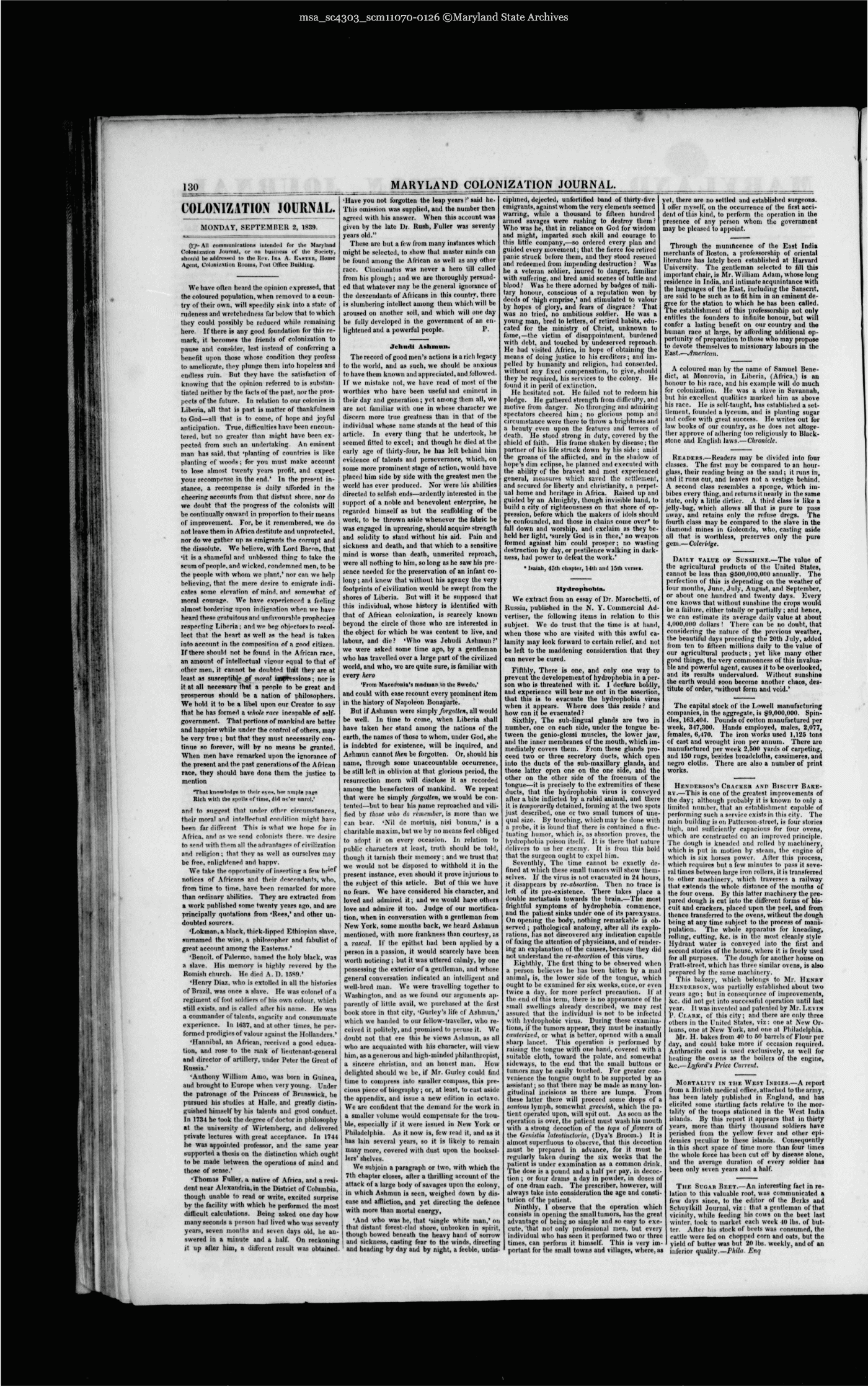
| 130 MARYLAND COLONIZATION JOURNAL. COLONIZATION JOURNAL. MONDAY, SEPTEMBER 2, 1839. All communications intended for the Marylnnd Colonization Journal, or on business of the Society, should be addressed to the Rev. Ira. A. Easter, Home Agent Colonization Rooms, Post Office Building. We have often heard the opinion expressed, that the coloured population, when removed to a coun- try of their own, will speedily sink into a state of rudeness and wretchedness far below that to which they could possibly be reduced while remaining here. If there is any good foundation for this re- mark, it becomes the friends of colonization to pause and consider, lest instead of conferring a benefit upon those whose condition they profess to ameliorate, they plunge them into hopeless and endless ruin. But they have the satisfaction of knowing that the opinion referred to is substan- tiated neither by the facts of the past, nor the pros- pects of the future. In relation to our colonies in Liberia, all that is past is matter of thankfulness to God—all that is to come, of hope and joyful anticipation. True, difficulties have been encoun- tered, but no greater than might have been ex- pected from such an undertaking An eminent man has said, that 'planting of countries is like planting of woods; for you must make account to lose almost twenty years profit, and expect your recompense in the end.' In the present in- stance, a recompense is daily afforded in the cheering accounts from that distant shore, nor do we doubt that the progress of the colonists will be continually onward in proportion to their means of improvement. For, be it remembered, we do not leave them in Africa destitute and unprotected, nor do we gather up as emigrants the corrupt and the dissolute. We believe, with Lord Bacon, that it is a shameful and unblessed thing to take the scum of people, and wicked, condemned men, to he the people with whom we plant,' nor can we help believing, that the mere desire to emigrate indi- cates some elevation of mind, and somewhat of moral courage. We have experienced a feeling almost bordering upon indignation when we have heard these gratuitous and unfavourable prophecies respecting Liberia: and we beg objectors to recol- lect that the heart as well as the head is taken into account in the composition of a good citizen. If there should not be found in the African race, an amount of intellectual vigour equal to that of other men, it cannot be doubted that they are at least as susceptible of moral impressions; nor is it at all necessary that a people to be ereat and prosperous should be a nation of philosophers. We hold it to be a libel upon our Creator to say that he has formed a whole race incapable of self- government. That portions of mankind are better and happier while under the control of others, may be very tnie ; hut that they must necessarily con- tinue so forever, will by no means be granted. When men have remarked upon the ignorance of the present and the past generations of the African race, they should have done them the justice to mention 'That knowledge to their eyes, her ample page Rich with the spoils of time, did ne'er unrol.' and to suggest that under other circumstances, their moral and intellectual condition might have been far different This is what we hope for in Africa, and as we send colonists there, we desire to send with them all the advantages of civilization and religion : that thev as well as ourselves may be free, enlightened and happv. We take the opportunity' of inserting a few hr10' notices of Africans and their descendants, who, from time to time, have been remarked for more than ordinary abilities. They are extracted from a work published some twenty years ago, and are principally quotations from 'Rees,' and other un- doubted sources. 'Lokman. a black, thick-lipped Ethiopian slave, surnamed the wise, a philosopher and fabulist of great account among the Easterns.' 'Benoit. of Palermo, named the holy black, was a slave. His memory is highly revered by the Romish church. He died A. D. 1589 'Henry Diaz, who is extolled in all the histories of Brazil, was once a slave. He was colonel of a regiment of foot soldiers of his own colour, which still exists, and is called alter his name. He was a commander of talents, sagacity and consummate experience. In 1HS7, and at other times, he per- formed prodigies of valour against the Hollanders.' 'Hannibal, an African, received a good educa- tion, and rose to the rank of lieutenant-general and director of artillery, under Peter the Great of Russia.' 'Anthony William Amo, was born in Guinea, and brought to Europe when vety young. Under the patronage of the Princess of Brunswick, he pursued his studies at Halle, and greatly distin- guished himself by his talents and good conduct. In 1731 he took the degree of doctor in philosophy at the university of Wirtetnberg, and delivered private lectures with great acceptance. In 1744 he was appointed professor, and the same year supported a thesis on the distinction which ought to be made between the operations of mind and those of sense.' 'Thomas Fuller, a native of Africa, and a resi- dent near Alexandria, in the District of Columbia, though unable to read or write, excited surprise by the facility with which he performed the most difficult calculations. Being asked one day how many seconds a person had lived who was seventy years, aeven months and seven days old, he an- swered in a minute and a half. On reckoning it up after him, a different result was obtained. •Have you not forgotten the leap years ?' said he- This omission was supplied, and the number then agreed with his answer. When this account was given by the late Dr. Rush, Fuller was seventy years old." These arc but a few from many instances which might be selected, to show that master minds can be found among the African as well as any other race. Cincinnatus was never a hero till called from his plough; and we are thoroughly persuad- ed that whatever may be the general ignorance of the descendants of Afiicans in this countrr, there is slumbering intellect among them which will be aroused on another soil, and which will one day he fully developed in the government of an en- lightened and a powerful people. V. Jehudi Ashmun. The record of good men's actions is a rich legacy to the world, and as such, we should be anxious to have them known and appreciated, and followed. If we mistake not, we have read of most of the worthies who have been useful and eminent in their day and generation; yet among them all, we are not familiar with one in whose character we discern more true greatness than in that of the individual whose name stands at the head of this article. In every thing that he undertook, he seemed fitted to excel; and though he died at the early age of thirty-four, he has left behind him evidence of talents and perseverance, which, on some more prominent stage of action, would have placed him side by side with the greatest men the world has ever produced. Nor were Ms abilities directed to selfish ends—ardently interested in the support of a noble and benevolent enterprise, he regarded himself as but the scaffolding of the work, to be thrown aside whenever the fabric he was engaged in uprearing, should acquire strength and solidity to stand without his aid. Pain and sickness and death, and that which to a sensitive mind is worse than death, unmerited reproach, were all nothing to him, so long as he saw his pre- sence needed for the preservation of an infant co- lony; and knew that without his agency the very footprints of civilization would be swept from the shores of Liberia. But will it be supposed that this individual, whose history is identified with that of African colonization, is scarcely known beyond the circle of those who are interested in the object for which he was content to live, and labour, and die? 'Who was Jehudi Ashmun?' we were asked some time ago, by a gentleman who has travelled over a large part of the civilized world, and who, we are quite sure, is familiar with every hero 'From Macedonia's madman to the Swede,' and could with ease recount every prominent item in the history of Napoleon Bonaparte. But if Ashmun were simply forgotten, all would be well. In time to come, when Liberia shall have taken her stand among the nations of the earth, the names of those to whom, under God, she is indebted for existence, will be inquired, and Ashmun cannot then be forgotten. Or, should his name, through some unaccountable occurrence, be still left in oblivion at that glorious period, the resurrection morn will disclose it as recorded among the benefactors of mankind. We repeat that were he simply forgotten, we would be con- tented—but to hear his name reproached and vili- fied by those who r/o renumber, is more than we can bear. 'Nil de mortuis, nisi bonum,' is a charitable maxim, but we by no means feel obliged to adopt it on every occasion. In relation to public characters at least, truth should be told, though it tarnish their memory ; and we trust that we would not be disposed to withhold it in the present instance, even should it prove injurious to the subject of this article. But of this we have no fears. We have considered his character, and loved and admired it; and we would have others love and admire it too. Judge of our mortifica- tion, when in conversation with a gentleman from New York, some months back, we heard Ashmun mentioned, with more frankness than courtesy, as a rateal. If the epithet had been applied by a person in a passion, it would scarcely have been worth noticing; but it was uttered calmly, by one possessing the exterior of a gentleman, and whose general conversation indicated an intelligent and well-bred man. We were travelling together to Washington, and as we found our arguments ap- parently of little avail, we purchased at the first book store in that city, 'Gurley's life cf Ashmun,' which we handed to our fellow-traveller, who re- ceived it politely, and promised to peruse it. We doubt not that ere this he views Ashmun, as all who are acquainted with his character, will view him, as a generous and high-minded philanthropist, a sincere christian, and an honest man. How delighted should we be, if Mr. Gurley could find time to compress into smaller compass, this pre- cious piece of biography; or, at least, to cast aside the appendix, and issue a new edition in octavo. We are confident that the demand lor the work in a smaller volume would compensate for the dou- ble, especially if it were issued in New York or Philadelphia. As it now is, few lead it, and as it has lain several years, so it is likely to remain many more, covered with dust upon the booksel- lers' shelves. We subjoin a paragraph or two, with which the 7th chapter closes, alter a thrilling account of the attack of a large body of savages upon the colony, in which Ashmun is seen, weighed down by dis- ease and affliction, and yet directing the defence with more than mortal energy, 'And who was he, that 'single white man,' on that distant forest-clad shore, unbroken in spirit, though bowed beneath the heavy hand of sorrow and sickness, casting fear to the winds, directing and heading by day and by night, a feeble, undis- ciplined, dejected, unfortified band of thirty-five emigrants, against whom the very elements seemed warring, while a thousand to fifteen hundred armed savages were rushing to destroy them ? Who was he, that in reliance on God for wisdom and might, imparted such skill and courage to this little company,—so ordered every plan and guided every movement; that the fierce foe retired panic struck before them, and they stood rescued and redeemed from impending destruction ? Was he a veteran soldier, inured to danger, familiar with suffering, and bred amid scenes of battle and blood? Was he there adorned by badges of mili- tary honour, conscious of a reputation won by deeds of 'high emprise,' and stimulated to valour by hopes ot glory, and fears of disgrace? That was no tried, no ambitious soldier. He was a young man, bred to letters, of retired habits, edu- cated for the ministry of Christ, unknown to fame,—the victim of disappointment, burdened with debt, and touched by undeserved reproach. He had visited Africa, in hope of obtaining the means of doing justice to his creditors; and im- pelled by humanity and religion, had consented, without any fixed compensation, to give, should they be required, his services to the colony. He found it in peril of extinction. He hesitated not. He failed not to redeem his pledge. He gathered strength from difficulty, and motive from danger. No thronging and admiring spectators cheered him; no glorious pomp and circumstance were there to throw a brightness and a beauty even upon the features and terrors of death. He stood strong in duty, covered by the shield of faith. His frame shaken by disease; the partner of his life struck down by his side ; amid the groans of the afflicted, and in the shadow of hope's dim eclipse, he planned and executed with the ability of the bravest and most experienced general, incisures which saved the settlement, and secured for liberty and Christianity, a perpet- ual home and heritage in Africa. Raised up and guided by an Almighty, though invisible hand, to build a city of righteousness on that shore of op- pression, before which the makers of idols should be confounded, and those in chains come over* to fall down and worship, and exclaim as they be- held her light, 'surely God is in thee,' no weapon formed against him could prosper; no wasting destrnction by day, or pestilence walking in dark- ness, had power to defeat the work.' * Isaiah, 45th chapter, 14th and 15th verses. yet, there are no settled and established surgeons. I offer myself, on the occurrence of the first acci- dent of this kind, to perform the operation in the presence of any person whom the government may be pleased to appoint. Through the munificence of the East India merchants of Boston, a professorship of oriental literature has lately been established at Harvard University. The gentleman selected to fill this important chair, is Mr. William Adam, whose long residence in India, and intimate acquaintance with the languages of the East, including the Sanscrit, are said to be such as to fit him in an eminent de- gree for the station to which he has been called. The establishment of this professorship not only entitles the founders to infinite honour, but will confer a lasting benefit on our country and the human race at large, by affording additional op- portunity of preparation to those who may propose to devote themselves to missionary labours in the East.—American. A coloured man by the name of Samuel Bene- dict, at Monrovia, in Liberia, (Africa,) is an honour to his race, and his example will do much for colonization. He was a slave in Savannah, but his excellent qualities marked him as above his race. He is self-taught, has established a set- tlement, founded a lyceiim, anil is planting sugar and coffee with great success. He writes out for law books of our country, as he does not altoge- ther approve of adhering too religiously to Black- stone and English laws.—Chronicle. Hydrophobia. We extract from an essay of Dr. Marochetti, of Russia, published in the N. Y. Commercial Ad- vertiser, the following items in relation to this subject. We do trust that the time is at hand, when those who are visited with this awful ca- lamity may look forward to certain relief, and not be left to the maddening consideration that they can never be cured. Fifthly, There is one, and only one way to prevent the developcment of hydrophobia in a per- son who is threatened with it. I declare boldly, and experience will bear me out in the assertion, that this is to evacuate the hydrophobia virus when it appears. Where does this reside ? and how can it be evacuated ? Sixthly, The sub-lingual glands are two in number, one on each side, under the tongue be- tween the genio-glossi muscles, the lower jaw, and the inner membranes of the mouth, which im- mediately covers them. From these glands pro- ceed two or three secretory ducts, which open into the ducts of the sub-maxillary glands, and those latter open one on the one side, and the other on the other side of the froenum of the tongue—it is precisely to the extremities of these ducts, that the hydrophobia virus is conveyed after a bite inflicted by a rabid animal, and there it is temporarily detained, forming at the two spots just described, one or two small tumors of une- qual size. By touching, which may be done with a probe, it is Ibund that there is contained a fluc- tuating humor, which is, as absoition proves, the hydrophobia poison itself. It is there that nature delivers to us her enemy. It is from this hold that the surgeon ought to expel him. Seventhly, The time cannot be exactly de- fined at which these small tumors will show them- selves. If the virus is not evacuated in 24 hours, it disappears by re-absortion. Then no trace is left of its pre-existence. There takes place a double metastasis towards the brain.—The most frightful symptoms of hydrophobia commence, and the patient sinks under one of its paroxysms. On opening the body, nothing remarkable is ob- served ; pathological anatomy, alter all its explo- rations, has not discovered any indication capable of fixing the attention of physicians, and of render- ing an explanation of the causes, because they did not understand the re-absortion of this virus. Eighthly, The first thing to be obseived when a person believes he has been bitten by a mad animal, is, the lower side of the tongue, which ought to be examined for six weeks, once, or even twice a day, for more perfect precaution. If at the end ol this term, there is no appearance of the small swellings already described, we may test assured that the individual is not to be infected with hydrophobic virus. During these examina- tions, if the tumors appear, they must be instantly cauterized, or what is better, opened with a small sharp lancet. This operation is performed by raising the tongue with one hand, covered with a suitable cloth, toward the palate, and somewhat tideways, to the end that the small buttons or tumors may be easily touched. For greater con- venience the tongue ought to be supported by an assistant; so that there may be made as many lon- gitudinal incisions as there are lumps. From these latter there will proceed some drops of a sunious lymph, somewhat greenish, which the pa- tient operated upon, will spit out. As soon as the operation is over, the patient must wash his mouth with a strong decoction of the tops of flowers of the Genistia luteotinctoria, (Dya's Broom.) It is almost superfluous to observe, that this decoction must be prepared in advance, for it must be regularly taken during the six weeks that the patient is under examination as a common drink. The dose is a pound and a half per pay, in decoc- tion ; or four drams a day in powder, in doses of of one dram each. The prescriber, however, will always take into consideration the age and consti- tution of the patient. Ninthly, 1 observe that the operation which consists in opening the small tumors, has the great advantage ol being so simple and so easy to exe- cute, that not only professional men, but every individual who has seen it performed two oi three times, can perform it himself. This is very im- portant for the small towns and villages, where, as Reapers.— Headers may be divided into four classes. The first may be compared to an hour- glass, their reading being as the sand; it runs in, and it runs out, and leaves not a vestige behind. A second class resembles a sponge, which im- bibes every thing, and returns it neaily in the same stale, only a little dirtier. A third class is like a jelly-bag, which allows all that is pure to pass away, and retains only the refuse dregs. The fourth class may he compared to the slave in the diamond mines in Golconda, who, casting aside all that is worthless, preserves only the pure gem.— Coleridge. Daily value of Sunshine.—The value of the agricultural products of the United States, cannot be less than $500,000,000 annually. The perfection of this is depending on the weather of tour months, June. July, August, and September, or about one hundred and tyventy days. Every one knows that without sunshine the crops would be a failure, either totally or partially ; and hence, we can estimate its average daily value at about 1,000,000 dollars! There can be no doubt, that considering the nature of the previous weather, the beautiful days preceding the 20th July, added liom ten to fifteen millions daily to the value of our agricultural products; yet like many other good things, the very commonness of this invalua- ble and powerful agent, causes it to be overlooked, and its results undervalued. Without sunshine the earth would soon become another chaos, des- titute of order, 'without form and void.' The capital stock of the Lowell manufacturing companies, in the aggregate, is $9,000,000. Spin- dles, 163,404. Pounds of cotton manufactured per week, 347,300. Hands employed, males, 2,077, females, 6,470. The iron works used 1,125 ton9 of cast and wrought iron per annum. There aro manufactured per week 2,500 yards of carpeting, and 150 rugs, besides broadcloths, cassimeres.and negro cloths. There are also a number of print works. Henderson's Cracker anp Biscuit Bake- ry.—This is one of the greatest improvements of the day; although probably it is known to only a limited number, that an establishment capable of performing such a service exists in this city. The main building is on Patterson-street, is four stories high, and sufficiently capacious for four ovens, which are constructed on an improved principle. The dough is kneaded and rolled by machinery, which is put in motion by steam, the engine of which is six horses power. After this process, which requires but a lew minutes to pass it seve- ral times between large iron rollers, it is transferred to other machinery, which traverses a railway that extends the whole distance of the mouths of the four ovens. By this latter machinery the pre- pared dough is cut into the different forms of bis- cuit and crackers, placed upon the peel, and from thence transferred to the ovens, without the dough being at any time subject to the process of mani- pulation. The whole apparatus for kneading, rolling, cutting, ike. is in the most cleanly style Hydrant water is conveyed into the first and second stories of the house, where it is freely used for all purposes. The dough for another house on Pratt-street, w Inch has three similar ovens, is also prepared by the same machinery. This bakery, which belongs to Mr. Henry Henderson, was partially established about hvo yeais ago; but in consequence of improvements, ike. did not get into successful operation until last year. It was invented and patented by Mr. Levin P. Clark, of this city; and there are only three others in the United States, viz: one at New Or- leans, one at New York, and one at Philadelphia. Mr. H. bakes from 40 to 50 barrels of Flour per day, and could bake more if occasion required. Anthracite coal is used exclusively, as well for heating the ovens as the boilers of the engine, Sic.—Lyford's Price Current. Mortality in the West Indies.—A report from a British medical office, attached to the army, has been lately published in England, and has elicited some startling facts relative to the mor- tality of the troops stationed in the West India islands. By this report it appears that in thirty years, more than thirty thousand soldiers have perished from the yellow fever and other epi- demics peculiar to these islands. Consequently in this short space of time more than four times the whole force has been cut off by disease alone, and the average duration of every soldier has been only seven years and a half. The Sugar Beet.—An interesting fact in re- lation to this valuable root, was communicated a few days since, to the editor of the Beiks and Schuylkill Journal, viz : that a gentleman of that vicinity, while feeding his cows on the beet last winter, took to maiket each week 40 lbs. of but- ter. Alter his stock of beets was consumed, the cattle were fed on chopped corn and oats, but the yield of butter was but 20 lbs. weekly, and of an inferior qualify.—Phila. Enq. |