 |
|
|
 |
|
 |
|
|||
|
||||
|
||||
|
Maryland State Archives Maryland Colonization Journal Collection MSA SC 4303 msa_sc4303_scm11070-0127 Enlarge and print image (5M) |
|
|
|
|
|
|
|
|||
|
||||
|
||||
|
Maryland State Archives Maryland Colonization Journal Collection MSA SC 4303 msa_sc4303_scm11070-0127 Enlarge and print image (5M) |
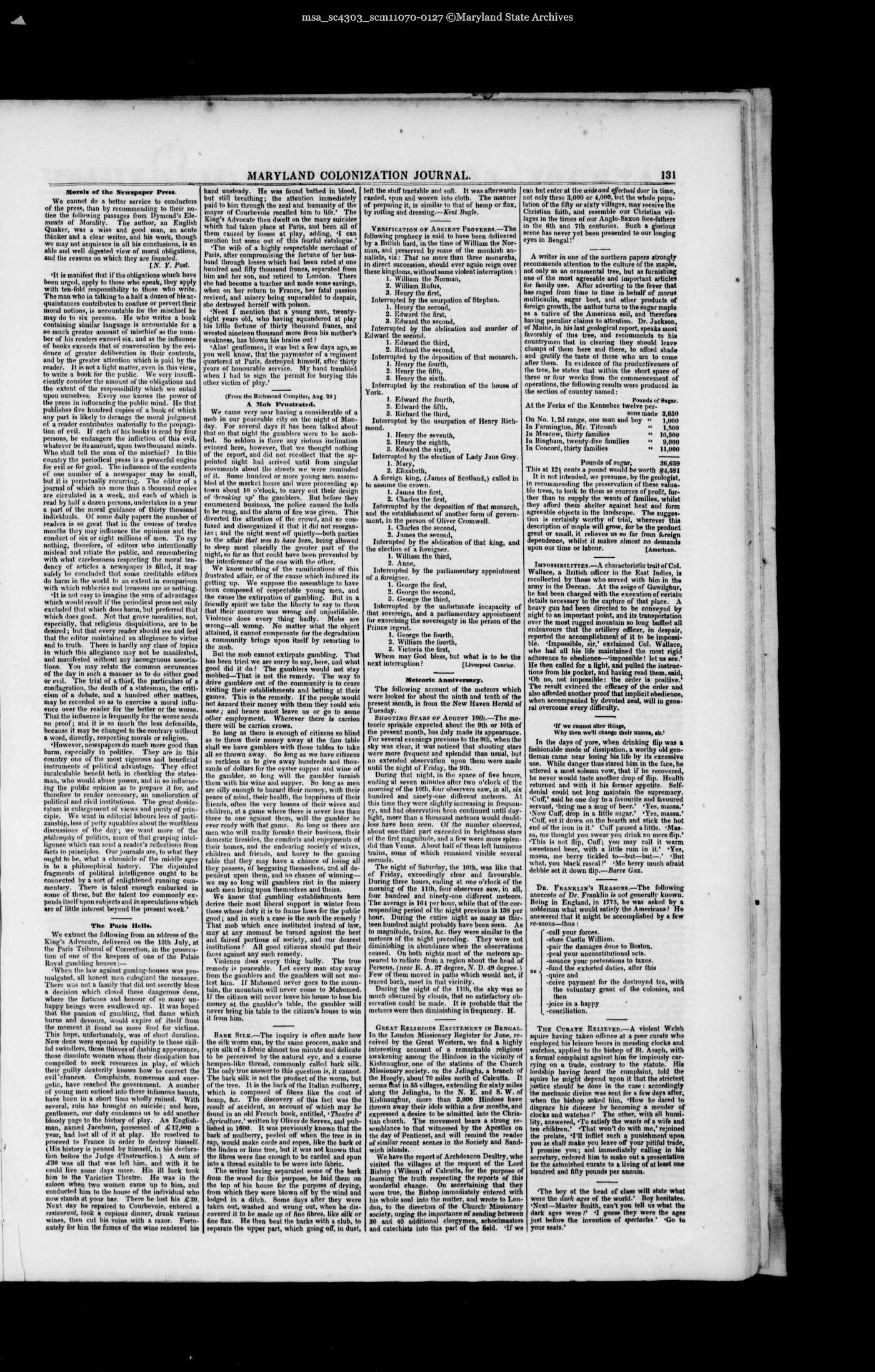
| MARYLAND COLONIZATION JOURNAL. 131 Morals of the Newspaper Press. We cannot do a better service to conductors of the press, than by recommending to their no- tice the following passages from Dymond's Ele- ments of Morality. The author, an English Quaker, was a wise and good man, an acute thinker and a clear writer, and his work, though we may not acquiesce in all his conclusions, is an able anil well digested view of moral obligations, and the reasons on which they are founded. [N. Y. Post. 'It is manifest that if the obligations which have been urged, apply to those who speak, they apply with ten-fold responsibility to those who write. The man who in talking to a half a dozen of his ac- quaintances contributes to confuse or pervert their moral notions, is accountable for the mischief he may do to six persons. He who writes a book containing similar language is accountable for a so much greater amount of mischief as the num- ber of his readers exceed six, and as the influence of books exceeds that of conversation by the evi- dence of greater deliberation in their contents, and by the greater attention which is paid by the reader. It is not a light matter, even in this view, to write a book for the public. We very insuffi- ciently consider the amount of the obligations and the extent of the responsibility which we entail upon ourselves. Every one knows the power of the press in influencing the public mind. He that publishes five hundred copies of a book of which any part is likely to derange the moral judgment of a reader contributes materially to the propaga- tion of evil. If each of his books is read by four persons, he endangers the infliction of this evil, whatever be its amount, upon twothousand minds. Who shall tell the sum of the mischief! In this countiy the periodical press is a powerful engine for evil or for good. The influence of the contents of one number of a newspaper may be small, but it is perpetually recurring. The editor of a journal of wliich no more than a thousand conies are circulated in a week, and each of whicli is read by half a dozen persons, undertakes in a year a part of the moral guidance of thirty thousand individuals. Of some daily papers the number of readers is so great that in the course of twelve months tiny may influence the opinions and the conduct of six or eight millions of men. To say nothing, therefore, of editors who intentionally mislead and vitiate the public, and remembering with what carelessness respecting the moral ten- dency of articles a newspaper is filled, it may safely be concluded that some creditable editors do harm in the world to an extent in comparison with which robberies ami treasons are as nothing. 'It is not easy to imagine the sum of advantages which would result if the periodical press not only excluded that which does harm, but preferred that which docs good. Not that grave moralities, not. especially, that religious disquisitions, are to be desired ; but that every reader should see and feel that the editor maintained an allegiance to virtue and to truth. There is hardly any class of topics in which this allegiance nr.iy not be manifested, and manifested without any incongruous associa- tions. You may relate the common occurences of the day in such a manner as to do either good or evil. The trial of ft thief, the particulars of a conflagration, the death of a statesman, the criti- cism of a debate, and a hundred other matters, may be recorded so as to exercise a moral influ- ence over the reader for the better or the worse. That the influence is frequently for the worse needs no proof; and it is so much the less defensible, because it may be changed to the contrary without a word, directly, respecting morals or religion. 'However, newspapers do much more good than harm, especially in politics. They are in this country one of the most vigorous and beneficial instruments of polilical advantage. They effect incalculable benefit both in checking the states- man, who would abuse power, and in so influenc- ing the public opinion as to prepare it for, and therefore to render necessary, an amelioration of political and civil institutions. The great deside- ratum is enlargement of views and purity of prin- ciple. We want in editorial labours less of parti- zanship, less of pelty squabbles about the worthless discussions of the day; we want more of the philomphy of politics, more of that grasping intel- ligence which can send a reader's reflections from facts to principles. Our journals are, to what they ought to be, what a chronicle oi the middle ages is to a philosophical history. The disjointed fragments of political intelligence ought to be connected by a sort of enlightened running com- mentary. There is talent enough embarked in some of these, but the talent too commonly ex- pends itself upon subjects and in speculations which arc of little interest beyond the present week.' The Paris Hells. We extract the following from an address of the King's Advocate, delivered on the l'lth July, at the Paris Tribunal of Correction, in the prosecu- tion of one of the keepers of one of the Palais Royal gambling houses :? 'When the law against gaming-houses was pro- mulgated, all honest men culngi/.i'd the measure. Then was not a family that did not secretly bless a decision wliich closed these dangerous dens, where the fortunes and honour of so many un- happy beings were swallowed up. It was hoped that the passion of gambling, that flame which burns and devours, would expire of itself from the moment it found no more food for victims. This hope, unfortunately, was of short duration. New dens were opened by cupidity to those skil- ful swindlers, those thieves of dashing appearance, those dissolute women whom their dissipation has compelled to seek resources in play, of wliich their guilty dexterity knows how to correct the evil'chances. Complaints, numerous and ener- getic, have reached the government. A number of young men enticed into these infamous haunts, have been in a short time wholly ruined. With several, ruin has brought on suicide; and here, gentlemen, our duty condemns us to add another bloody page to the history of play. Ah English- man, named Jacobson, possessed of $12,000 a year, had lost all of it at play. He resolved to proceed to France in order to destroy himself. (His history is penned by himself, in his declara- tion before the Judge d'lnstruction.) A sum of t.;n was all that was left him, and with it he could live some days more. His ill luck took him to the Varieties Theatre. He was in the saloon when two women came up to him, and conducted him to the house of the individual who now stands at your bar. There he lost his j?30. Next day he repaired to Conrbevoie, entered a rettaurant, took a copious dinner, drank various wines, then cut his veins with a razor. Fortu- nately for him the fumes of the wine rendered his hand unsteady. He was found bathed in blood, but still breathing; the attention immediately paid to him through the zeal and humanity of the mayor of Conrbevoie recalled him to life.' The King's Advocate then dwelt on the many suicides which had taken place at Paris, and been all of them caused by losses at play, adding, 'I can mention but some out of this fearful catalogue.' 'The wife of a highly respectable merchant of Paris, after compromising the fortune of her bus- band through losses which had been rated at one hundred and fifty thousand francs, separated from him and her son, and retired to London. There she had become a teacher and made some savings, when on her return to France, her fatal passion revived, and misery being superadded to despair, she destroyed herself with poison. 'Need I mention that a young man, twenty- eight years old, who having squandered at play his little fortune of thirty thousand francs, and wrested nineteen thousand more from his mother's weakness, has blown his brains out ? 'Alas! gentlemen, it was but a few days ago, as you well know, that the paymaster of a regiment quartered at Paris, destroyed himself, after thirty years of honourable service. My hand trembled when I had to sign the permit for burying this other victim of play.' (From the Richmond Compiler, Aug. 20 ) A Mob Frustrated. We came very near having a considerable of a mob in our peaceable city on the night of Mon- day. For several days it has been talked about that on that night the gamblers were to be mob- bed. So seldom is there any riotous inclination evinced here, however, that we thought nothing of the report, and did not recollect that the ap- pointed night had airived until from singular movements about the streets we were reminded of it. Some hundred or more young men assem- bled at the market house and were proceeding up town about 10 o'clock, to carry out their design of 'breaking up' the gamblers. But before they commenced business, trie police caused the bells to be rung, and the alarm of fire was given. This diverted the attention of the crowd, and so con- fused and disorganized it that it did not reorgan- ize ; and the night went off quietly?both parties to the affair that was to have been, being allowed to sleep most placidly the greater part of the night, so far as that could have been prevented by the interference of the one with the other. We know nothing of the ramifications of this frustrated affair, or of the cause w hich induced its getting up. We suppose the assemblage to have been composed of respectable young men, and the cause the extirpation of gambling. But in a friendly spirit we take the liberty to say to them that their measure was wrong and unjustifiable. Violence does every thing badly. Mobs are wrong?all wrong. No matter what the object attained, it cannot compensate for the degradation a community brings upon itself by lesorting to the mob. But the mob cannot extirpate gambling. That has been tried we are sorry to say, heie, and what good did it do? The gamblers would not stay mobbed?That is not the remedy. The way to drive gamblers out of fhe community is to cease visiting their establishments and betting at their games. This is the remedy. If the people would not hazard their money with them they could win none ; and hence must leave us or go to some other employment. Wherever there is carrion there will be carrion crows. So long as there is enough of citizens so blind as to throw their money away at the faro table shall we have gamblers with those tables to take all so thrown away. So long as we have citizens so reckless as to give away hundreds ami thou- sands of dollars for the oyster supper and wine of the gambler, so long will the gambler furnish them with his wine and supper. So long as men are silly enough to hazard their money, with their peace of mind, their health, the happiness of their fiiends, often the very homes of their wives and children, at a game where there is never less than three to one against them, will the gambler he ever ready with that game. So long as there are men who will madly forsake their business, their domestic firesides, the comforts and enjoyments of their homes, ami the endearing society of wives, children ami friends, and hurry to the gaining table that they may have a chance of losing all they possess, of beggaring themselves, and all de- pendent upon them, and no chance of winning? we say so long will gamblers riot in the misery such men bring upon themselves and theirs. We know that gambling establishments here derive their most liberal support in winter from those whose duty it is to frame laws for the public good; and in such a case is the mob the remedy ? That mob which once instituted instead of law, may at any moment be turned against the best and fairest portions of society, and our dearest institutions ? All good citizens should put their faces against any such remedy. Violence does every thing badly. The true remedy i? peaceable. Let every man stay away from tlie gamblers and the gamblers will not mo- lest him. If Mahomed never goes to the moun- tain, the mountain will never come to Mahomed. If the citizen will never leave his house to lose his money at the gambler's table, the gambler will never bring his table to the citizen's house to win it from him. left the stuff tractable and soft. It was afterwards carded, spun and woven into cloth. The manner of preparing it, is similar to that of hemp or flax, by rotting and dressing.?Kent Bugle. Bark Silk.?The inquiry is often made how the silk worm can, by the same process, make and spin silk of a fabric almost too minute and delicate to be perceived by the natural eye, and a coarse hempen-like thread, commonly called bark silk. The only true answer to this question is, it cannot The bark silk is not the product of the worm, but of the tree. It is the bark of the Italian mulberry, which is composed of fibres like the coat of hemp, etc. The discovery of this fact was the result of accident, an account of which may be found in an old French book, entitled, 'Theatre d' Agriculture,' written by Oliver de Serves, and pub- lished in 1600. It was previously known that the bark of mulberry, peeled off when the tree is in sap, would make cords and ropes, like the bark of the linden or lime tree, but it was not known that the fibres were fine enough to be carded and spun into a thread suitable to be wove into fabric. The writer having separated some of the bark from the wood for this purpose, he laid them on the top of his house for the purpose of drying, from which they were blown off by the wind and lodged in a ditch. Some days after they were taken out, washed and wrung out, when he dis- covered it to be made up of fine fibres, like silk or fine flax. He then beat the barks with a club, to separate the upper part, which going off, in dust, Verification or Ancient Proverbs.?The following prophecy is said to have been delivered by a British bard, in the time of William the Nor- man, and preserved by some of the monkish an- nalists, viz: That no more than three monarchs, in direct succession, should ever again reign over these kingdoms, without some violent interruption : 1. William the Norman, 2. William Rufus, 3. Henry the first, Interrupted by the usurpation of Stephen. 1. Henry the second, 2. Edward the first, 3. Edward the second, Interrupted by the abdication and murder of Edward the second. 1. Edward the third, 2. Richard the second. Interrupted by the deposition of that monarch. 1. Henry the fourth, 2. Henry the filth, 3. Henry the sixth. Interrupted by the restoration of the house ot York. 1. Edward the fourth, 2. Edward the fifth, 3. Richard the third, Interrupted by the usurpation of Henry Rich- mond. 1. Henry the seventh, 2. Henry the eighth, 3. Edward the sixth, Interrupted by the election of Lady Jane Grey. 1. Mary, 2. Elizabeth, A foreign king, (James of Scotland,) called in to assume the crown. 1. James the first, 2. Charles the first. Interrupted by the deposition of that monarch, and the establishment of another form of govern- ment, in the person of Oliver Cromwell. 1. Charles the second, 2. James the second, Interupted by the abdication of that king, and the election of a foreigner. 1. William the third, 2. Anne, Interrupted by the parliamentary appointment of a foreigner. 1. George the first, 2. George the second, 3. George the third, Interrupted by the unlbrtunate incapacity of that sovereign, and a parliamentary appointment for exercising the sovereignty in the person of the Prince regent. 1. George the fourth, 2. William the fourth, 3. Victoria the first, Whom may God bless, but what is to be the next interruption > [Liverpool Courier. can bnt enter at the wide and effectual door in time, not only these 3,000 or 4,000, but the whole popu- lation of the fifty or sixty villages, may receive the Christian faith, and resemble our Christian vil- lages in the times of our Anglo-Saxon fore-fathers in the 6th and 7th centuries. Such a glorious scene has never yet been presented to our longing eyes in Bengal!' A writer in one of the northern papers itrongly recommends attention to the culture of the maple, not only as an ornamental tree, but as furnishing one of the most agreeable and important articles for family use. After adverting to the fever that has raged from time to time in behalf of moras multicaulis, sugar beet, and other products of foreign growth, the author turns to the sugar maple as a native of the American soil, and therefore having peculiar claims to attention. Dr. Jackson, of Maine, in his last geological report, speaks most favorably of this tree, and recommends to his countrymen that in clearing they should leave clumps of them here and there, to afford shade and gratify the taste ot those who are to come after them. In evidence of the productiveness of the tree, he states that within the short space of three or four weeks from the commencement of operations, the following results were produced in the section of country named: Pounds of Sugar. At the Forks of the Kennebec twelve per- sons made 3,650 On No. 1, 2d range, one man and boy " 1,000 In Fannington, Mr. Titcomb " 1,500 In Moscow, thirty families " 10,500 In Bingham, twenty-five families " 9,000 In Concord, thirty families " 11,000 Pounds of sugar, 36,659 This at 12 1/2 cents a pound would be worth $4,581 It is not intended, we presume, by the geologist, in recommending the preservation of these valua- ble trees, to look to them as sources of profit, fur- ther than to supply the wants of families, whilst they afford them shelter against heat and form agreeable objects in the landscape. The sugges- tion is certainly worthy of trial, wherever this description of maple will grow, for be the product great or small, it relieves us so far from foreign dependence, whilst it makes almost no demands upon our time or labour. [American. Meteoric Anniversary, The following account of the meteors which were looked for about the ninth and tenth of the present month, is from the New Haven Herald of Tuesday. Shooting Stars of August 10th.?The me- teoric sprinkle expected about the 9th or 10th of the present month, has duly made its appearance. For several evenings previous to the 9th, when the sky was clear, it was noticed that shooting stars were more frequent and splendid than usual, but no extended observation upon them were made until the night of Friday, the 9th. During that night, in the space of five hours, ending at seven minutes after two o'clock of the morning of the 10th, four observers saw, in all, six hundred and ninety-one different meteors. At this time they were slightly increasing in frequen- cy, and had observation been continued until day- light, more than a thousand meteors would doubt- less have been seen. Of the number observed, about one-third part exceeded in brightness stars of the first magnitude, and a few were more splen- did than Venus. About half of them left luminous trains, some of which remained visible seveial seconds. The night of Saturday, the 10th, was like Ihat of Friday, exceedingly clear and favourable. During three hours, ending at one o'clock of the morning of the 11th, four observcis saw, in all, four hundred and ninety-one different meteors. The average is 161 per hour, while that of the cor- responding period of the night previous is 138 per hour. During the entire night as many as thir- teen hundred might probably have been seen. As to magnitude, trains, &c. they were similar to the meteors of the night preceding. They were not diminishing in abundance when the observations ceased. On both nights most of the meteors ap- peared to radiate from a region about the head of Perseus, (near R. A. 37 degree, N. D. 49 degree.) Few of them moved in paths wliich would not, if traced back, meet in that vicinity. During the night of the 11th, the sky was so much obscured by clouds, that no satisfactory ob- solvation could be made. It is probable that the meteors were then diminishing in frequency. H. Great Religious Excitement in Bengal. In the London Missionary Register lor June, re- ceived by the Great Western, we find a highly interesting account of a remarkable religious awakening among the Hindoos in the vicinity of Kishnaughur, one of the stations of the Church Missionary society, on the Jelingha, a branch of the Hoogly, about 70 miles north of Calcutta. It seems that in 55 villages, extending for sixty miles along the Jelingha, to the N. E. and S. W. of Kishnaughur, more than 3,000 Hindoos have thrown away their idols within a few months, and expressed a desire to be admitted into the Chris- tian church. The movement bears a strong re- semblance to that witnessed by the Apostles on the day of Penticost, and will remind the reader of similar recent scenes in the Society and Sand- wich islands. We have the report of Archdeacon Dealtry, who visited the villages at the request of the Lord Bishop (Wilson) of Calcutta, for the purpose of learning the truth respecting the reports of this wonderful change. On ascertaining that they were true, the Bishop immediately entered with his whole soul into the matter, and wrote to Lon- don, to the directors of the Church Missionary society, urging the importance of sending between 30 and 40 additional clergymen, schoolmasters and catechists into this part of the field. 'If we Impossibilities.?A characteristic trait of Col. Wallace, a British officer in the East Indies, if recollected by those who served with him in the army in the Deccan. At the seigeof Gawilghur, he had been charged with the execution of certain details necessary to the capture of that place. A heavy gun had been directed to be conveyed by night to an important point, and its transportation over the most rugged mountain so long baffled all endeavours that tlie artillery officer, in despair, reported the accomplishment of it to be impossi- ble. 'Impossible, sir,' exclaimed Col. Wallace, who had all his life maintained the most rigid adherence to obedience?'impossible! let us see.' He then called for a light, and pulled the instruc- tions from his pocket, and having read them, said, 'Oh no, not impossible: the order is positive.' The result evinced the efficacy of the order and also afforded another proof that implicit obedience, when accompanied by devoted zeal, will in gene- ral overcome every difficulty. 'If we cannot alter things, Why then we'll change their names, sir.' In the days of yore, when drinking flip was a fashionable mode of dissipation, a worthy old gen- tleman came near losing his life by its excessive use. While danger thus stared him in the face, he uttered a most solemn vow, that if he recovered, he never would taste another drop of flip. Health returned and with it his former appetite. Self- denial could not long maintain the supremacy. 'Cuff,' said he one day to a favourite and favoured servant, 'bring me a mug of beer.' 'Yes. massa.' 'Now Cuff, drop in a little sugar.' 'Yes, massa.' 'Cuff, set it down on the hearth and stick the hot end of the iron in it.' Cull'paused a little. 'Mas- sa, me thought you swear you drink no more flip.' 'This is not flip, Cuff; you may call it warm sweetened beer, with a liltle rum in it.' 'Yes, massa, me berry tickled to?but?but?.' 'But what, you black rascal?" 'Me berry much afraid debble set it down flip.?Barre Gaz. Dr. Franklin's Reasons.?The following aneccote of Dr. Franklin is not generally known. Being in England, in 1775, he was asked by a nobleman what would satisfy the Americans? He answered that it might be accomplished by a few re-asons?thus: -call your forces. -store Castle William. -pair the damages done to Boston. -peal your unconstitutional acta. -nounce your pretensions to taxes. -fund the extorted duties, after this -quire and -ceive payment for the destroyed tea, with the voluntary grant of the colonies, and then -joice in a happy -conciliation. The Curate Relieved.?A violent Welsh squire having taken offence at a poor curate who employed his leisure hours in mending clocks and watches, applied to the bishop of St. Asaph, with a formal complaint against him for impiously car- rying on a trade, contrary to the statute. His lordship having heard the complaint, told the squire he might depend upon it that the strictest justice should be done in the case : accordingly the mechanic divine was sent for a few days after, when the bishop asked him, 'How he dared to disgrace his diocese bv becoming a mender of clocks and watches ?' The other, with all humi- lity, answered, ?To satisfy the wants of a wife and ten children." 'That won't do with me,' rejoined the prelate, 'I'll inflict such a punishment upon you as shall make you leave off your pitiful trade, I promise you; and immediately calling in hia secretary, ordered him to make out a presentation for the astonished curate to a living of at least one hundred and fifty pounds per annum. 'The boy at the head of class will state what were the dark ages of the world.' Boy hesitates. 'Next?Master Smith, can't you tell us what the dark ages were.'' 'I guess they were the ages just before the invention of spectacles' 'Go to your seats.' RE |