 |
|
|
 |
|
 |
|
|||
|
||||
|
||||
|
Maryland State Archives Maryland Colonization Journal Collection MSA SC 4303 msa_sc4303_scm11070-0128 Enlarge and print image (5M) |
|
|
|
|
|
|
|
|||
|
||||
|
||||
|
Maryland State Archives Maryland Colonization Journal Collection MSA SC 4303 msa_sc4303_scm11070-0128 Enlarge and print image (5M) |
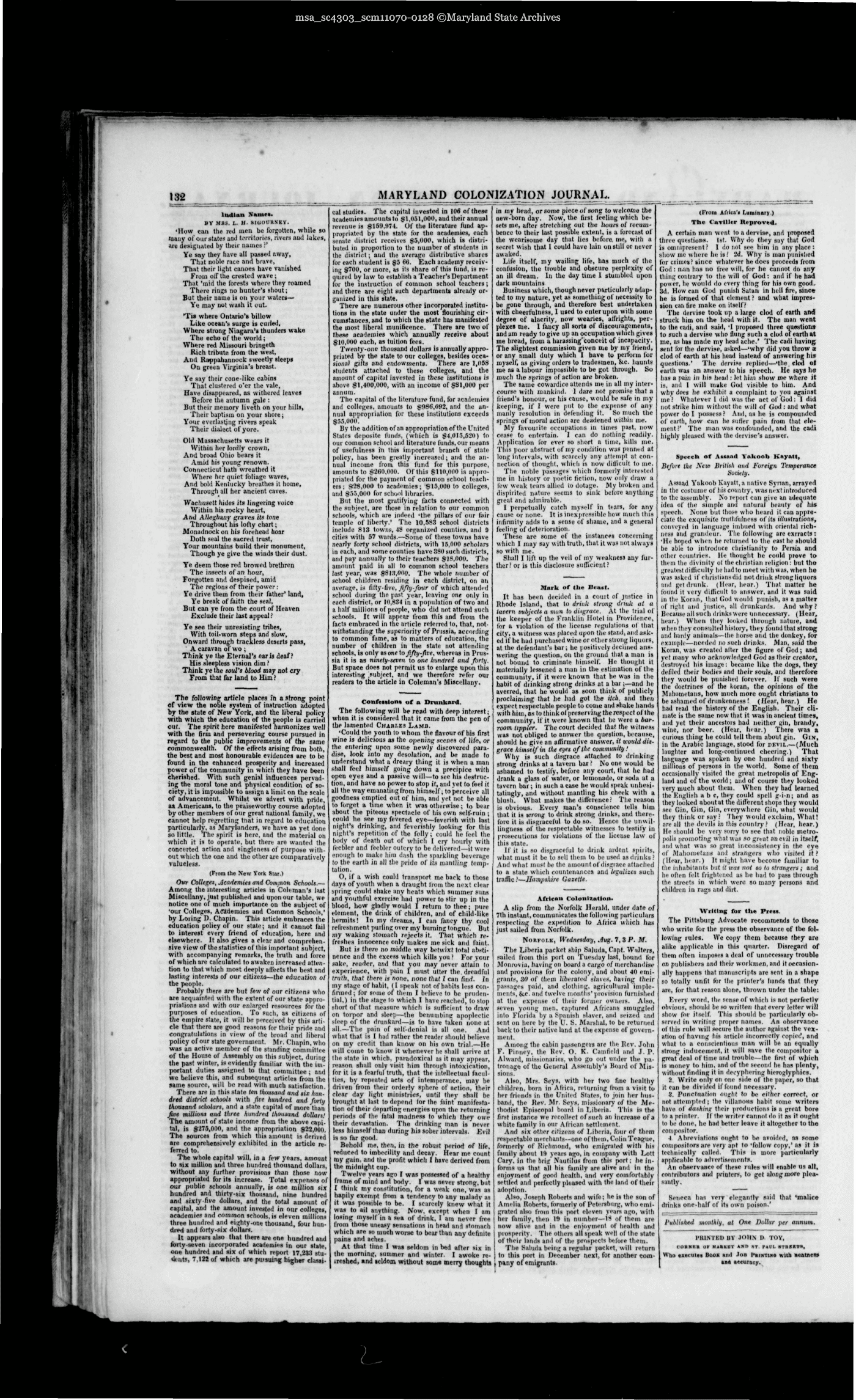
| 132 MARYLAND COLONIZATION JOURNAL. Indian Names. BY MRS. L. H. SIGOURNEY. 'How can the red men be forgotten, while so many of our states and territories, rivers and lake*, are designated by then names ?' Ye say they have all passed away, That noble race and brave, That their light canoes have vanished From oil' the crested wave ; That 'mid the forests where they roamed There rings no hunter's shout; But their name is on your waters— Ye may not wash it out. 'Tis where Ontario's billow Like ocean's surge is curled, Where strong Niagara's thunders wake The echo of the world ; Where red Missouri bringeth Rich tribute from the west, And Raippahannock sweetly sleeps On green Virginia's breast. Ye say their cone-like cabins That clustered o'er the vale, Have disappeared, as withered leaves Before the autumn gale : But their memory liveth on your hills, Their baptism on your shore; Your everlasting rivers speak Their dialect of yore. Old Massachusetts wears it Within her lordly crown, And broad Ohio bears it Amid his young renown. Connecticuthath wreathed it Where her quiet foliage waves, And bold Kentucky breathes it home. Through all her ancient caves. Wachusett hides its lingering voice Within his rocky heart, And Alleghany graves its tone Throughout his lofty chart; Monadnock on his forehead hoar Doth seal the sacred trust, Your mountains build their monument. Though ye give the winds their dust. Ye deem those red browed brethren The insects of an hour, Forgotten and despised, amid The regions of their power: Ye drive them from their father' land. Ye break of faith the seal, But can ye from the court of Heaven Exclude their last appeal I Ye sec their unresisting tribes, With toil-worn steps and slow, Onward through trackless deserts pass, A caravan of wo ; Think ye the Eternal's ear is deaf? His sleepless vision dim ? Think ye the soul's blood may not cry From that far land to Him ! The following article places in a strong point of view the noble system of instruction adopted by the state of New York, and the liberal policy with which the education of the people is carried out. The spirit here manifested harmonizes well with the firm and persevering course pursued in regard to the public improvements ol the same commonwealth. Of the effects arising from both, the best and most honourable evidences arc to be found in the enhanced prosperity and increased power of the community in which they have been cherished. With such genial influences pervad- ing the moral tone and physical condition of so- ciety, it is impossible to assign a limit on the scale of advancement. Whilst we advert with pride, as. Americans, to the praiseworthy course adopted by other members of our great national family, we cannot help regretting that in regard to education particularly, as Marylanders, we'have as yet done so little. The spirit is here, and the material on which it is to operate, but there are wanted the concerted action and singleness of purpose with- out which the one and the other are comparatively valueless. (From the New York Star.) Our Colleges, Jicademies and Common Schools.— Among the interesting articles in Coleman's last Miscellany, just published and upon our table, we notice one of much importance on the subject of 'our Colleges, Academies and Common Schools,' by Loiing I). Chapin. This article embraces the education policy of our state; and it cannot fail to interest every friend of education, here and elsewhere. It also gives a clear and comprehen- sive view of the statistics of this important subject, with accompanying remarks, the truth and force of which are calculated to awaken increased atten- tion to that which most deeply affects the best and lasting interests of our citizens—the education of the people. Probably there are but few of our citizens who are acquainted with the extent of our state appro- priations and with our enlarged resources for the purposes of education. To such, as citizens of the empire state, it will be p"rceived by this arti- cle that there are good reasons for their pride and congratulations in view of the broad and liberal policy of our state government. Mr. Chapin, who was an active member of the standing committee of the House of Assembly on this subject, during the past winter, is evidently familiar with the im- portant duties assigned to that committee ; and we believe this, and subsequent articles from the same source, will be read with much satisfaction. There are in this state ten thousand and six hun- dred district schools with five hundred and forty thousand scholars, and a state capital of more than five millions and three hundred thousand dollars! The amount of state income from the above capi- tal, is $275,000, and the appropriation $22,000. The sources from which this amount is derived are comprehensively exhibited in the article re- ferred to. The whole capital will, in a few years, amount to six million and three hundred thousand dollars, without any further provisions than those now appropriated for its increase. Total expenses of our public schools annually, is one million six hundred and thirty-six thousand, nine hundred and sixty-five dollars, and the total amount of capital, and the amount invested in our colleges, academies and common schools, is eleven millions three hundred and eighty-one thousand, four hun- dred and forty-six dollars. It appears also that there are one hundred and forty-seven incorporated academies in our state, one hundred and six of which report 17,233 stu- dents, 7,122 of which are pmsuing higher classi- cal studies. The capital invested in 106 of these academies amounts to $1,051,000, and their annual revenue is .$159,974. Of the literature fund ap- propriated by the state for the academies, each senate district receives $5,000, which is distri- buted in proportion to the number of students in the district; and the average distributive shares for each student is $5 66. Each academy receiv- ing $700, or more, as its share of this fund, is re- quired by law to establish a Teacher's Department lor the instruction of common school teachers; and there are eight such departments already or- ganized in this state. There are numerous other incorporated institu- tions in the state under the most flourishing cir- cumstances, and. to which the state has manifested the most liberal munificence. There arc two of these academies which annually receive about $10,000 each, as tuition fees. Twenty-one thousand dollars is annually appro- priated by the state to our colleges, besides occa- sional gifts and endowments. There are 1,058 students attached to these colleges, and the amount of capital invested in these institutions is above $1,400,000, with an income of $81,000 per annum. The capital of the literature fund, for academies and colleges, amounts to $986,092, and the an- nual appropriation for these institutions exceeds $.i.),0(IO. By the addition of an appropriation of the United States deposite funds, (which is $4,015,520) to our common school and literature funds, our means of usefulness in this important branch of state policy, has been greatly increased; and the an- nual income from this fund for this purpose, amounts to $260,000. Of this $110,000 is appro- priated for the payment of common school teach- ers ; $28,000 to academies; $15,000 to colleges, and $55,000 for school libraries. But the most gratifying facts connected with the subject, are those in relation to our common schools, which are indeed 'the pillars of our fair temple of liberty.' The 10,583 school districts include 813 towns, 48 organized counties, and 9 cities with 57 wards.—Some of these towns have nearly forty school districts, with 15,000 scholars in each, and some counties have 380 such districts, and pay annually to their teachers $18,000. The amount paid in all to common school teachers last year, was $813,000. The whole number of school children residing in each district, on an average, is fifty-five, fifty-four of which attended school during the past year, leaving one only in earn district, or 10,834 in a population of two and a half millions of people, who did not attend such schools. It will appear from this and from the facts embraced in the article referred to, that, not- withstanding the superiority of Prussia, according to common fume, as to matters of education, the number of children in the state not attending schools, is only as one to fifty-five, whereas in Prus- sia it is as ninety-seven to one hundred and forty. But space does not permit us to enlarge upon this interesting .subject, and we therefore refer our readers to the article in Coleman's Miscellany. Confessions of a Drunkard. The following will be read with deep interest; when it is considered that it came from the pen of the lamented Charles Lamb. 'Could the youth to whom the flavour of his first wine is delicious as the opening scenes of life, or the entering upon some newly discovered para- dise, look into my desolation, and be maoe to understand what a dreary thing it is when a man shall feel himself going down a precipice with open eyes and a passive w ill—to see his destruc- tion, and have no power to stop it, and yet to feel it all the way emanating from himself; to perceive all goodness emptied out of him, and yet not be able to forget a time when it was otherwise; to bear about the piteous spectacle of his own self-ruin ; could he see my fevered eye—feverish with last night's drinking, and feverishly looking for this night's repetition of the folly; could he fed the body of death out of which I cry hourly with leebler and feebler outcry to be delivered—it were enough to make him dash the sparkling beverage to the earth in all the pride of its mantling temp- tation. O, if a wish could transport me back to those days of youth when a draught from the next clear spring could shake any heats which summer suns and youthful exercise had power to stir up in the blood, how gladly would 1 return to thee; pure element, the drink of children, and of child-like hermits! In my dreams, I can fancy thy cool refreshment purling over my burning tongue. But my waking stomach rejects it. That which re- freshes innocence only makes me sick and faint. But is there no middle way betwixt total absti- nence and the excess which kills you ? For your sake, reader, and that you may never attain to experience, with pain I must utter the dreadful truth, that there is none, none that I can find. In iny stage of habit, (I speak not of habits less con- firmed j for some of them I believe to be pruden- tial,) in the stage to which I have reached, to stop short of that measure which is sufficient to draw on torpor and sleep—the benumbing apoplectic sleep of the drunkard—is to have taken none at all.—The pain of self-denial is all one. And what that is I had rather the reader should believe on my credit than know on his own trial.—He will come to know it whenever he shall arrive at the state in which, paradoxical as it may appear, reason shall only visit him through intoxication, for it is a feartul truth, that the intellectual facul- ties, by repeated acts of intemperance, may be driven from their orderly sphere of action, their clear day light ministries, until they shall be brought at last to depend lor the faint manifesta- tion of their departing energies upon the returning periods of the fatal madness to which they owe their devastation. The drinking man is never less himself than during his sober intervals. Evil is so far good. Behold me, then, in the robust period of life, reduced to imbecility and decay. Hear me count my gain, and the profit which I have derived from the midnight cup- Twelve years ago I was possessed of a healthy frame of mind and body. I was never strong, but I think my constitution, for a weak one, was as hapily exempt from a tendency to any malady as it was possible to be. I scarcely knew what it was to ail anything. Now, except when I am losing inyself'in a sea of drink, I am never free from those uneasy sensations in head and stomach which are so much worse to bear than any definite pains and aches. At that time I was seldom in bed after six in the morning, summer and winter. I awoke rc- ireshed, and seldom without some merry thoughts in my head, or some piece of song to welcome the new-born day. Now, the fust feeling which be- sets me, alter stretching out the hours of recum- bence to their last possible extent, is a forecast of the wearisome day that lies before, me, with a secret w ish that 1 could have lain on still or never awaked. Life itself, my wailing life, has much of the contusion, the trouble and obscure perplexity of an ill dream. In the day time 1 stumbled upon dark mountains Business which, though never p&rticularly adap- ted to my nature, yet as something of necessity to be gone through, and therefore best undertaken with cheerfulness, I used to enter upon with some degree of alacrity, now wearies, affrights, per- plexes me. I fancy all sorts of discouragements, and am ready to give up an occupation which gives me bread, from a harassing'conceit of incapacity. The slightest commission given me by my friend, or any small duty which I have to perform for myself, as giving orders to tradesmen, &c. haunts me as a labour impossible to be got through. So much the springs of action are broken. The same cowardice attends me in all my inter- course with mankind. 1 dare not promise that a friend's honour, or his cause, would he safe in my keeping, if I were put to the expense of any manly resolution in defending it. So much the springs ol inoral action are deadened within me. My favourite occupations in limes past, now cease to entertain. I can do nothing readily. Application lor ever so short a time, kills me. This poor abstract of my condition was penned at long intervals, with scarcely any attempt at con- nection of thought, which is now difficult to me. The noble passages which formerly interested me in history or poetic fiction, now only draw a few weak tears allied to dotage. My broken ,md dispirited nature seems to sink before anything great and admirable. I perpetually catch myself in tears, for any cause or none. It is inexpressible how much this infirmity adds to a sense of shame, and a general feeling of deterioration. These are some of the instances concerning which I may say with truth, that it was not always so with me. Shall I lift up the veil of my weakness any fur- ther.' or is this disclosuie sufficient? Mark of the Beast. It has been decided in a court of justice in Rhode Island, that to drink strong drink at a tavern subjects a man to disgrace. At the trial of the keeper of the Franklin Hotel in Providence, for a violation of the license regulations ol that city, a witness was placed upon the stand, and ask- ed if he had purchased wine or other strong liquors, at the defendant's bar; he positively declined ans- wering the question, on the ground that a man is not bound to criminate himself. He thought it materially lessened a man in the estimation of the community, if it were known that he was in the habit of drinking strong drinks at a bar;—and he averred, that he would as soon think of publicly proclaiming that lie had got the itch, and then expect respectable people to come and shake hands with him, as to think of preserving the respect of the community, if it were known that he were a bar- room tippler. The court decided that the witness was not obliged to answer the question, because, should he give an affirmative answer, it would dis- grace himself in the eyes of the community! Why is such disgrace attached to drinking strong drinks at a tavern bar? No one would be ashamed to testify, before any court, that he had drank a glass of water, or lemonade, or soda at a tavern bar; in such a case he would speak unhesi- tatingly, and without mantling his cheek with a blush. What makes the difference: The reason is obvious. Every man's conscience tells him that it is wrong to drink strong drinks, and there- fore it is disgraceful to do so. Hence the unwil- lingness of the respectable witnesses to testily in prosecutions for violations of the license law ol this state. If it is so disgraceful to drink ardent spirits, what must it be to sell them to be used as drinks? And what must be the amountof disgiaec attacked to a state which countenances and legalizes such traffic ?—Hampshire Uazette. African Colonization. A slip from the Norfolk Herald, under date of 7th instant, communicates the following particulars respecting the expedition to Africa which has just sailed from Norfolk. Norfolk, Wednesday, Aug. 7, 3 P. M. The Liberia packet ship Saluda, Capt. Walters, sailed from this port on Tuesday last, bound tor Monrovia, having on board a cargo of merchandise and provisions for the colony, and about 40 emi- grants, 30 of them liberated slaves, having their passages paid, and clothing, agricultural imple- ments, &c. and twelve months' provision furnished at the expense of their limner owners. Also, seven young men, captured Africans smuggled into Florida by a Spanish slaver, and seized and sent on here by the U. S. Marshal, to be returned back to their native land at the expense of govern- ment. Among the cabin passengers are the Rev. John F. Pinney, the Rev. O. K. Camfield and J. P. Alward, missionaries, who go out under the pa- tronage of the General Assembly's Board of Mis- sions. Also, Mrs. Seys, with her two fine healthy children, born in Africa, returning from a visit to her friends in the United States, to join her hus- band, the Rev. Mr. Seys, missionary of the Me- thodist Episcopal board in Liberia. This is the first instance we recollect of such an increase of a white family in our African settlement. And six other citizens of Liberia, four of them respectable merchants—one of them, Colin Teague, formerly of Richmond, who emigrated with his family about 19 years ago, in company with Lott Cary, in the brig Nautilus from this port; he in- forms us that all his family are alive and in the enjoyment of good health, and very comfortably settled and perfectly pleased with the land of their adoption. Also, Joseph Roberts and wife; he is the son of Amelia Roberts, formerly of Petersburg, who emi- grated also from this port eleven years ago, with her family, then 19 in number—18 of ttiein are now alive and in the enjoyment of health and prosperity. The others all speak well of Ihe state of their lands and of the prospects before them. The Saluda being a regular packet, will return to this port in December next, for another corn- piny of emigrants. (From Africa'sLuminary ) The Caviller Reproved. A certain man went to a dervise, and proposed three questions. 1st. Why do they say that God is omnipresent? I do not see him in anyplace: show me where he is? 2d. Why is man punished for crimes? since whatever he does proceeds from God: man has no free will, for he cannot do any thing contrary to the will of God: and if he had power, he would do every thing lor his own good. 3d. How can God punish Satan in hell fire, since he is formed of that element I and what impres- sion can fire make on itself? The dervise took up a large clod of earth and struck him on the head with if. The man went to the cadi, and said, 'I proposed three questions to such a dervise who flung such a clod of earth at me, as has made my head ache.' The cadi having sent lor the dervise, asked—'why did you throw a clod of earth at his head instead of answering his questions.' The dervise replied—'the clod ot earth was an answer to his speech. He says he has a pain in his head : let him show me where it is, and I will make God visible to him. And why does he exhibit a complaint to you against me? Whatever I did was the act of God : I did not strike him without the uill of God : and what power do I possess ? And, as he is compounded of earth, how can he sutler pain from that ele- ment?' The man was confounded, and the cadi highly pleased with the dervise's answer. Speech of Assaad Yakoob Kayatt, Before the New British and Foreign Temperance Society, Assaad Yakoob Kayatt, a native Syrian, arrayed in the costume of his country, was next introduced to the assembly. No report can give an adequate idea of the simple and natural beauty of his speech. None but those who heard it can appre- ciate the exquisite truthfulness of its illustrations, conveyed in language imbued with oriental rich- ness and grandeur. The following are exrracts : •He hoped when he returned to the east he should be able to introduce Christianity to Persia and other countries. He thought he could prove to them tin: divinity ol the christian religion: but tho greatest difficulty he had to meet with was, when he was asked if christians did not drink strong liquors and get drunk. (Hear, hear.) That matter he found it very difficult to answer, and it was said in the Koran, that God would punish, as a matter of right and justice, all drunkards. And why? Hi 'cause all such drinks were unnecessary. (Hear, hear.) When they looked through natuie, and when they consulted history, they found that strong and hardy animals—the horse and the donkey, for examph—needed no such drinks. Man, said the Koran, was created alter the figure of God; and yet many who acknowledged God as their creator, destroyed his image: became like the dogs, they defiled their bodies and their souls, and therefore they would be punished forever. If such were the doctrines of the koran, the opinions of the Mahometans, how much more ought christians to be ashamed of drunkenness ! (Hear, hear.) He had read the history of the English. Their cli- mate is the same now that it was in ancient times, and yet their ancestors had neither gin, brandy, wine, nor beer. (Hear, loar.) There was a curious thing he could tell them about gin. Giv, in the Arabic language, stood lor devil.— (Much laughter and long-continued cheering.) That language was spoken by one hundred and sixty millions of persons in the world. Some of them occasionally visited the great metropolis of Eng- land and of the world; and of course they looked very much about them. When they had learned the English a b c, they could spell g-i-n; and as they looked about at the different shops they would see Gin, Gin, Gin, everywhere Gin, what would they think or say? They would exclaim. What! are all the devils in this country ? (Hear, hear.) He should be very sorry to see that noble metro- polis promoting what was so great an evil in itself, and what was so great inconsistency in the eye of Mahometans and strangers who visited it? (Hear, hear.) It might have become familiar to the inhabitants but it was not so to strangers; arid he often felt frightened as he had to pass through the streets in which were so many persons and children in rags and dirt. Writing for the Press. The Pittsburg Advocate recommends to those who write for the press the observance of tbe fol- lowing rules. We copy them because they are alike applicable in this quarter. Disregard of them often imposes a deal of unnecessary trouble on publishers and their workmen, and it occasion- ally happens that manuscripts are sent in a shape so totally unfit for the printer's hands that they are, for that reason alone, thrown under the table: Every word, the sense of which is not perfectly obvious, should be so written that every letter wiil show for itself. This should be particularly ob- served in writing proper names. An observance ol this rule will secure the author against the vex- ation of having his article incorrectly copied, and what to a conscientious man will be an equally strong inducement, it will save the compositor a great deal of time and trouble—the first of which is money to hiin, and of the second he has plenty, without finding it in decyphering hieroglyphics. 2. Write only on one side of the paper, so that it can be divided if found necessary. 3. Punctuation ought to be either correct, or not attempted ; the villanous habit some writers have of dashing ttieir productions is a great bore to a printer. If the writer cannot do it as it ought to be done, he had better leave it altogether to the i uijjjxisitor. 4 Abreviations ought to he avoided, as some compositors are very apt to 'follow copy,' as it is technically called. This is more particularly applicable to advertisements. An observance of these rules will enable us all, contributors and printers, to get along more plea- santly. Seneca has very elegantly said that 'malice drinks one-half of its own poison.' 1'ublished monthly, at One Dollar per annum. nam by j<>hn d toy, .....M It UF MAkKBT *»" ST PACL STRSKTS, Who •xerutst Boos ami Job l-ms-riso with aeatneis ana accuracy. |