 |
|
|
 |
|
 |
|
|||
|
||||
|
||||
|
Maryland State Archives Maryland Colonization Journal Collection MSA SC 4303 msa_sc4303_scm11070-0129 Enlarge and print image (5M) |
|
|
|
|
|
|
|
|||
|
||||
|
||||
|
Maryland State Archives Maryland Colonization Journal Collection MSA SC 4303 msa_sc4303_scm11070-0129 Enlarge and print image (5M) |
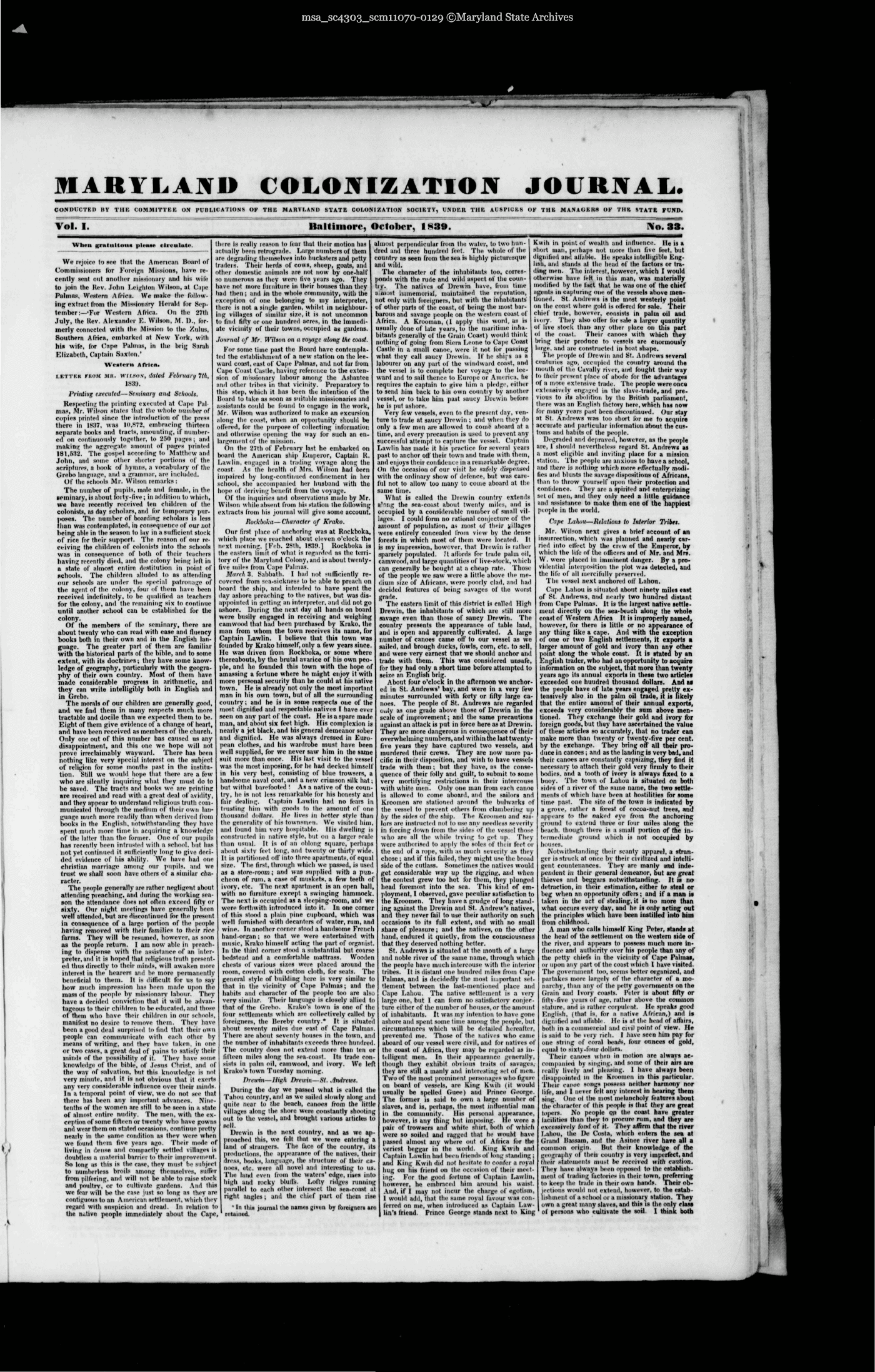
| MARYLAND COLONIZATION JOURNAL. CONDUCTED MY THE COMMITTEE ON PUBLICATIONS OF THE MARYLAND STATE COLONIZATION SOCIETY, UNDER THE AUSPICES OF THE MANAGERS OF THE STATE FUND. Vol. I. Baltimore, October, 1839. No. 33. When gratuitous please circulate. We rejoice to see that the American Board of Commissioners tor Foreign Missions, liave re- cently sent out another missionary ami his wife to join the Rev. John Leighton Wilson, at Cape Palmas, Western Africa. We make the follow- ing extract from the Missionary Herald for Sep- tember:—'For Western Africa. On the 27th July, the Rev. Alexander F. Wilson, M. D., for- merly connected with the Mission to the Zulus, Southern Africa, embarked at New York, with his wile, for Cape Palmas, in the brig Sarah Elizabeth, Captain Saxton.' Western Africa. LETTER FROM MR. WILSON, dated February 7th, 1839. Printing executed—Seminary and Schools. Respecting the printing executed at Cape Pal mas, Mr. Wilson states that the whole number of copies printed since the introduction of the press there in 1837, was 10,872, embracing thirteen separate hooks and tracts, amounting, if number- ed on continuously together, to 250 pages; and making the aggregate amount of pages printed 181,532. The gospel according to Matthew and John, and some other shorter portions of the scriptures, a book of hymns, a vocabulary of the tirebo language, and a grammar, are included. Of the schools Mr. Wilson remarks : The number of pupils, male and female, in the seminary, is about forty-five; in addition to which, we have recently received tell children of the colonists, H day scholars, and liir temporary pur- poses. The number of boarding scholais is less than was contemplated, in consequence of our not being able in the season to lay in a sufficient stock of rice for their support. The reason of our re- ceiving the children of colonists into the schools was in consequence of both ot their teachers having recently died, and the colony being bit in a state of almost entire destitution in point of schools. The children alluded to as attending our schools are under the special patronage of the agent of the colony, loin of them have been rcceiveil indefinitely, to be qualified as teachers for the colony, anil the remaining six lo continue until another school can be established for the colony. Of the members of the seminary, there are about twenty who can read with ease and fluency books both in their own and in the English lan- guage. The greater part of them are familiar with the historical parts of the bible, and to some extent, with its doctrines; they have some know- ledge of geography, particularly with the geogra- phy of their own country. Most of them have made considerable progress in arithmetic, and they can write intelligibly both in English and in Grebo. The morals of our children are generally good, and we find them in many respects much more tractable and docile than we expected them to be. Eight of them give evidence of a change of heart, and have been received as members of the church. Only one out of this number has caused us any disappointment, and this one we hope will not prove irreclaimably wayward. There has been nothing like very special interest on the subject of religion for some months past in the institu- tion. Still we would hope that there are a few who are silently inquiring what they must do to be saved. The tracts and books we are printing are received and read with a great deal of avidity, and they appear to understand religious truth com- municated through the medium of their own lan- guage much more readily than when derived from books in the English, notwithstanding they have spent much more time in acquiring a knowledge of the latter than the former. One of our pupils has recently been intrusted with a school, but has not yet continued it sufficiently long to give deci- ded evidence of his ability. We have had one christian marriage among our pupils, and we trust we shall soon have others of a similar cha- racter. The people generally are rather negligent about attending preaching, and during the working sea- son the attendance does not often exceed fifty or sixty. Our night meetings have generally been well attended, but are discontinued for the present in consequence of a large portion of the people having removed with their families to their rice farms. They will be resumed, however, as soon as the people return. I am now able in preach- ing to dispense with the assistance of an inter- preter, and it is hoped that religions truth present- ed thus directly to their minds, will awaken more interest in the hearers arid be more permanently beneficial to them. It is difficult for us to say bow much impression has been made upon the mass of the people by missionary labour. They have a decided conviction that it will be advan- tageous to their children to he educated, and those of them who have their children in our schools, manifest no desire lo remove them. Thev have been a good deal surprised to find that their own people can communicate with each other by means of writing, and thev have taken, in one or two cases, a great deal of pains to satisfy their minds of the possibility of it. They have some knowledge of the bible, of Jesus Christ, and of the way of salvation, but this knowledge is not very minute, and it is not obvious that it exerts any verv considerable influence over their minds. In a temporal point of view, we do not see that there has been any important advances. Nine- tenths of the women are still to be seen in a state of almost entire nudity. The men, with the ex- ception of some fifteen or twenty who have gowns and wear them on stated occasions, continue pretty nearly in the same condition as thev were when we found them five years ago. Their mode of living in dense and compactly settled villages is doubtless a material barrier to their improvement. So long as this is the case, they must be subject to numberless broils among themselves, suffer from pilfering, and will not be able to raise stork and poultry, or to cultivate gardens. And Ibis we fear will be the rase just so long as they are contiguous to an American settlement, which they regard with suspicion and dread. In relation to the native people immediately about the Cape, there is really leason to fear that their motion has actually heen retrograde. Large numbers of them are degrading themselves into hucksters ami petty traders. Their herds of cows, cheep, goats, and other domestic animals are not now by one-half so numerous as they were live years ago. They have not more furniture in Iheir houses than they had then; and in the whole community, with the exception of one belonging to my interpreter, there is not a single garden, whilst in neighbour- ing villages of similar size, it is not uncommon to find fifty or one hundred acres, in the immedi- ate vicinity of their towns, occupied as gardens. Journal of Mr. Wilson on a voyage along the coast. For some time past the Hoard have contempla- ted the establishment of a new .station on the lee- ward coast, east of Cape Patinas, and not far from Cape Coast Caslle, having reference to the exten- sion of missionary labour among the Ashantee and other tribes in that vicinity. Preparatory to this step, which it has been the intention of the Hoard to take as soon as suitable missionaries and assistants could be found to engage in the work, Mr. Wilson was authorized to make an excursion along the coast, when an opportunity should be offered, for the purpose of collecting information and otherwise opening the way for such an en- largement of the mission. On the 27th of February last he embarked on hoard the American ship Emperor, Captain K. I.nwlin, engaged in a trading voyage along the coast As the health of Mrs. Wilson had been impaired by long-continued confinement in her school, she accompanied her husband with the hope of deriving benefit from the voyage. Of the inquiries ami observations made by Mr. Wilson while absent from his station the following extracts from his journal will give some account. Rockboka— Character of Krako. Our first place of anchoring was at Rockboka, which place we reached about eleven o'clock the next morning, [Feb. 2*th, MM.] Rockboka is the eastern limit of what is regarded as the terri- tory of the Maryland Colony, and is about twenty- five miles from Cape l'almas. March 3. Sabbath. I had not sufficiently re- covered from sea-sickness to be able to preach on hoard the ship, and intended to have spent the day ashore preaching to the natives, but was dis- appointed in getting an interpreter, and did not go ashore. During the next day all hands on board were busily engaged in receiving and weighing camwood that had been purchased by Krako, the man from whom the town receives its name, for Captain I.awlin. I believe that this town was founded by Krako himself, only a few years since. He was driven from Rockboka, or some where thereabouts, by the brutal avarice of his own peo- ple, and he founded this town with the hope of amassing a fortune where he might enjoy it with more personal security than he could at his native town. He is already not only the most important man in his own town, but of all the surrounding country; and he is in some respects one of the most dignified and respectable natives I have ever seen on any part of the coast. He is a spare made man, and about six feet high. His complexion is nearly a jet black, and his general demeanor sober and dignified. He was always dressed in Euro- pean clothes, and his wardrobe must have been well supplied, for we never saw him in the same suit more than once. His last visit to the vessel was the most imposing, for he had decked himself in his very best, consisting of blue trowsers, a handsome naval coat,and a new crimson silk hat; but withal barefooted ! As a native of the coun- try, he is not less remarkable for his honesty and fair dealing. Captain I.awlin had no tears in trusting him with goods to the amount of one thousand dollars. He lives in better style than the generality of his townsmen. We visited him, and found him very hospitable. His dwelling is constructed in native style, but on a larger scale than usual. It is of an oblong square, perhaps about sixty feet long, and twenty or thirty wide. It is paititioned off into three apartments, of equal size. The first, through which we passed, is used as a store-room; and was supplied with a pun- cheon of rum. a case of muskets, a few teeth of ivory, etc. The next apartment is an open hall, with no furniture except a swinging hammock. The next is occupied as a sleeping-room, and we were forthwith introduced into it. In one corner of this stood a plain pine cupboard, which was well furnished with decanters of water, rum, and wine. In another comer stood a handsome French hand-organ ; so that we were entertained with music, Krako himself acting the part of organist. In the third corner stood a substantial but coarse bedstead and a comfortable mattrass. Wooden chests of various sizes were placed around the room, covered with cotton cloth, tor seats. The general style of building here is very similar to that in the vicinity of Cape l'almas; and the habits and character of the people too are also very similar. Their language is closely allied to that of the Crebo. Krako's town is one of the tour settlements which arc collectively called by foreigners, the Hereby country.* It is situated about seventy miles due east of Cape Palmas. There are about seventy houses in the town, and the number of inhabitants exceeds three hundred. The country does not extend more than ten or fifteen miles along the sea-coast. Its trade con- sists in palm oil, camwood, and ivory. We left Krako's town Tuesday morning. Drewin—High Drewin—St Andrews. During the day we passed what is called the Tahou country, and as we sailed slowly along and quite near to the beach, canoes from the little villages along the shore were constantly shooting out to the vessel, and brought various articles to sell. Drewin is the next country, and as we ap- proached this, we felt that we were entering a land of strangers. The face of the country, its productions, the appearance of the natives, their dress, books, language, the structure of their ca- noes, etc. were all novel and interesting to us. The land even from the waters' edge, rises into high and rocky blurt's. Lofty ridges running parallel to each other intersect the sea-coast at right angles ; and the chief part of them rise * In this journal the names given by foreigners are retained. almost perpendicular from the water, to two hun- dred and three hundred feet. The whole of the country as seen from the sea is highly picturesque and wild. The character of the inhabitants too, corres- ponds with the rude and wild aspect of the coun- try. The natives of Drewin have, from time almost immemorial, maintained the reputation, not only with foreigners, but with the inhabitants of other parts of the const, of being the most bar- barous and savage people on the western coast of Africa. A Krooman, (1 apply this word, as is usually done of late years, to the maritime inha- bitants generally ol the Grain Coast) would think nothing of going from Siera Leone to Cape Coast Castle in a small canoe, were it not lor passing what they call saucy Drewin. If he ships as a labourer on any part of the windward coast, and the vessel is to complete her voyage to the lee- ward and to sail thence to Europe or America, he requires the captain to give him a pledge, either to send him back to his own conntiy by another vessel, or to take him past saucy Drewin before he is put ashore. Very few vessels, even to fhe present day. ven- ture to trade at saucy Drewin ; and when they do only a few men are allowed to coin? aboard at a time, and every precaution is used to prevent any successful attempt to capture the vessel. Captain Lawlin has made it bis practice for several years past to anchor oil'their town and trade with them, and enjoys their confidence in a remarkable degree. On the occasion of our visit he safely dispensed with the ordinary show of defence, but was care- ful not to allow too many to come aboard at the same time. What is called the Drewin country extends a'lng the sea-coast about twenty miles, and is occupied by a considerable number of small vil- lages. I could form no rational conjecture of the amount of population, as most of their villages were entirely concealed from view by the dense forests in which most of them were located. It is my impression, however, that Drewin is rather sparsely populated. It affords for trade palm oil, camwood, and large quantities of live-stock, which can generally be bought at a cheap rate. Those of the people we saw wire a little above the me- dium size of Africans, were poorly clad, and bad decided features of being savages of the worst grade. The eastern limit of this district is railed High Drewin, the inhabitants of which are still more savage even than those of saucy Drewin. The country presents the appearance of table land, and is open and apparently cultivated. A large number of canoes came off to our vessel as we sailed, and brough ducks, fowls, corn, etc. to sell, and were very earnest that we should anchor ami trade with tlicm. This was considered unsafe, for they had only a short time before attempted to seize an English brig. About four o'clock in the afternoon we anchor- ed in St. Andrews' bay, and were in a very few minutes surrounded with forty or fifty large ca- noes. The people of St. Andrews are regarded o..ly as one grade above those of Drewin in the scale of improvement; and the same precautions against an attack is put in force here as at Drewin. They are more dangerous in consequence of their overwhelming numbers, and within the last twenty- five years they have captured two vessels, and murdered their crews. They arc now more pa- cific in their disposition, and wish to have vessels trade with them; but they have, as the conse- quence of their folly and guilt, to submit to some very mortifying restrictions in their intercnuse with white men. Only one man from each canoe is allowed to come aboard, and the sailors and Kroomen are stationed around the bulwarks of the vessel to prevent others from clambering up by the sides of the ship. The tv'roomen and sai- lors are instructed not to use anv needless severity in forcing down from the sides of the vessel those who are all the while trying to get up. They were authorised to apply the soles of tin ii feet or the end of a rope, with as much severity as they chose ; and if this failed, they might use the broad side of the cutlass. Sometimes the natives would get considerable way up the rigging, and when the contest grew too hot for them, they plunged head foremost into the sea. This kind of em- ployment, I observed, gave peculiar satisfaction to the Kroomen, They have a grudge of long stand- ing against the Drewin and St. Andrew's natives, and they never fail to use their authority on such occasions to its full extent, and with no small share of pleasure; and the natives, on the other hand, endured it quietly, from the consciousness that they deserved nothing better. St. Andrews is situated at the mouth of a large and noble river of the same name, through which the people have much intercouse with the interior tribes. It is distant one hundred miles from Cape I'almas, and is decidedly the most important set. •lenient between the last-mentioned place and Cape Lahou. The native settlement is a very- large one, but I can form no satisfactory conjec- ture either of the number of houses, or the amount of inhabitants. It was my intention to have MM ashore and spent some time among the people, but circumstances which will be detailed berealter, prevented me. Those of the natives who came aboard of our vessel were civil, and for natives of the coast of Africa, they may be regarded as in- telligent men. In their appearance generally, though they exhibit obvious traits of savages, they are still a manly and interesting set of men. Two of the most prominent personages who figure on board of vessels, are King Kwih (if would usually be spelled Guee) and Prince George. The former is said to own a large number of slaves, and is. perhaps, the most influential man in the community. His personal appearance, however, is any thing but imposing. He wore a pair of trowsers and white shirt, both of which were so soiled and ragged that he would have passed almost any where out of Africa for the veriest beggar in the world. King Kwih and Captain Lawlin had been friends of long standing ; and King Kwih did not hesitate to confer a royal hug on his friend on the occasion of their mei t- ing. For the good fortune of Captain Lawlin, however, he embraced him around his waist. And, if I may not incur the charge of egotism, I would add, that the same royal favour was con- ferred on me, when introduced as Captain Law- lin's friend. Prince George stands next to King Kwih in point of wealth and influence. He is 1 short man, Ml haps not more than five feet, but dignified and alfable. He speaks intelligible Eng- lish, and stands at the head of the factors or tra- ding men. The interest, however, which I would otherwise have lett in this man, was materially modified by the fact that he was one of the chief agents in capturing one of the vessels above men- tioned. St. Andrews is the most westerly point on the coast where gold is offered for sale. Their chief traile, however, consists in palm oil and ivory. They also oiler for sale a larger quantity of live stock than any other place on this part of the coast. Their canoes with which they bring their produce to vessels are enormously large, and are constructed in boat shape. The people of Drewin and St. Andrews several centuries ago, occupied the country around the mouth of the Cavalry river, am! fought their way to their present place of abode for the advantages of a more extensive trade. The people were once extensively engaged in the slave-trade, and pre- vious to its abolition by the British parliament, there was an English factory here, which has now for ninny years past been discontinued. Our stay at St. Andrews was loo short for me to acquire accurate and particular information about the cus- toms and habits of the people. Degraded and depraved, however, as the people are, I should nevertheless regard St. Andrew, as a most eligible and inviting place for a mission station. The people are anxious to have a school, and there is nothing which morf effectually modi- lies and blunts the savage dispositions of Africans, than to throw yourself upon their protection ami confidence. They are a spirited and enterprizing set of men, and they only need a little guidance rind assistance to niake them one of the happiest people in the world. Cape Lahou—Relations to Interior Tribes. Mr. Wilton next gives a brief account of an insurrection, which was planned and nearly car- ried into elfeet by the crew of the Emperor, by which the life of the officers and of Mr. and Mrs. W. were placed in imminent danger. By a pro- vidential interposition the plot was detected, and the life of all mercifully preserved. The vessel next anchored off Lahou. Cape Lahou is situated about ninety miles east of St. Andrews, and nearly two hundred distant from Cape Palmas. It is the largest native settle- ment directly on the sea-beach along the whole coast of Western Africa It is improperly named, however, for there is little or no appearance of any thing like a cape. And with trie exception of one or two English settlements, it exports a larger amount of gold and ivory than any other point along the whole coast. It is stated by an English trader, who had an opportunity to acquire information on the subject, that more than twenty years ago its annual exports in these two articles exceeded one huudred thousand dollars. And as the people have of late years engaged pretty ex- tensively also in the palm oil trade, it is likely that the entire amount of their annual exports, exceeds very considerably the sum above men- tioned. They exchange their gold and ivory for foreign goods, but they have ascertained the value of these articles so accurately, that no trader can make more than twenty or twenty-five per cent. by the exchange. They bring off all their pro- duce in canoes ; and as the landing is very bad, and their canoes are constantly capsizing, they find it necessary to attach their gold very firmly to their bodies, and a tooth of ivory is always fixed to a buoy. The town of Lahou is situated on both sides of a river of the same name, the two settle- ments of which have been at hostilities for some time past. The site of the town is indicated by a grove. lather a forest of cocoa-nut trees, and appears to (lie naked eye from the anchoring ground to extend three or four miles along the beach, though there is a small portion of the in- termediate ground which is not occupied by houses. Notwithstanding their scanty apparel, a stran- ger is struck at once bv their civilized and intelli- gent countenances. They are manly and inde- pendent in their general demeanor, but are great thieves ami beggars notwithstanding. It is no detraction, in their estimation, either to steal or beg when an opportunity offers; and if a man is taken in the act of stealing, it is no more than what occurs every dav, and he is only acting out the piinciples which have been instilled into him from childhood. A man who calls himself King Peter, stands at the head of the settlement on the western side of the river, and appears to possess much more in- fluence and authority over his people than any of the petty chiefs in the vicinity of Cape Palmas, or upon any part of the coast which I have visited. The government too, seems better organized, and paitakcs more largely of the character of a mo- narchy, than any of the petty governments on file Grain and Ivory coasts. Peter is about fifty or fifty-five years of age, rather above tiie common stature, and is rather corpulent. He speaks good English, (that is, for a native African,) and is dignified and affable. He is at the head of affairs, both in a commercial ami civil point of view. He is said to be very rich. 1 have seen him nay for one string of coral beads, four ounces of gold, equal to sixtv -four dollars. Their canoes when in motion are always ac- companied by singing, and some of their airs are really lively ami pleasing. I have always been disappointed in the Kroomen in this particular. Their canoe songs possess neither harmony nor life, and I never felt any interest in hearing them sing. One of the most melancholy features about the character of this people is that they are great topers. No people on the ci>ast have greater facilities than they to procure rum, and they are excessively fond of it. They affirm that the river l.ahou, the He Costa, which enters the sea at Grand Bassam, and the Asinee river have all a common origin. But their knowledge of the geography OS theii counfiy is very imperfect, and their statements must be received with caution. They have always been opposed to the establish- ment of tiading factories in their town, preferring to keep the trade in their own bands. Their ob- lections would not extend, however, to the estab- lishment of a school or a missionary station. They own a great many slaves, and this is the only class of persons who cultivate the soil. I think both |