 |
|
|
 |
|
 |
|
|||
|
||||
|
||||
|
Maryland State Archives Maryland Colonization Journal Collection MSA SC 4303 msa_sc4303_scm11070-0130 Enlarge and print image (4M) |
|
|
|
|
|
|
|
|||
|
||||
|
||||
|
Maryland State Archives Maryland Colonization Journal Collection MSA SC 4303 msa_sc4303_scm11070-0130 Enlarge and print image (4M) |
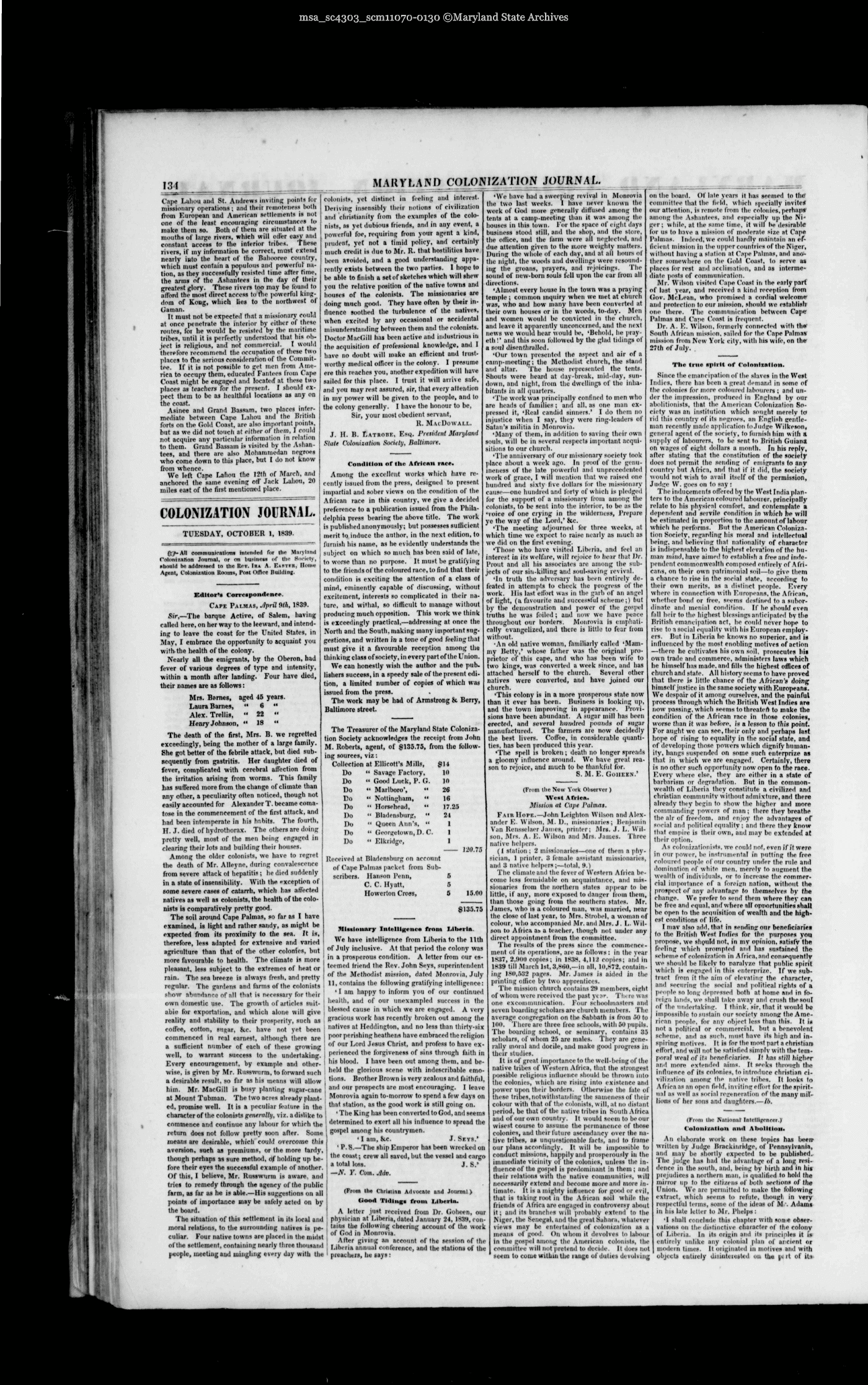
| 134 MARYLAND COLONIZATION JOURNAL. Cape Lahou and St. Andrews inviting points for missionary operations ; and their remoteness both from European and American settlements is not one of the least encouraging circumstances to make them so. Both of them are situated at the mouths of large rivers, which will oiler oasv and constant access to the interior tribes, 'these rivers, if my information be correct, most extend nearly into the heart of the Bahooree country, which must contain a populous and powerful na- tion, as they successfully resisted time after time, the arms of the Ashantees in the day of their greatest glory. These rivers too may be Ibund to afford the most direct access to the powerful king- dom of Kong, which lies to the northwest of Gaman. It must not be expected that a missionary could at once penetrate the interior by either of these routes, for he would be resisted by the maritime tribes, until it is perfectly understood that his ob- ject is religious, and not commercial. I would therefore recommend the occupation of these two places to fhe serious consideration of the Commit- tee. If it is not possible to get men from Ame- rica to occupy them, educated Fantees from Cape Coast might be engaged and located at these two places as teachers for the present. I should ex- pect them to be as healUiful locations as any on the coast. Asinee and Grand Bassam, two places inter- mediate between Cape Lahou and the British forts on the Gold Coast, are also important points, but as we did not touch at either of them, I could not acquire any particular information in relation to them. Grand Bassam is visited by the Ashan- tees, and there are also Mohammedan negroes who come down to this place, but I do not know from whence. We left Cape Lahon fhe 12th of March, and anchored the same evening otf Jack Lahou, 20 miles east of the first mentioned place. COLONIZATION JOURNAL. TUESDAY, OCTOBER 1, 1839. All communications intended for the Maryland Coloniz.ation Journal, or on business of the Society, should be addressed to the Rev. Ira A. Easter, Home Agent, Colonization Rooms, Post Office building. colonists, yet distinct in feeling and interest. Deriving insensibly their notions of civilization and Christianity fiom the examples of the colo- nists, as yet dubious friends, and in any event, a powerful foe, requiring from your agent a kind, prudent, yet not a fimid policy, and certainly much credit is due to Mr. R. that hostilities have been avoided, and a good understanding appa- rently exists between the two parties. I hope to be able to finish a set of sketches which will shew you fhe relative position of the native towns and houses of the colonists. The missionaries are doing much good. They have often by their in- fluence soothed the turbulence of the natives, when excited by any occasional or accidental misunderstanding between them and the colonists. Doctor MacGill has been active and industrious in the acquisition of professional knowledge, and 1 have no doubt will make an efficient and trust- worthy medical officer in the colony. I presume ere this reaches you, another expedition will have sailed fortius place. I trust it will arrive safe, and you may rest assured, sir, that every attention in my power will be given to the people, and to the colony generally. I have the honour to be, Sir, your most obedient servant, R. MacDowall. J. H. B. Latrobe, Esq. President Maryland State Colonization Society, Baltimore. Condition or the African race. Among the excellent works which have re- cently issued from the press, designed to present impartial and sober views on the condition of the African race in this country, we give a derided preference to a publication issued from the Phila- delphia press bearing the above title. The work is published anonymously; but possesses sufficient merit to induce the author, in the next edition, to furnish his name, as he evidently understands the subject on which so much has been said of late, to worse than no purpose. It must be gratifying to the friends of the coloured race, to find that their condition is exciting the attention of a class of mind, eminently capable of discussing, without excitement, interests so complicated in their na- ture, and wi'hal, so difficult to manage without producing much opposition. This work we think is exceedingly practical,—addressing at once the North and the South, making many important sug- gestions, and written in a tone of good feeling that must give it a favourable reception among the thinking class of society, in every part of the Union. We can honestly wish the author and the pub- lishers success, in a speedy sale of the present edi- tion, a limited number of copies of which was issued from the press. The work may be had of Armstrong & Berry, Baltimore street. Editor's Correspondence. Cape Palmas, April 9th, 1839. Sir,—The barque Active, of Salem, having called here, on her way to the leeward, and intend- ing to leave the coast for the United States, in May, I embrace the opportunity to acquaint you with-the health of the colony. Nearly all the emigrants, by the Oberon, had fever of various degrees of type and intensity, within a month after landing. Four have died, their names are as follows: Mrs. Barnes, aged 45 years. Laura Barnes, " 6 " Alex. Trellis, " 22 " Henry Johnson, " 18 " The death of the first, Mrs. B. we regretted exceedingly, being the mother of a large family. She got better of the febrile attack, but died sub- sequently from gastritis. Her daughter died of fever, complicated with cerebral affection from the irritation arising from worms. This family has suffered more from the change of climate than any other, a peculiarity often noticed, though not easily accounted for Alexander T. became coma- tose in the commencement of the first attack, and had been intemperate in his habits. The fourth, H. J. died of hydrothorax. The others are doing pretty well, most of the men being engaged in clearing their lots and building their houses. Among the older colonists, we have to regret the death of Mr. Alleyne, during convalescence from severe attack ot hepatitis; he died suddenly in a state of insensibility. With the <-xception of some severe cases of catarrh, which has affected natives as well as colonists, the health of the colo- nists is comparatively pretty good. The soil around Cape Palmas, so far as I have examined, is light and rather sandy, as might be expected from its proximity to the sea. It is, therefore, less adapted for extensive and varied agriculture than that of the other colonies, but more favourable to health. The climate is more pleasant, less subject to the extremes of heat or rain. The sea breeze is always fresh, and pretty regular. The gardens and farms of the colonists show abundance of all that is necessary for their own domestic use. The growth of articles suit- able for exportation, and which alone will give reality and stability to their prosperity, such as colfee, cotton, sugar, tkc. have not yet been commenced in real earnest, although there are a sufficient number of each of these growing well, to warrant success to the undertaking| Every encouragement, by example and other- wise, is given by Mr. Russwurm, to forward such a desirable result, so far as his means will allow him. Mr. MacGill is busy planting sugar-cane at Mount Tubman. The two acres already plant- ed, promise well. It is a peculiar feature in the character of the colonists generally, viz. a dislike to commence and continue any labour for which the return does not follow pretty soon after. Some means are desirable, which could overcome this aversion, such as premiums, or the more tardy, though perhaps as sure method, of holding up be- fore their eyes the successful example of another. Of this, I believe, Mr. Russwurm is aware and tries to remedy through the agency of the public farm, as far as he is able.—His suggestions on all points of importance may be safely acted on by the board. The situation of this settlement in its local and moral relations, to the surrounding natives is pe- culiar. Four native towns are placed in the midst of the settlement, containing nearly three thousand people, meeting and mingling every day with the The Treasurer of the Maryland State Coloniza- tion Society acknowledges the receipt from John M. Roberts, agent, of $135.75, from the follow- ing sources, viz: Collection at Ellicott's Mills, $14 Do " Savage Factory, 10 Do " Good Luck, P. G. 10 Do " Marlboro', " 26 Do " Nottingham, " 16 Do " Horsehead, " 17.25 Do " Bladensburg, " 24 Do " Queen Ann's, " 1 Do " Georgetown, D. C. 1 Do " Elkridge, 1 120.75 Received at Bladensburg on account of Cape Palmas packet from Sub- scribers. Hanson Penn, 5 C. C. Hyatt, 5 Howerton Cross, 5 15.00 $135.75 •We have had a sweeping revival in Monrovia the two last weeks. 1 have never known the work of God more generally diffused HHM the tents at a camp-meeting than it was among the houses in this town, for the space of eight days business stood still, and the shop, and the store, the office, and the tiirm were all neglected, anil due attention given to the more weighty mutters. During the whole of each day, and at all hours of the night, the woods and dwellings were resound- ing the groans, prayers, and rejoicings. The sound of new-born souls fell upon the ear from all directions. 'Almost every house in the town was a praying temple; common inquiry when we met at church was, who and how many have been converted at their own houses or in the woods, to-day. Men and women would be convicted in the chuich, and leave it apparently unconcerned, and the next news we would hear would he, 'Behold, lie pray etb!' and this soon followed by the glad tidings of a soul disenthralled. 'Our town presented the aspect and air of a camp-meeting; the Methodist church, the stand arid altar. The house represented the tents. Shouts were heard at day-break, mid-day, sun- down, and night, from the dwellings of the inha- bitants in all quarters. 'The work was principally confined to men who arc heads of families ; ami all, as one man ex- pressed it, 'Real candid sinners.' I do them no injustice when I say, they were ring-leaders of Satan's militia in Monrovia. 'Many of them, in addition to saving their own souls, will be in several respects important acqui- sitions to our church. 'The anniversary of our missionary society took place about a week ago. In proof of the gam. ineness of the late powerful and unprecedented work of grace, I will mention that we raised one hundred and sixty five dollars for the missionary cause—one hundred and forty of which is pledged fiir the support of a missionary from among the colonists, to be sent into the interior, to be as the 'voice of one crying in the wilderness, Prepare ye the way of the Lord,' ftc. 'The meeting adjourned lor three weeks, at which time we expect to raise nearly as much as we did on the first evening. 'Those who have visited Liberia, and feel an interest in its welfare, will rejoice to hear that Dr. Piout and all his associates are among the sub- jects of our siti-killing and soul-saving revival. 'In truth the adversary has boon entirely de- feated in attempts to check the progress of the work. His last effort was in the garb of an angel of light, (a favourite and successful scheme;) but by the demonstration and power of the gospel truths lie was foiled ; and now we have peace throughout our borders. Monrovia is emphati- cally evangelized, and there is little to fear from without. •An old native woman, familiarly called 'Mam- my Betty,' whose father was the original pro- prietor of this cape, and who has been wife to two kings, was converted a week since, and has attached herself to the church. Several other natives were converted, and have joined our church. 'This colony is in a more prosperous state now than it ever has been. Business is looking up, and the town improving in appearance. Provi- sions have been abundant. A sugar mill has been erected, and several hundred pounds of sugar manufactured. The farmers ate now decidedly the best livers. Coffee, in considerable quanti- ties, has been produced this year. 'The spell is broken; death no longer spreads a gloomy itillucnce around. We have great rea- son to rejoice, and much to be thankful for. S. M. E. Guiiein.' on the board. Of late years it has seemed lo the committee that the field, which specially invites our attention, is remote from the colonies, perhaps among the Ashantees. and especially up the Ni' ger; while, at the same lime, it will be desirable for us to have a mission of moderate size at Cape Palmas. Indeed, we could hardly maintain an ef- ficient mission in the upper countries of the Niger, without having a station at Cape Palmas, and ano- ther somewhere on the (odd Coast, to serve as places lor rest and acclimation, and as interme- diate posts of communication. Mr. Wilson visited Cape Coast in the early part of last year, and received a kind reception from Gov. McLean, who promised a cordial welcome and protection to our mission, should we establish one (here. The communication between Cape Palmas and Caps Const is frequent. Dr. A. E. Wilson, formerly connected with the South African mission, sailed for the Cape Palmas mission from New York city, with his wile, on the 27th of July. Missonary Intelligence from Liberia We have intelligence from Liberia to the 11th of July inclusive. At that period the colony was in a prosperous condition. A letter from our es- teemed friend the Rev. John Seys, superintendent of the Methodist mission, dated Monrovia, July 11, contains the following gratifying intelligence: ' I am happy to inform you of our continued health, and of our unexampled success in the blessed cause in which we are engaged. A very gracious work has recently broken out among the natives at Heddington, and no less than thirty-six poor perishing heathens have embraced the religion of our Lord Jesus Christ, and profess to have ex- perienced the forgiveness of sins through faith in his blood. I have been out among them, and be- held the glorious scene with indescribable emo- tions. Brother Brown is very zealous and faithful, and our prospects are most encouraging. I leave Monrovia again to-morrow to spend a few days on that station, as the good work is still going on. 'The King has been converted to God, and seems determined to exert all his influence to spread the gospel among his countrymen. ' I am, &c. J. Seys.' ' P. S.—The ship Emperor has been wrecked on the coast; crew all saved, but the vessel and cargo a total loss. J. S.' —N. Y. Com. Adv. (From the Christian Advocate and Jourrnal ) Good Tidings fromLiberia. A letter just received from Dr. Goheen, our physician at Liberia, dated January 24, 1839, con- tains the following cheering account of the work of God in Monrovia. Alter giving an account of the session of (he Liberia annual conference, and the stations of the preachers, he says: (From the New York Observer ) "West Africa. Mission at Cape Palmas. Fair Hope.—John Leighton Wilson and Alex- ander E. Wilson. M. D., missionaries; Benjamin Van Rensselaer James, printer; Mrs. J. L. Wil- son, Mrs. A. E. Wilson and Mrs. James. Three native helpers. (1 station ; 2 missionaries—one of fhem a phy- sician, 1 printer. 3 female assistant missionaries, and 3 native helpers;—total. 9.) The climate and the fever of Western Africa be- come less formidable on acquaintance, and mis- sionaries from the northern slates appear to be little, if any, more exposed to danger from them, than those going from the southern states. Mr. James, who is a coloured man, was married, near the close of last year, to Mrs. Strobel, a woman of colour, who accompanied Mr. and Mrs. J. L. Wil- son to Africa as a teacher, though not under any direct appointment from the committee. The results of the press since the commence- ment of its operations, are as follows : in the year 1837, 2,900 copies; in 1838. 4,112 copies; and in 1839 till March 1st, 3,860,—in all, 10,872. contain- ing 180,532 pages. Mr. James is aided in the printing office by two apprentices. The mission church contains 29 members, eight of whom were received the past yi If. Tin re was one excommunication. Four schoolmasters and seven boarding scholars are church members. The average congregation on the Sabbath is from 50 to 100. There are three free schools, with 50 pupils. The boarding school, or seminary, contains 35 scholars, of whom 25 are males. They are gene- rally moral and docile, and make good progress in their studies. It is of great importance to the well-being of the native tribes of Western Africa, that the strongest possible religious intlueiice should be thrown into the colonies, which are rising into existence and power upon their borders. Otherwise the fate of these tribes,notwithstanding the sameness of their colour with that of the colonists, w ill, at no distant period, be that of the native tribes in South Africa and of our own country. It would seem to be our wisest course to assume the permanence of those colonies, and their future ascendancy over the na- tive tribes, as unquestionable facts, and to frame our plans accordingly. It will be impossible to conduct missions, happily and prosperously in the immediate vicinity of the colonies, unless the in- fluence of the gospel is predominant in them; and their relations with the native communities, will necessarily extend and become more and more in- timate. It is a mighty influence lor good or evil, that is taking root in the African soil while the friends of Africa are engaged in controversy about it; and its branches will probably extend to the Niger, the Senegal, and the great Sahara, whatever views may be entertained of colonization as a means of good. On whom it devolves to l,d«un in the gospel among the American colonisls, the The true spirit of Colonization. Since the emancipation of the slaves in the West Indies, there has been a great demand in some of fhe colonies for more coloured labourers ; and un- der the impression, produced in England bv our abolitionists, that the American Colonization So- ciety was an institution which sought merely to rid this country of ils negroes, an English gentle- man recently made application fo Judge Wilkeson, general agent of (he society, to furnish him with a supply of labourers, to he sent to British Guiana on wages of eight dollars a month. In his reply, after stating that the constitution of the society does not permit fhe sending of emigrants fo any country but Africa, and that if it did, (he society would not wish to avail itself of the permission, Judge W. goes on to say : The inducements offered by the West India plan- ters to the American coloured labourer, principally relate to his physical comfort, and contemplate a dependent and servile condition in which he will be estimated in proportion to the amount of labour which be performs. But the American Coloniza- tion Society, regarding his moral and intellectual being, and believing that nationality of character is indispensable to the highest eleva'ion of the hu- man mind, have aimed to establish a free arid inde- pendent commonwealth composed entirely of Afri- cans, on their own patrimonial soil—to give them a chance to rise in the social slate, according to (heir own merits, as a distinct people. Every where in connection with Europeans, (he African, whether bond or free, seems destined to a subor- dinate and menial condition, If he should even fall heir to the highest blessings anticipated by (he British emancipation act, he could never hope (o rise to a social equality with his European employ- ers. But in Liberia he knows no superior, and is influenced by the most ennbling motives of action -—there he cultivates his own soil, prosecutes his own trade and commerce, administers laws which he himself has made, and fills the highest offices of church and stale. All history seems to have proved that there is litfle chance of the African's doing himself justice in the same society with Europeans. We despair of it among ourselves, and the painful process through which the British West Indies are now peering, which seems to threaten to make the condition of the African race in those colonies, worse than it was before, is a lesson to this point. For aught we can see, their only and perhaps last hope of rising to equality in the social state, and of developing those powers which dignify human- ity, hangs suspended on some such enterprize as that in which we are engaged. Certainly, there is no other such Opportunity now open to fhe race. Every where else, they are either in a state of barbarism or degradation. But in the common- wealth of Liberia they constitute a civilized and christian community without admixture, and there already they begin to show the higher and more commanding pow'ers of man ; there they breathe the air of freedom, and enjoy the advantages of social and political equality; and there they know that culture is their own, and may be extended at their option. As colonizationisfs. we could not, even if U were in our power, be instrumental in putting the free coloured people of our country under (he rule and domination of white men. merely to augment the wealth of individuals, or to increase the commer- cial importance of a foreign nation, without the prospect of any advantage fo themselves by the change. We prefer to send them where they can be free and equal, and where all opportunities shall be open to the ariiuisition of wealth and the high- est conditions of life. I mav also add, that in sending our beneficiaries fo the British West Todies for the purposes you propose, we should not, in mv opinion, satisfy the feeling which prompted and has sustained the scheme of colonization in Africa, and consequently we should he likely to paralyze that public spirit which is engaged in this enterprize. If we sub- tract from it the aim of elevating the character, and securing the social and political rights of a people so long depressed both at home and in fo- reign lands, we shall take away and crush the soul of flip undertaking. I think, sir. that it would be impossible to sustain our society among the Ame- rican people, for any object less than this. It is not a political or commercial, but a benevolent scheme, and as such, must have its high and in- spiring motives. It is for the most part a christian effort, and will not be satisfied simply with the tem- poral weal of its beneficiaries. It has still higher and more extended aims. It seeks through the influence of its colonies, to introduce christian ci- vilization among the native tribes. It looks to Africa as an open field, inviting effort for the spirit- ual as well as social regeneration of the many mil- lions of her sons and daughters.—lb. (From the National Intelligencer.) Colonizations and Abolition. An elaborate work on these topics has been written by Judge Brackinridge, of Pennsylvania, and may be shortly expected to be published. The judge has had the advantage of a long resi- dence in the south, and, being by birth and in his prejudices a northern man, is qualified to hold the mirror up to the citizens of both sections of the Union. We are permitted to make the following extract, which seems to refute, though in very respectful terms, some of the ideas of Mr. Adams in his late letter to Mr. Phelps: 'I shall conclude this chapter with some obser- vations on the distinctive character of the colony of Liberia. In its origin and its principles it i» entirely unlike any colonial plan of ancient or modern times. It originated in motives and with objects entirely disinterested on the out of its- |