 |
|
|
 |
|
 |
|
|||
|
||||
|
||||
|
Maryland State Archives Maryland Colonization Journal Collection MSA SC 4303 msa_sc4303_scm11070-0131 Enlarge and print image (5M) |
|
|
|
|
|
|
|
|||
|
||||
|
||||
|
Maryland State Archives Maryland Colonization Journal Collection MSA SC 4303 msa_sc4303_scm11070-0131 Enlarge and print image (5M) |
|
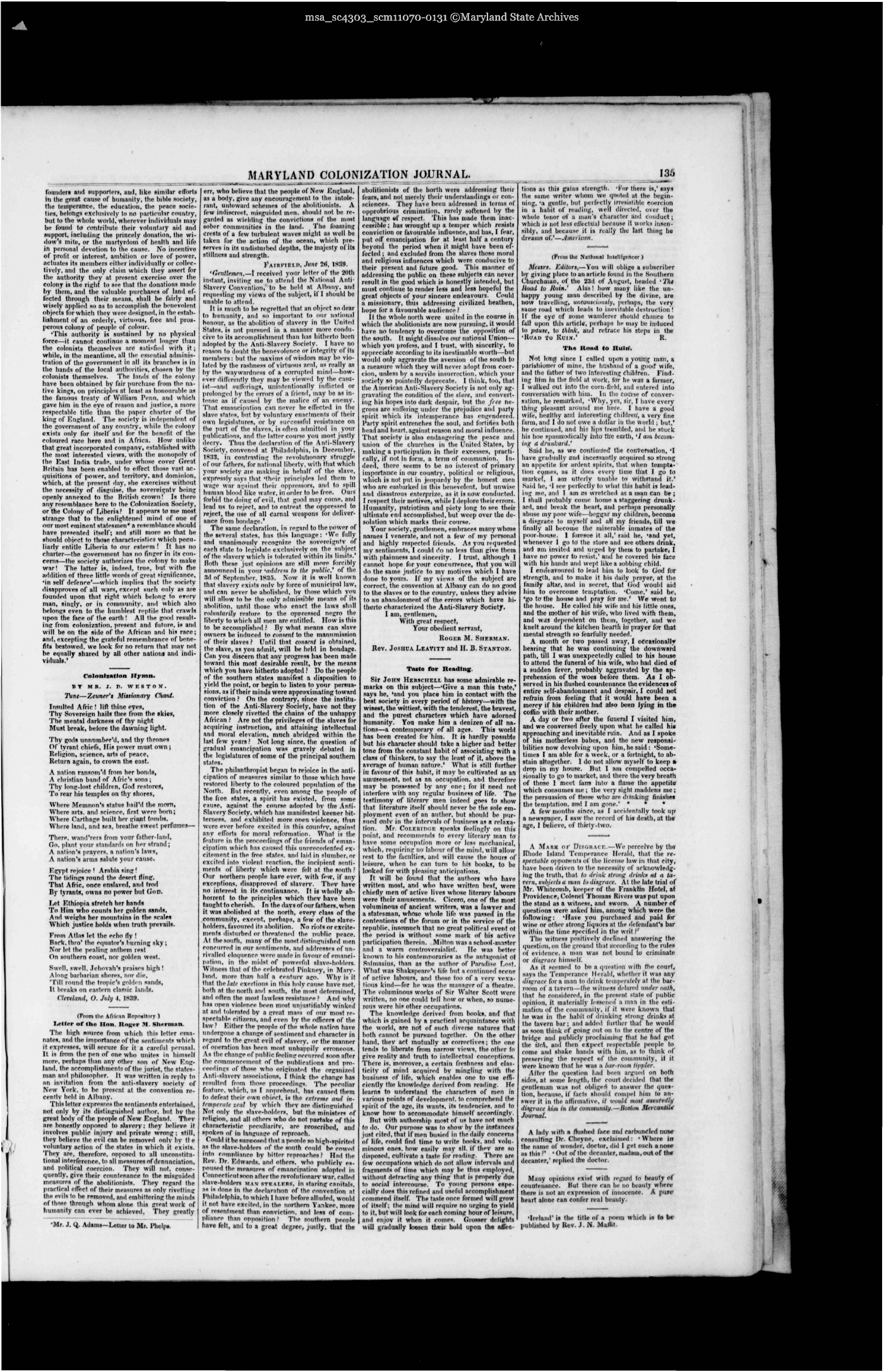
founders and supporters, and, like similar efforts
in the great cause of humanity, the bihle society,
tlie temperance, the education, the peace socie-
ties, belongs exclusively to no particular country,
but to the whole world, wherever individuals may
be found to Contribute their voluntary aid anil
support, including the princely donation, the wi-
dow's rnite, or the martyrdom of health and life
in personal devotion to the cause. No incentive
of profit or interest, ambition or love of power,
actuates its members either individually or collec-
tively, and the only claim which they assert for
the authority they at present exercise over the
colony is the risrht to see that the donations made
by thein, and the valuable purchases of land ef-
fected through their means, shall be fairly and
wisely applied so as to accomplish the benevolent
objects for which they were designed, in the estab-
lishment of an orderly, virtuous, free and pros-
perous colony of people of colour.
'This authority is sustained by no physical
force—it cannot continue a moment longer than
the colonists themselves are satisfied with it ;
while, in the meantime, all the essential adminis-
tration of the government in all its branches is in
the hands of the local authorities, chosen by the
colonists themselves. The lands of the colony
have been obtained by fair purchase from the na-
tive kings, on principles at least as honourable as
the famous treaty of William Penn, and which
gave him in the eye of reason and justice, a more
respectable title than the paper charter of the
king of England. The society is independent of
the government of any country, while the colony
exists only for itself and for the benefit of the
coloured race here and in Africa. How unlike
that great incorporated company, established with
the most interested views, with the monopoly of
the East India trade, under whose cover Great
Britain has been enabled to effect those vast ac-
quisitions of power, and territory, and dominion,
which, at the present day, she exercises without
the necessity of disguise, the sovereignty being
openly annexed to the Hritish crown! Is there
any resemblance here to the Colonization Society,
or the Colony of Liberia? it appears to me most
strange that to the enlightened mind of one of
our mo«t eminent statesmen" a resemblance should
have presented itself; and still more so that he
should object to those characteristics which pecu-
liarly entitle Liberia to our esteem ! It has no
charter—the government has no finger in its con-
cerns—the society authorizes the colony to make
war! The latter is, indeed, true, but with file
addition of three little words of great significance,
'in self defence'—which implies that the society
disapproves of all wars, except such only as are
founded upon that right which belong to every
man, singly, or in community, and which also
belongs even to the humblest reptile that crawls
upon the face of the earth! All the good result-
ing from colonization, present and future, is and
will be on the side of the African and his race;
and, excepting the grateful remembrance of bene-
fits bestowed, we look for no return that may not
he equally shared by all other nations and indi-
viduals.'
Colonization Hymn,
BY MR. J. D. WESTON.
Tune—Zcuner't Missionary Chant.
Insulted Afric ! lift thine eyes,
Thy Sovereign hails thee from the skies,
The mental darkness of thy night
Must break, before the dawning light.
Thy gods nnnninber'd, and thy thrones
Of tyrant chiefs. His power must own;
Keligion, science, arts of peace.
Return again, to crown the east.
A nation ransom'd from her bonds,
A christian band of A Trie's sons;
Thy long-lost children, God restores,
To rear bis temples on thy shores.
Where Memnon's statue bail'd the morn.
Where arts, and science, first were born;
Where Carthage built her giant tombs,
Where land, and sea, breathe sweet perfumes-
There, wand'rers from vour father-land,
fio, plant vour standards on her strand;
A nation's prayers, a nation's laws,
A nation's arms salute your cause.
Egypt rejoice I Arabia sing'
The tidings round the desert fling.
That Afric, once enslaved, and trod
By tyrants, owns no power but God.
Let Ethiopia stretch her hands
To Him who counts her golden sands.
And weighs her mountains in the scales
Which justice holds when truth prevails.
From Atlas let the echo fly !
Back,thro' the equator's burning sky;
Nor let the pealing anthem rest
On southern coast, nor golden west.
Swell, swell. Jehovah's praises high !
Along barbarian shores, nor die,
'Till round the tropic's golden sands,
It breaks on eastern classic lands.
Cleveland, O. July 4, 1839.
(From The African Repository )
Letter of the Hon. Roger M. Sherman.
The high source from which this letter ema-
nates, and the importance of the sentiments which
it expresses, will secure for it a careful perusal.
It is from the pen of one who unites in himsell
more, perhaps than any other son of New Eng-
land, the accomplishments of the jurist, the states-
man and philosopher. It was written in reply to
an invitation from the anti-slavery society of
New York, to be present at the convention re-
cently held in Albany.
This letter expresses the sentiments entertained,
not only by its distinguished author, but by the
great body of the people of New England. They
are honestly opposed to slavery; they believe it
involves public injury and private wrong; still,
they believe the evil can be removed only by tl e
voluntary action of the states in which it exists.
They are, therefore, opposed to all unconstitu-
tional interference, to all measures of denunciation,
and political coercion. They will not, conse-
quently, give their countenance to the misguided
measures of the abolitionists. They regard the
practical effect of their measures as only rivetling
the evils to he removed, and embittering the minds
of those through whom alone this great work of
humanity can ever be achieved. They greatly
•Mr. J. Q|. Adams— Letter to Mr. Phelps.
err, who believe that the people of New England,
as a body, give any encouragement to the intole-
rant, untoward schemes of the abolitionists. A
few indiscreet, misguided men, should not be re-
garded as wielding the convictions of the most
sober communities in the laud. The foaming
Crests of a few turbulent waves might as well be
taken for the action of the ocean, which pre-
serves in its undistuibed depths, the majesty of its
stillness and strength.
Fairfield, June 26, 1839.
'Gentlemen,—I received your letter of the 20th
instant, inviting me to attend the National Anti-
Slavery Convention,' to be held at Albany, and
requesting my views of the subject, if I should be
unable to attend.
It is much to be regretted that an object so dear
to humanity, and so important to our national
honour, as the abolition id' slavery in the United
States, is not pursued in a manner more condu-
cive to its accomplishment than has hitherto been
adopted by the Anti-Slavery Society. I have no
reason to doubt the benevolence or integrity of its
members: but the maxims of wisdom may be vio-
lated by the rashness of virtuous zeal, as really as
by the waywardness of a corrupted mind—how-
ever differently they may be viewed by the casu-
ist—and sufferings", Unintentionally inflicted or
prolonged by the errors of a friend, may be as in-
tense as if caused by the malice of an enemy.
That emancipation Can never be elfected in the
slave states, but by voluntary enactments of their
own legislatures, or by successful resistance on
the part of the slaves, is often admitted in your
publications, and the latter course you most justly
decry. Thus the declaration of the Anti-Slavery
Society, convened at Philadelphia, in December,
1R33, in contrasting the revolutionary struggle
of our fathers, for national liberty, with that which
your society nie making in behalf of the slave,
expressly says that 'their principles led them to
wage war against their oppressors, and to spill
human Mood like water, in order to be free. Ours
forbid the doing of evil, that good may come, and
lead us to reject, and to entreat the oppressed to
reject, the use of all carnal weapons for deliver-
ance from bondage.'
The same declaration, in regard to the power of
the several states, has this language: 'We fully
and unanimously recognize the sovereignty of
each state to legislate exclusively on the subject
of the slavery which is tolerated within its limits.'
Both these just opinions are still more forcibly
announced in your 'address to the public,' of the
3d of September, MM, Now it is well known
that slavery exists onlv by force of municipal law,
and can never be abolished, by those which vou
will allow to be the only admissible means of its
abolition, until those who enact the laws shall
voluntarily restore to the oppressed negro the
liberty to which all men are entitled. How is this
to be accomplished ? By what means can slave
owners be induced to consent to the manumission
of their slaves? Until that consent is obtained,
the slave, as you admit, will be held in bondage.
Can you discern that any progress has been made
toward this most desirable result, bv the means
which yon have hitherto adopted ? Do the people
of the southern states manifest a disposition to
yield the point, or begin to listen to your persua-
sions, as if their minds were approximating toward
conviction ? On the contrary, since the institu-
tion of the Anti-Slavery Society, have not they
more closely rivetted the chains of the unhappy
African ? Are not the privileges of the slaves for
acquiring instruction, and attaining intellectual
and moral elevation, much abridged within the
last few years ? Not long since, the question of
gradual emancipation was gravely debated in
the legislatures of some of the principal southern
states.
The philanthropist began to rejoice in the anti-
cipation of measures similar to those which have
restored liberty to the coloured population of the
North. But recently, even among the people of
the fiee states, a spirit has existed, from some
cause, against the course adopted by the Anti-
Slavery Society, which has manifested keener bit-
terness, anil exhibited more onen violence, than
were ever before excited in this country, against
any efforts for moral reformation. What is the
feature in the proceedings of the friends of eman-
cipation which has caused this unprecedented ex-
citement in the free states, and laid in slumber, or
excited into violent reaction, the incipient senti-
ments of liberty which were felt at the south ?
Our northern people have ever, with few, if any
exceptions, disapproved of slavery. They have
no interest in its continuance. It is wholly ab-
hoirent to the principles which thev have been
taught to cherish. In the days of our fathers, when
it was abolished at the north, every class of the
community, except, perhaps, a few of the slave-
holders, favoured its abolition. No riots orexcite-
ments disturbed or threatened the public peace.
At the south, many of the most distinguished men
concurred in our sentiments, and addresses of un-
rivalled eloquence were made in favour of emanci-
pation, in the midst of powerful slave-holders.
Witness that of the celebrated Pinkney, in Mary-
land, more than half a century ago. Why is it
that the / |