 |
|
|
 |
|
 |
|
|||
|
||||
|
||||
|
Maryland State Archives Maryland Colonization Journal Collection MSA SC 4303 msa_sc4303_scm11070-0132 Enlarge and print image (5M) |
|
|
|
|
|
|
|
|||
|
||||
|
||||
|
Maryland State Archives Maryland Colonization Journal Collection MSA SC 4303 msa_sc4303_scm11070-0132 Enlarge and print image (5M) |
|
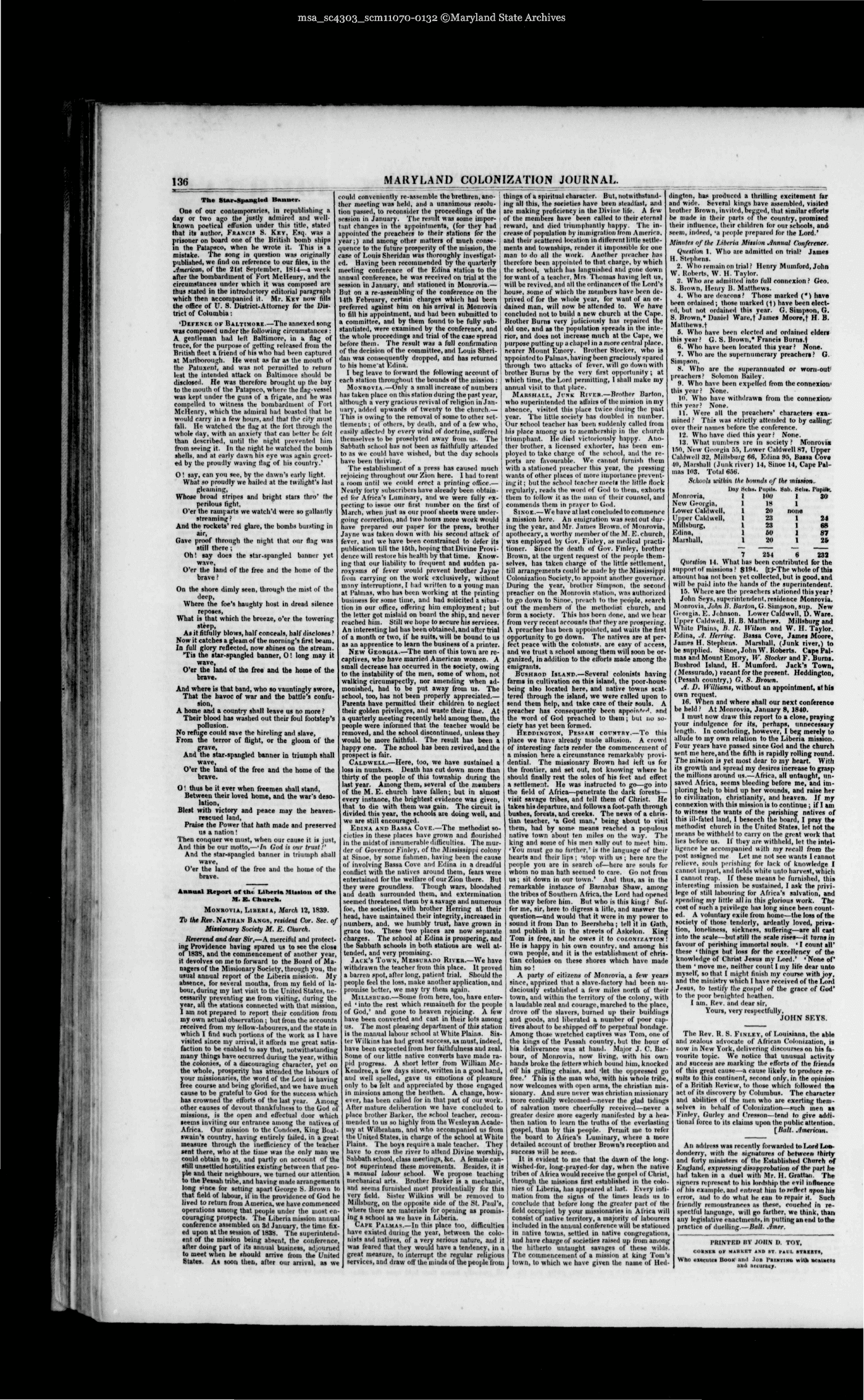
136
MARYLAND COLONIZATION JOURNAL.
The Star .Spangled Banner.
One of our contemporaries, in republishing a
day or two ago the justly admired and well-
known poetical effusion under this title, stated
that its author, Francis S. Key, Esq. was a
prisoner on board one of the British bomb ships
in the Patapsco, when he wrote it. This is a
mistake. The song in question was originally
published, we find on reference to our files, in the
American, of the 21st September, 1814—a week
after the bombardment of Fort Mclleiiry, and the
circumstances under which it was composed are
thus stated in the introductory editorial paragraph
which then accompanied it. Mr. Key now fills
the office of U. S. District-Attorney for the Dis-
trict of Columbia:
'Defence of Baltimore.—The annexed song
was composed under the following circumstances :
A gentleman had left Baltimore, in a flag of
truce, for the purpose of getting released from the
British fleet a friend of his who had been captured
at Marlborough. He went as far as the mouth of
the Patuxent, and was not permitted to return
lest the intended attack on Baltimore should be
disclosed. He was therefore brought up (he bay-
to the mouth of the Patapsco, where the flag-vessel
was kept under the guns of a frigate, and he was
compelled to witness the bombardment of Fort
McHenry, which the admiral had boasted that he
would carry in a few hours, and that the city must
fall. He watched the flag at the fort through the
whole day, with an anxiety that can better be felt
than described, until the night prevented him
from seeing it. In the night he watched the bomb
shells, and at early dawn his eye was again grcct-
ed by the proudly waving flag of his country.'
O! say, can you see. by the dawn's early lijiht.
What so proudly we nailed at the twilight's last
gleaming,
Whose broad stripes and bright stars thro' the
perilous fight,
O'er the ramparts we watch'd were so gallantly
streaming I
And the rockets' red glare, the bombs bursting in
air,
Gave proof through the night that our flag was
still there ;
Oh! say does the star-spangled banner yet
wave.
O'er the land of the free and the home of the
brave'
On the shore dimly seen, through the mist of the
deep,
Where the foe's haughty host in dread silence
reposes,
What is that which the breeze, o'er the towering
steep,
As it fitfully blows, half conceals, half discloses?
Now it catches a gleam of the morning's first beam,
In full glory reflected, now shines on the stream.
Tis the star-spangled banner, O! long may it
wave.
O'er the land of the free and the home of the
brave.
And where is that band, who so vauntingly swore,
That the havoc of war and the battle's confu-
sion,
A home and a country shall leave us no more ?
Their blood has washed out their foul footstep's
pollusion.
No refuge could save the hireling and slave.
From the terror of flight, or the gloom of the
grave.
And the star-spangled banner in triumph shall
wave,
O'er the land of the free and the home of the
brave.
O! thus be it ever when freemen shall stand,
Between their loved home, and the war's deso-
lation,
Blest with victory and peace may the heaven-
rescued land.
Praise the Power that hath made and preserved
us a nation!
Then conquer we must, when our cause it is just,
And this be our motto,—-In God is our trust!'
And the star-spangled banner in triumph shall
wave,
O'er the land of the free and the home of the
brave.
Annual Report of the Liberia Mission or the
M. E. Church.
Monrovia, Liberia, March 12, 1839.
To the Rev. Nathan Bangs, resident Cor. Sec. of
Missionary Society M. E. Church.
Reverend and dear Sir,—A rnerciful and protect-
ing Providence having spared us to see the close
ofl83S, and the commencement of another year,
it devolves on me to forward to the Board of Ma-
nagers of the Missionary Society, through you, the
usual annual report of the Liberia mission. My
absence, for several months, from my field of la-
bour, during my last visit to the United States, ne-
cessarily preventing me from visiting, during the
year, all tn» stations connected with that mission,
I am not prepared to report their condition from
my own actual observation ; but from the accounts
received from my lellow-labourers.and the state in
which I find such portions of the work as I have
visited since my arrival, it affords me great satis-
faction to be enabled to say that, notwithstanding
many things have occurred during the year, within
the colonies, of a discouraging character, yet on
the whole, prosperity has attended the labours of
your missionaries, the word of the Lord is having
free course and being glorified, and we have much
cause to be grateful to God for the success which
has crowned the efforts of the last year. Among
other causes of devout thankfulness to the God of
missions, is the open and effectual duor which
seems inviting our entrance among the natives of
Africa. Our mission to the. Condoes, King Boat-
swain's country, having entirely failed, in a great
measure through the inefficiency of the teacher
sent there, who at the time was the only man we
could obtain to go, and partly on account of the
still unsettled hostilities existing between that peo-
ple and their neighbours, we turned our attention
to the Peasah tribe, and having made arrangements
long since for setting apart George S. Brown to
that field of labour, if in the providence of God he
lived to return from America, we have commenced
operations among that people under the most en-
couraging prospects. The Liberia mission annual
conference assembled on 8d January, the time fix-
ed upon at the session of 183s. The superintend-
ent of the mission being absent, the conference,
after doing part of its annual business, adjourned
to meet when he should arrive from the United
States. As soon then, after our arrival, as we
could conveniently re-assemble the brethren, ano-
ther meeting was held, and a unanimous resolu-
tion passed, to reconsider the proceedings of the
session in January. The result was some impor-
tant changes in trie appointments, (for they had
appointed the preachers to their stations for the
year;) and among other matters of much conse-
quence to the future prosperity of the mission, the
case of Louis Sheridan was thoroughly investigat-
ed. Having been recommended by the quarterly
meeting conference of the Edina station to the
annual conference, he was received on trial at the
session in January, and stationed in Monrovia.—
But on a re-assembling of the conference on the
14th February, certain charges which had been
preferred against him on his arrival in Monrovia
to fill his appointment, and had been submitted to
a committee, and by them found to be fully sub-
stantiated, were examined by the conference, and
the whole proceedings and trial of the case spread
before them. The result was a full confirmation
of the derision of the committee, and Louis Sheri-
dan was consequently dropped, and has returned
to his home at Edina.
I beg leave to forward the following account of
each station throughout the bounds of the mission:
Monrovia.—Only a small increase of numbers
has taken place on this station during the past year,
although a very gracious revival of religion in Jan-
uary, added upwards of twenty to the church.—
This is owing to the removal of some to other set-
tlements ; of others, by death, and of a few who,
easily aflected by every wind of doctrine, silvered
themselves to be proselyted away from us. The
Sabbath school has not been as faithfully attended
to as we could have wished, but the day schools
have been thiiving.
The establishment of a press has caused much
rejoicing throughout our Zion here. I had to rent
a room until we could erect a printing office.—
Nearly Ibrty subscribers have already been obtain-
ed lor Africa's Luminary, and we were fully |