 |
|
|
 |
|
 |
|
|||
|
||||
|
||||
|
Maryland State Archives Maryland Colonization Journal Collection MSA SC 4303 msa_sc4303_scm11070-0133 Enlarge and print image (5M) |
|
|
|
|
|
|
|
|||
|
||||
|
||||
|
Maryland State Archives Maryland Colonization Journal Collection MSA SC 4303 msa_sc4303_scm11070-0133 Enlarge and print image (5M) |
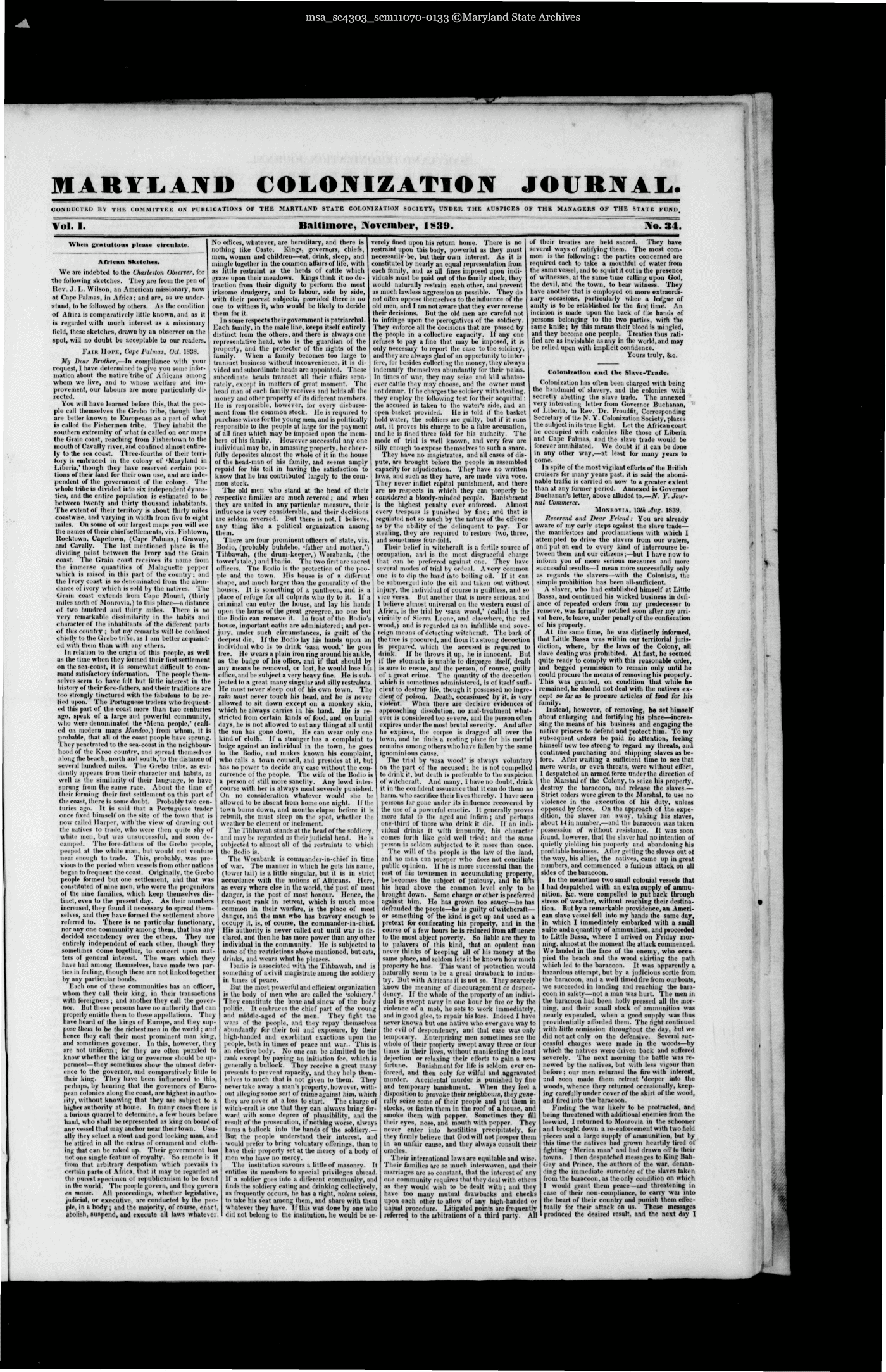
| MARYLAND COLONIZATION JOURNAL. CONDUCTED BY THE COMMITTEE ON PUBLICATIONS OF THE MARYLAND STATE COLONIZATION SOCIETY, UNDER THE AUSPICES OF THE MANAGERS OF THE STATE FUND. Vol. I. Baltimore. November, l839. No. 34. When gratuitous please circulate. African Sketches. We are indebted to the Charleston Observer, for the following sketches. They are from the pen of Rev. J. L. Wilson, an American missionary, now at Cape l'almas, in Africa; and are, as we under- stand, to be followed by others. As the condition of Aliica is comparatively little known, and as it is regarded with much interest as a missionary field, these sketches, drawn by an observer on the spot, will no doubt be acceptable to our readers. Fair Horn, Cape Palmas, Oct. 1838. My Dear Brother,—In compliance with your request, I have determined to give you some infor- mation about the native tribe of Africans among whom we live, and to whose welfare and im- provement, our labours are more particularly di- rected. You will have learned before this, that the peo- ple call themselves the Grebo tribe, though they are better know n to Europeans as a part of what is called the Fishermen tribe. They inhabit the southern extremity of what is called on our maps the Grain coast, reaching from Fishertown to the mouthof Cavally river, and confined almost entire- ly to the sea coast. Three-fourths of their terri- tory is embraced in the colony of 'Maryland in Liberia,' though they have reserved certain por- tions ol their land lor their own use, and are inde- pendent of the government of the colony. The whole Iribe is divided into six independent dynas- ties, and the entire population is estimated to be between twenty and thirty thousand inhabitants. The extent of their territory is about thirty miles coastwise, ami varying in width from five to eight miles. On some of our largest maps you will see the names ol their chief settlements, viz. Fishtown, Rocktown, Capetown, (Cape l'almas.) Graway, and Cavally. The last mentioned place is the dividing point between the Ivory and the Grain coast. The Grain coast receives its name lion. the immense quantities of Malaguette pepper which is raised in this part of the country ; and the Ivory coast is so denominated from the abun- dance ol ivory which is sold by the natives. The Grata coast extends from Cape Mount, (thirty miles north of Monrovia.) to this place—a distance of two hundred and thirty miles. There is no very remarkable dissimilarity in the habits and character Of the inhabitants of the dillcrciit parts of this country ; but my remarks will be confined childly to the Grebo tribe, as I am better acquaint- ed with them than with any others. In relation to the origin of this people, as well as the time when they formed their first settlement on the sea-coast, it is somewhat difficult to com- mand satisfactory information. The people them- selves seem to have lilt but little interest in the history of their fore-fathers, and their traditions are too strongly tinctured with the fabulous to be re- lied upon. The Portuguese traders who frequent- ed this part of the coast more than two centimes ago, speak of a large and powerful community, who were denominated the Mena people,' (rail- ed on modern maps Mandoo,) than wdiom, it is probable, that all ol the coast people have sprung. They penetrated to the sea-coast in the neighbour- hood of the Kroo country, and spread themselves along the beach, north and south, to the distance of several bundled miles. The Grebo tribe, as evi- dently appears from their character and habits, as well as the similarity of their language, to have sprung liotii the same race. About the time of their forming their first settlement on this part of the coast, there is some doubt, l'robably two cen- turies ago. It is said that a Portuguese trader once fixed himself on the site of the town that is now called Harper, with the view of drawing out the natives to trade, who were then quite shy of while men, but was unsuccessful, and 1001 de- camped. The fore-fathers of the Grebo people, peeped at the white man, hut would not venture near enough to trade. This, probably, was pre- vious to the period when vessels fiom other nations began to frequent the coast. Originally, the Giebo people formed but one settlement, and that was constituted of nine men, who were the progenitors of the nine families, which keep themselves dis- tinct, even to the present day. As their numbers increased, they found it necessary to spread them- selves, and they have formed the settlement above referred to. There is no paiticular functionary, nor any one community among them, that has any decided ascendency over the others. They are entirely independent of each other, though they sometimes come together, to concert upon mat- ters of general interest. The wars which they have had among themselves, have made two par- ties in feeling, though these arc not linked together by any particular bonds. Each one of these communities has an officer, whom thry call their king, in theii transactions with foreigners ; and another they call the gover- nor. But these persons have no authority that ran properly eniitle them to these appellations. They nave heard of the kings of Europe, and they sup- pose them to be the richest men in the world ; and hence they call their most prominent man king, and sometimes governor. In this, however, they are not uniform ; for they are often puzzled to know whether the king or governor should be up- permost— they sometimes show the utmost defer- ence to the governor, and comparatively little to their king. They have been influenced to this, perhaps, by hearing that the governors of Euro- pean colonics along the coast, are highest in autho- lity, without knowing that they aie subject to a higher authority at home. In many cases there is a furious quarrel to determine, a few hours before hand, who shall be represented as king on board of any vessel that may anchor near their town. Usu- ally they select a stout and good locking man, and lie attired in all the extras of ornament and cloth- ing that can be raked up. Their government has not one single feature of royalty. So remote is it from tint arbitrary despotism which prevails in certain partH of Aliica. that it may be regarded as the purest specimen of republicanism to be found in the world. The people govern, and they govern en masse. All proceedings, whether legislative, judicial, or executive, are conducted by the peo- ple, in a body ; and the majority, of course, enact, abolish, suspend, and execute all laws whateiti. No olfices, whatever, are hereditary, and there is nothing like Caste. Kings, governors, chiefs, men, women and children—eat, drink, sleep, and mingle together in the common atlairs of life, with M little restraint as the herds of cattle which graze upon their meadows. Kings think it no de- traction from their dignity to perforin the most irksome drudgery, and to labour, side by side, with their poorest subjects, provided there is no one to witness it, who would be likely to deride them for it. In some respects theirgovernment is patriarchal. Each family, in the male line, keeps itself entirely distinct from the others, and there is always one representative head, who is the guardian of the property, and the protector of the rights of the family. When a family becomes too large to transact business without inconvenience, it is di- vided and subordinate heads are appointed. These subordinate heads transact all their affairs sepa- rately, except in matters of great moment. The head man of each family receives and holds all the money and other property of its dillerent members. He is responsible, however, for every disburse- ment from the common stock. He is required to purchase wives for the young men, and is politically responsible to the people at large for the payment of all lines which may be imposed upon the inein- beis of his family. However successful any one individual may be, in amassing property, he cheer- fully deposites almost the whole of it in the house of the head-man of his family, and seems ainplv repaid for his toil in having the satisfaction to know that he has contributed largely to the com- mon stock. The old men who stand at the head of their respective families are much revered ; and when they are united in any particular measure, their influent e is very considerable, and their decisions are seldom reversed. Hut there is not, I believe, any thing like a political organization among them. There are four prominent officers of state, viz. Bodio, (probably btihdcho, 'father and mother,') Tihbawah, (the ilium-keeper,) Woiabank, (the tower's tale,) and Ibadio. The two first are sacred officers. The Bodio is the protection of the peo- ple and the town. His house is of a different shape, and much larger than the generality of the houses. It is something of a pantheon, and is a place of refuge lor all culprits who fly to it. If a criminal can enter the house, and lay his hands upon the horns of the great greegree, no one but the liodio can remove it. In front of the Bodio's house, important oaths are administered; and per- juiy, under such circumstances, is guilt of the deepest die, if the Bodio lay his hands upon an individual who is to drink 'sasa wood," he goes free. He wears a plain iron ring around his ankle, as the badge of his ollice, and if that should by any means be removed, or lost, he would lose his office, and be subject a very heavy fine. He is sub- jected to a great many singular and silly restraints. He must never sleep out of his own town. The rain must never touch his head, and he is never allowed to sit down except on a monkey skin, which he always carries in his hand. He is re- stricted from certain kinds of fowl, and on burial days, he is not allowed to eat any thing at all until the sun has gone down, He can wear only one kind of cloth. If a stranger has a complaint to lodge against an individual in the town, he goes to the liodio, and makes known his complaint, who calls a town council, and presides at it, but has no power to decide any case without the con- currence of the people. The wife of the Bodio is a person of still more sanctity. Any lewd inter- course with her is always most severely punished, On no consideration whatever would she be allowed to be absent from home one night, if the town burns down, and mouths elapse before it is rebuilt, she must sleep on the spot, whether the weather be clement or inclement. The Tihbawah stands at the head of the soldiery, and may be regarded as their judicial head. He is subjected to almost all of the restraints to which the liodio is. The Worabank is commander-in-chief in time of war. The manner in which he gets his name, (tower tail) is a little singular, but it is in strict accordance with the notions of Africans. Here, as every where else in the world, the post of most danger, is the post of most honour. Hence, the rear-most rank in retreat, which is much more common in their warfare, is the place of most danger, and the man who has bravery enough to occupy it, is, of course, the commander-in-chief. His authority is never called out until war is de- clared, and then he has more power than any other individual in the community. He is subjected to none of the restrictions above mentioned, but eats, drinks, and wears what he pleases. Ibadio is associated with the Tihbawah, and is something of acivil magistrate among the soldiery in tunes of peace. But the most powerful and efficient organization is the body of men who are called the -soldiery.' They constitute the bone and sinew of the body politic. It embraces the chief part of the young and middle-aged of the men. They fight the wall of the people, and they repay themselves abundantly for their toil and exposure, by their high-handed and exorbitant exactions upon the people, both in times of peace and war.- This is an elective body. No one can be admitted to the rank except by paying an initiation fee, which is generally a bullock. They receive a great many presents to prevent rapacity, and they help them- selves to much that is not given to them. They never take away a man's property, however, with- out alhgiiigsome soit of crime against him, which they are never at a loss to start. The charge of witchcraft is one that they can always bring for- ward with some degree of plausibility, and the result of the prosecution, if nothing worse, always turns a bullock into the hands of the soldiery.— But the people understand their interest, and would prefer to bring voluntary offerings, than to have their property set at the mercy of a body of men who have no mercy. The institution savours a little of masonry. It entitles its members to special privileges abioad. If a soldier goes into a different community, and finds the soldiery eating and drinking collectively, as frequently occuis, he has a right, nolens volens, to take his seat among them, and share with them whatever they have. If this was done by one who did not belong to the institution, he would be se- of their treaties are held sacred. They have several ways of ratifying them. The most com- mon is the following: the parties concerned are required each to lake a mouthful of water from the same vessel, and to squirt it out in the presence of witnesses, at the same time calling upon God, the devil, and the town, to bear witness. They have another that is employed on more extraordi- nary occasions, particularly when a les". ;ue of amity is to be established for the fust time. An incision is made upon the back of t ,'e hauiis of persons belonging to the two parties, with the same knife; by this means their blood is mi igled, ami they become one people. Treaties thus rati- fied are as inviolable as any in the world, and may be relied upon with implicit confidence. Yours truly, kc. verely fined upon his return home. There is no restraint upon this body, powerful as they must necessarily be, but their own interest. As it is constituted by nearly an equal representation from each family, and as all fines imposed upon indi- viduals must be paid out of the family slock, they would naturally restrain each other, ami prevent as much lawless aggression as possible. '1 hey do not often oppose themselves to the influence of the old men, and I am not aware that they ever reverse their decisions. But the old men are careful not to infringe upon the prerogatives of the soldiery. They enforce all the decisions that arc passed by the people in a collective capacity. If any one refuses to pay a fine that may be imposed, it is only necessary to report the case to the soldiery, and they are always glad of an opportunity to inter- fere, for besides collecting the money, they always indemnify themselves abundantly for their pains. In times of war, they may seize and kill whatso- ever cattle they may choose, and the owner must not demur. If he charges the soldiery with stealing, they employ the following test for their acquittal: the accused is taken to the water's side, and an open basket provided. He is told if the basket hold water, tlic soldiers are guilty, but if it runs out, it proves his charge to be a false accusation, and he is lined three fold lor his audacity. The mode of trial is well known, and very few are silly enough to expose themselves to such a snare. They have no magistrates, and all cases of dis- pute, are brought before the people ill assembled capacity for adjudication. They have no written laws, and such as they have, are made viva voce. They never inflict capital punishment, and there are no respects in which they can properly be considered a bloody-minded people. Banishment is the highest penalty ever enforced. Almost every trespass is punished by fine; and that is regulated not so much by the nature of the otierice as by the ability of the delinquent to pay. For stealing, they are required to restore two, three, and sometimes four-fold. Their belief in witchcraft is a fertile source of occupation, an 1 is the most disgraceful charge that can be preferred against one. They have several model of trial by ordeal. A very common one is to dip the hand into boiling oil. If it can he submerged into the oil and taken out without injury, the individual id' course is guiltless, and so vice versa. Hut another that is more serious, and I believe almost universal on the western coast of AlHca, is the trial by -sasa wood,' (called in the vicinity of Siena I.eone, and elsewhere, (he red wood,) anil is regarded as an infallible ami sove- reign means of detecting witchcraft. The bark of the tree is procured, and fiom it a strong decoction is prepared, which the accused is required to drink. If he throws it up, he is innocent. But if the stomach is unable to disgorge itself, death is sure to ensue, and the person, of course, guilty of a great crime. The quantity of the decoction which is sometimes administered, is of itself sulli- cient to destroy life, though it possessed no ingre- dient of poison. Death, occasioned by it, is very violent. When there are decisive evidences of approaching dissolution, no inal-treatment what- ever is considered too severe, ami the person often expires under the most brutal severity. And alter he expiree, the corpse is dragged all over the town, and he finds a resting place for his mortal remains among others who have fallen by the same ignominious cause. The trial hy 'sas.i wood' is always voluntary on the part of the accused ; he is not compelled to drink it, but death is preferable to the suspicion of witchcraft. And many, I have no doubt, drink it in tlie confident assurance that it can do tbein no barm, who sacrifice their lives thereby. I have seen persons far gone under its influence recovered by the use of a powerful emetic, it generally proves more fatal lo the aged and infirm; and perhaps one-third of those who drink it die. If an indi- vidual drinks it with impunity, his character comes forth like gold well tried ; and the same person is seldom subjected to it more than once. The will of the people is the law of the land, and no man can prosper who does not conciliate public opinion, if he is more successful than the lest of his townsmen in accumulating properly, he becomes the subject of jealousy, and he lifts his head above the common level only to be brought down. Some charge or other is preferred against him. He has grown too saucy—he has defrauded the people—he is guilty of witchcraft— or something of the kind is got up and used as a pretext for confiscating bis pioperty, and in the course of a few hours he is reduced iiom affluence to the most abject poverty. So liable are they to to palavers of this kind, that an opulent man never thinks of keeping all of his money at the same place, and seldom lets it be known how much property he has. This want of protection would naturally seem to be a great drawback to indus- try. But with Africans it is not so. They scarcely know the meaning of discouragement or despon- dency. If the whole of the property of an indivi- dual is swept away in one hour by file or by the violence of a mob, he sets to work immediately, and in good glee, to repair his loss. Indeed I have never known but one native who ever gave way to the evil of despondency, and that case was only temporary. Enterprising men sometimes see the whole ot their property swept away three or four tunes in their lives, without manifesting the least dejection or relaxing their efforts to gain a new Ibrtune. Banishment for life is seldom ever en- forced, and then only for wilful and aggravated murder. Accidental murder is punished by fine and temporary banishment. When they feel a disposition to provoke their neighbouis, they gene- rally seize some of their people and put them in stocks, or fasten them in the roof of a house, and smoke thein with pepper. Sometimes they fill their eyes, nose, and mouth with pepper. They never enter into hostilities precipitately, for they firmly believe that God w ill not prosper them in an unfair cause, and they always consult their oracles. Their international laws are equitable and wise. Their families are so much interwoven, and their marriages are so constant, that the interest of any one community requires that they deal with others as they would wish to be dealt with; and they have too many mutual drawbacks and checks upon each other to allow of any high-handed or unjuat procedure. Litigated points are frequently referred to the aribitrations of a third party. All Colonization and the Slave-Trade. Colonization has often been charged with being the handmaid of slavery, and the colonies with secretly abetting the slave trade. The annexed very inteiesting letter from Governor Buchanan, ' of Liberia, to Rev. Dr. Proudfit, Corresponding Secretary of the N. Y. Colonization Society, places the subject in its true light. Let the African coast be occupied with colonies like those of Liberia and Cape l'almas, and the slave trade would be forever annihilated. We doubt if it can be done in any other way,—at least for many years to come. In spite of the most vigilant efforts of the British cruisers for many years past, it is said the abomi- nable tralfic is carried on now to a greater extent than at any former period. Annexed is Governor Buchanan's letter, above alluded to.—N. Y. Jour- nal Commerce. Monrovia, 13th Aug. 1839. Reverend and Dear Friend: You are already aware of my early steps against the slave trade— the manifestoes and proclamations with which I attempted to drive the slavers from our waters, and put an end to every kind of intercourse be- tween them and our citizens;—but I have now to inform you of more serious measures and more successful results—I mean more successfully only as regards the slavers—with the Colonists, the simple prohibition has been all-sufficient. A slaver, who had established himself at Little Bassa, and continued bis wicked business in defi- ance of repeated orders from my predecessor to remove, was formally notified soon after my arri- val here, to leave, under penalty of the confiscation of his property. At the same time, he was distinctly informed, that Little Bassa was within our territorial juris- diction, where, by the laws of the Colony, all slave dealing was prohibited. At first, he seemed quite ready to comply with this reasonable order, and begged permission to remain only until he could procure the means of removing his property. This was granted, on condition that while he remained, he should not deal with the natives ex- cept so far as to procure articles of food for his family. Instead, however, of removing, he set himself about enlarging and fortifying his place—increa- sing the means of his business and engaging the native princes to defend and protect him. To my subsequent orders he paid no attention, feeling himself now too strong to regard lny threats, and continued purchasing and shipping slaves as be- fore. After waiting a sufficient time to see that mere words, or even threats, were w ithout effect, I despatched an aimed force under the direction of the Marshal of the Colony, to seize bis pioperty, destroy the baracoon, and release the slaves.— Strict orders were given to the Marshal, to use no violence in the execution of his duty, unless opposed by force. On the approach of the expe- dition, the slaver ran away, taking his slaves, about II in number,—and the baracoon was taken possession of without resistance. It was soon found, however, that the slaver had no intention of quietly yielding his property and abandoning his profitable business. Alter getting the slaves out ot the way, his allies, the natives, came up in great numbers, and commenced a furious attack on all sides of the baracoon. In the meantime two small colonial vessels that I had despatched with an extra supply of ammu- nition, Itc. were compelled to puttiack through stress of weather, without reaching their destina- tion. But by a leinarkable providence, an Ameri- can slave vessel fell into my hands the same day, in which I immediately embarked with a small suite and a quantity of ammunition, and proceeded to Little Bassa, where 1 arrived on Friday mor- ning, almost at the moment the attack commenced. We landed in the face of the enemy, who occu- pied the beach and the wood skirting the path which led to the baracoon. It was apparently a hazardous attempt, but by a judicious sortie from the baracoon, and a well timed fire from our boats, we succeeded in landing and reaching the bara- coon in safety—not a man was hurt. The men in the baracoon had been hotly pressed all the mor- ning, and their small stock of ammunition was nearly expended, when a good supply was thus providentially atlorded them. The fight continued with little remission throughout the day, but we did not act only on the defensive, lateral suc- cessful charges were made in the woods—by which the natives were driven back and suffered severely. The next morning the battle was re- newed by the natives, but with less vigour than before; our men returned the fire with interest, and soon made them retreat 'deeper into the woods, whence they returned occasionally, keep- ing carefully under cover of the skirt of the wood, and fired into the baracoon. Finding the war likely to be protracted, and being threatened with additional enemies from the leeward, I returned to Monrovia in the schooner and brought down a re-eiilbrcemeiit w ith two field pieces and a large supply of ammunition, but by this time the natives hail grown heartily tired of fighting ' Mcrica man' and had drawn off to their towns. I then despatched messages to King Bab- Gay and Prince, the authors of the war, deman- ding the immediate surrender of the slaves taken from the baracoon, as the only condition on which I would grant them peace—and threatening in case of their non-compliance, to carry war into the heart of their country and punish them effec- tually for their attack on us. These messages produced the desired result, and the next day I |